Get Full Government Meeting Transcripts, Videos, & Alerts Forever!
Get email alerts on the Pretrial Detention Bail topic
No spam. Unsubscribe anytime.
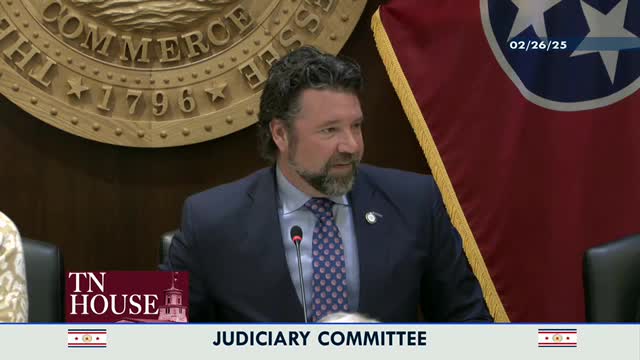
House Judiciary Committee advances constitutional amendment to allow judges to deny bail in some violent cases
Summary
House Joint Resolution 49, a proposed amendment to the Tennessee Constitution that would give judges authority to deny bail in certain cases involving public-safety risk or flight-risk, advanced from the House Judiciary Committee to the Finance, Ways and Means Committee after extended testimony and questions.
House Joint Resolution 49, a proposed amendment to the Tennessee Constitution that would give judges authority to deny bail in certain cases involving public-safety risk or flight-risk, advanced from the House Judiciary Committee to the Finance, Ways and Means Committee after extended testimony and questions.
The committee voted to send HJR 49 to Finance, Ways and Means; the clerk recorded 17 ayes, 2 nays and 2 present-not-voting. The sponsor, Chairman Howe of the House Judiciary Committee, summarized the amendment as restoring judicial discretion in pretrial detention for defendants who—based on the evidence presented—pose a continuing threat to public safety or a flight risk.
Supporters who testified urged the committee to approve the resolution so voters can decide. Rafael Manguel, identified in testimony as a senior fellow at the Manhattan Institute for Policy Research, told the committee, "The first duty of the government is to provide for the safety and security of its citizenry," and argued that permitting judges to detain particularly risky defendants before trial protects the public. Manguel recounted a case from New York in which a defendant released pretrial later killed an alleged victim, using the example to illustrate his point about incapacitation during the pretrial period.
Stephen Crump, executive director of the Tennessee District Attorneys General Conference, said his office had taken an uncommon step of actively supporting the measure, and that district attorneys would work statewide if the amendment goes to the ballot. Mike Donovan, deputy executive director of the same conference and a former federal prosecutor, told the committee the amendment would bring Tennessee's approach closer to the federal Bail Reform Act of 1984 by allowing detention where statutory criteria are met and due process is observed.
Committee members questioned witnesses about legal standards, safeguards and implementation. Representative Hardaway asked about the level of proof available at the time a court would consider detention; witnesses said the current evidentiary language in the Tennessee Constitution—"when proof is evident or the presumption is great"—would remain part of the inquiry and judges would still be required to put findings in writing and to provide hearings with opportunities for defense evidence.
Several members pressed on how risk would be determined in practice. Witnesses described objective risk-assessment tools used in other jurisdictions—algorithmic instruments that weight prior arrests and convictions, age, employment status and similar variables—to produce scores labeled low, medium or high risk to help guide judicial decisions. Committee members also raised concerns about potential changes to the list of offenses covered between this legislative vote and any eventual public referendum; witnesses replied that statutory lists would be public law by the time the amendment appears on a ballot.
Opponents and skeptical members raised constitutional and fairness concerns. Representative Johnson observed that the current state constitutional language affords a broad right to bail, so a change would be significant. Witnesses and the sponsor replied that federal precedent does not guarantee an absolute federal right to bail (citing United States Supreme Court precedent) and that the amendment would align the state provision with the federal framework that permits pretrial detention in some circumstances while preserving due-process protections.
Committee discussion included repeated references to research on crimes committed while defendants are on pretrial release. Witnesses cited a Bureau of Justice Statistics analysis and local analyses showing a measurable share of violent offenses committed by people with open cases; they said incapacitation during the pretrial period can prevent some of those incidents. Witnesses also discussed costs of crime to victims and the state when arguing the amendment's societal benefits.
After roughly two hours of testimony and subsequent member questioning, the committee voted to advance HJR 49 to Finance, Ways and Means so the amendment can proceed through the legislative process and, if approved again by the General Assembly, go to a voter referendum.
Votes at a glance: House Joint Resolution 49 — Sent to Finance, Ways and Means; recorded vote: 17 ayes, 2 nays, 2 present-not-voting.
What happens next: Under the resolution process for constitutional amendments, HJR 49 must be passed by the General Assembly again in a subsequent session and then be placed on the ballot for voter consideration. If passed by voters, enabling statutes and lists of qualifying offenses would be public law and available for review.
Ending: Committee members closed the HJR 49 portion of the hearing after the vote and moved on to other bills on the calendar.