Get Full Government Meeting Transcripts, Videos, & Alerts Forever!
Get email alerts on the Wildlife Twra topic
No spam. Unsubscribe anytime.
Senate committee advances bid to toughen poaching penalties and asks agency to study drone use for wounded‑game recovery
Summary
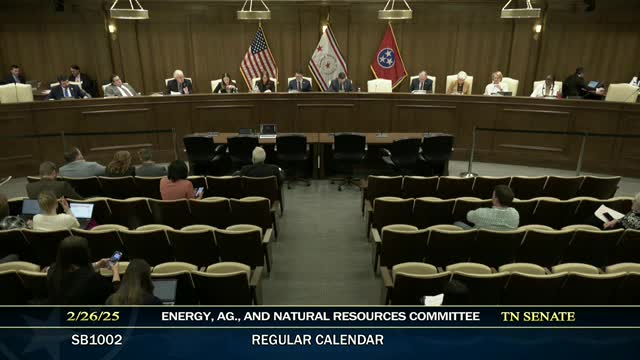
The committee voted to send a measure increasing penalties for taking wildlife while trespassing to finance and to calendar a separate bill directing the Tennessee Fish and Wildlife Commission to consider rules allowing drones to locate wounded deer; members debated landowner access and tracking across leases.
The Senate Energy, Agriculture and Natural Resources Committee advanced legislation that would increase penalties for taking wildlife while trespassing and separately directed the Tennessee Fish and Wildlife Commission to study whether drones can be authorized under rules or proclamations to locate and retrieve wounded deer.
Senator Wally, sponsor of the penalties modernization bill (Senate Bill 14), said many landowners in his district report poaching and trespass that goes unpunished because current penalties are low. The bill would raise the maximum penalty for removing wild animals while trespassing from the level of a Class C misdemeanor to a Class B misdemeanor and increase the fine ceiling (sponsor cited raising fines up to $500) to deter repeated, brazen trespass.
Senator Lowe asked about practical situations in which a hunter might wound a deer and the animal runs to adjacent property or across multiple hunting leases. Colonel Dale Grant, TWRA law‑enforcement staff, said that under current law hunters must obtain permission from an adjoining landowner before entering their land to recover a wounded animal; the proposed change increases penalties for trespass‑taking but does not itself create a right to cross other people’s property. TWRA staff indicated the bill increases penalties only and does not change existing statutory permissions.
On a related measure, Senator Wally introduced Senate Bill 130 to allow the Tennessee Fish and Wildlife Commission to promulgate rules or issue proclamations authorizing the use of drones to locate or retrieve wounded game under defined conditions. Sponsors emphasized the bill does not authorize flying over private property without consent; rather, it gives the commission a framework to analyze public safety, privacy and enforcement safeguards before permitting any drone use. The sponsor noted 13 states currently permit similar uses in some form and asked the commission to study privacy and misuse risks.
The committee voted to send the penalties modernization bill (SB14) to the finance committee. The drone study bill (SB130) was moved to the calendar; the secretary recorded eight ayes and one pass on that motion.
Ending: Sponsors said TWRA and the Fish and Wildlife Commission should work with stakeholders to ensure rules protect private‑property rights while enabling humane recovery of wounded animals; committee members signaled further discussion in subsequent hearings.