Get Full Government Meeting Transcripts, Videos, & Alerts Forever!
Get email alerts on the Tdot Budget topic
No spam. Unsubscribe anytime.
TDOT asks legislature for recurring and one-time funds to arrest falling pavement and aging bridges
Summary
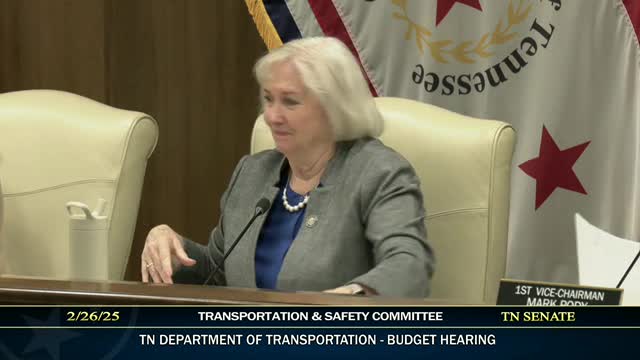
Tennessee Department of Transportation leaders told the Senate Transportation and Safety Committee they need both recurring and nonrecurring funding to keep pavements and bridges from deteriorating further, to expand rural service patrols and mowing cycles, and to cover personnel costs the agency has absorbed since 2022.
Tennessee Department of Transportation leaders told the Senate Transportation and Safety Committee that they need both recurring and one-time funding to maintain roads and bridges and to accelerate projects slowed by flat gas-tax revenue and high construction inflation.
The department presented the governor's proposed budget and a mix of recurring and nonrecurring requests that would expand pavement- and bridge-preservation work, add rural service patrols and mowing cycles, increase spot-safety funding and cover personnel costs the agency has absorbed since 2022.
Why it matters: TDOT officials said pavement and bridge conditions are approaching levels where deferred work becomes significantly more expensive. The department asked the Legislature to fund both ongoing maintenance and a nonrecurring push to move projects up in its 10-year plan so repairs do not compound into larger failures.
Commissioner (Tennessee Department of Transportation) opened the presentation by describing a shift in revenue and costs: "we are very much a, traditionally, TDOT has been a eat what you kill, agency" that depended on gas-tax growth, and that growth has flattened while construction inflation has risen. Deputy Commissioner and Chief Financial Officer Joe Galvato, Deputy Commissioner and Chief Engineer Will Reed and Deputy Commissioner for Planning Preston Elliott each described condition trends and the department's specific funding requests.
TDOT officials stressed three diagnostic points: the average age of Tennessee bridges is 48 years; pavement-condition measures have declined toward the department's 50% target for good condition; and construction costs have spiked in recent years. Reed showed a graph comparing the percentage of bridges built by decade and told the committee Tennessee has more older structures than the national average. "Design life typically for a bridge is about 75 years," he said, adding that aging assets increase the state's need for preservation funding.
Key recurring requests described to the committee include: - $16 million recurring for pavement preservation to add roughly 30 lane miles of recurring preservation work statewide; the department said this expands the annual program that already funds resurfacing. - $16 million recurring for bridge preservation to treat about 700,000 square feet of bridge deck with low‑cost treatments that can extend service life. - $6 million recurring to add one additional cycle of mowing and litter pickup on state routes; TDOT noted these activities affect safety (sight distance) as well as appearance. - About $16.7 million recurring for rural service patrols to extend the existing "help" program into rural interstates, where response times and crash severity tend to be worse. - An increase to the spot-safety program (an additional roughly $12 million recurring request) to raise per-region funding for low-cost safety projects such as turn lanes, signage and traffic-signal improvements. - A recurring personnel request to help cover roughly $74 million of salary increases the agency absorbed since February 2022; TDOT said last year’s employee pay increases cost the department about $12 million and that TDOT does not receive separate reimbursements for its share of statewide pay pools.
Nonrecurring requests described include a $109 million infusion for pavement projects to accelerate about 47 projects already in the three-year plan, a $59 million nonrecurring bridge-preservation request to advance 15–18 projects, $7 million nonrecurring for spot-safety projects, and a $50 million contribution to the existing state infrastructure fund to provide low-interest loans to local governments for priority projects. TDOT also referenced a larger general-fund subsidy proposal included in the governor's package to expedite projects in the department's 10-year plan.
On the Transportation Modernization Act (TMA) and Hurricane Helene response, the commissioner said the TMA enabled very fast contracting after the storm: the department used TMA authority and available funds to start emergency repairs the day after the event and has already requested and received partial federal reimbursement. TDOT reported it has reduced the number of initially closed routes from 49 to seven and that some interstate sections are open to a single lane in each direction while longer-term repairs continue.
TDOT also defended its recent improvements in project delivery: after process changes in 2022 the department reported it now lets to contract over 90% of the projects it budgets for in a given year, compared with about a 50% delivery rate in earlier years.
Committee members pressed officials on inflation risk, project rescoping and whether private-sector capacity exists to ramp up if funding increases. TDOT said it rescoped and reestimated projects in the 10‑year plan, added a 3% annual escalation factor to estimates and maintains monthly monitoring of contractors' progress and capacity. "We rescoped and re estimated every single one of those projects," Reed said, while acknowledging that long-term forecasting of inflation is not an exact science.
The committee voted by voice to send the transportation budget to the Finance Committee; the record shows a roll call on the final motion with eight ayes recorded to advance the budget to finance.
Ending: TDOT said it will provide members and the committee a detailed accounting of how any one-time dollars are allocated if the budget is approved, and officials asked for authority and funding to prioritize state-of-good-repair projects and to expand safety and maintenance services across urban and rural routes.