Get Full Government Meeting Transcripts, Videos, & Alerts Forever!
Get email alerts on the Healthy Buildings Ordinance topic
No spam. Unsubscribe anytime.
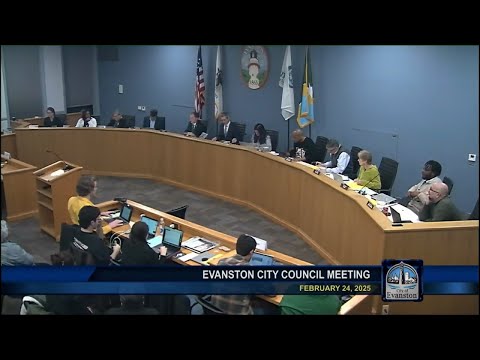
Evanston delays Healthy Buildings ordinance after intense public comment; vote tabled to March 10
Summary
After several hours of public testimony and council debate, Evanston councilors voted to table the Healthy Buildings Ordinance to allow more time for amendments and stakeholder work ahead of a March 10 continuation.
Evanston city councilors on Feb. 24 agreed to delay action on a landmark Healthy Buildings Ordinance after extensive public comment and council debate, voting to table further action until the council's March 10 meeting.
The ordinance would require covered buildings — defined in the draft as those over 20,000 square feet — to meet three performance goals by 2050: improved energy efficiency (measured by energy use intensity), elimination of on-site emissions, and procurement of renewable electricity. The ordinance sets up a year-long rulemaking process and creates two new public bodies — a Healthy Buildings Accountability Board and a Technical Committee — to set interim standards, define “equity-prioritized buildings,” and oversee alternative compliance pathways.
City staff and the ordinance’s sponsors framed the measure as the city’s next step to meet Evanston’s Climate Action and Resilience Plan goals and to put a public, transparent rulemaking process in place. Kira Pratt, the city’s sustainability and resilience manager, told council, “The Healthy Buildings Ordinance … requires that buildings over 20,000 square feet meet the following three performance metrics by 2050,” and summarized the rulemaking and alternative-compliance approach the ordinance would create.
Supporters who addressed the council argued the ordinance is a necessary, long-term policy to reduce local greenhouse gas emissions and to stimulate retrofits and jobs. “Passing the HBO lives up to the commitment we made as a community when we passed CARP,” said a council member during debate. Many university students, labor organizers and climate advocates urged adoption.
Opponents — including building owners, property managers, and some landlords and tenants — said the rule set and timelines were still unclear and could raise costs for building owners and tenants. Several property owners and financial-sector commenters warned that uncertainty about compliance rules could affect financing and valuations. Council members expressed concern about sequencing: multiple councilors said the detailed rules that will determine compliance and alternative pathways should be developed with direct and durable representation from building owners and other affected stakeholders before final adoption.
Council debate produced a series of proposed amendments (including proposals to add formal seats for building-owner representatives on the Technical Committee and to require clearer reporting on affordability impacts). Rather than adopt last-minute language, the council voted to table the ordinance and asked that proposed amendments be circulated to colleagues and stakeholders in advance of the March 10 session. The motion to table passed 7–1.
Votes at a glance - Worker Retention Ordinance (HS1, ordinance 21-O-25): Passed 8–0 with 1 abstention (Herakaris) earlier in the meeting; councilors said the ordinance will provide job protections for campus and contractor employees. (See action record below.) - Contract award: PropVisor (Putting Assets to Work): Approved 8–1 (one no vote). The contract is funded by a U.S. Department of Transportation grant to support analysis and community engagement around city-owned assets. - Single-source agreement amended (MicroSystems Inc.): Amendment to increase the amount to $95,000 and the agreement were approved 9–0.
What happens next City staff will continue rulemaking work and reconvene council on March 10 with proposed amendments and the full packet of suggested language. The draft ordinance requires the new boards to make technical determinations — including baselines, interim targets (set every five years), and criteria for alternative compliance — before fines or enforcement steps would be applied. Staff said benchmarking (the annual energy and water reporting that underlies the program) will continue during the rulemaking period.
Ending note Councilors said they wanted to avoid a rushed final vote without clearer, public, technical guidance and direct representation for affected building owners on the rulemaking committees. Councilors and staff asked stakeholders to work together before the March 10 meeting so any amendments are available in the packet ahead of the vote.