Get Full Government Meeting Transcripts, Videos, & Alerts Forever!
Get email alerts on the Military Installation Infrastructure topic
No spam. Unsubscribe anytime.
House panel approves revolving funds to support schools, infrastructure at Oklahoma military installations
Summary
The committee approved two bills establishing revolving funds to create a vehicle for future legislative appropriations aimed at improving education and infrastructure on and near military bases, with sponsors saying the bills are preemptive steps to reduce the risk of base realignments and closures.
Majority Floor Leader Lee West on Tuesday presented two bills that create revolving funds intended to allow the state to later provide money for infrastructure and education facilities serving military installations across Oklahoma.
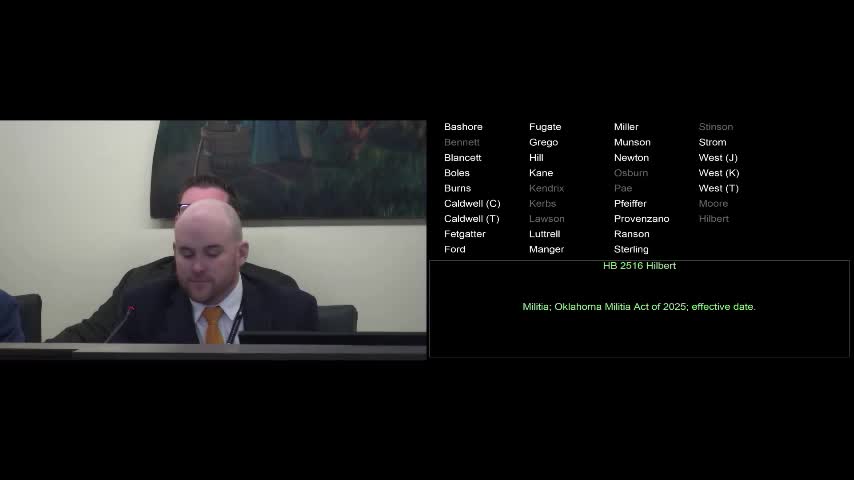
The measures — House Bill 25 16 and House Bill 25 18 — passed the committee on voice votes (each reported out with a due pass) after sponsors described them as framework bills that establish programs but contain no immediate appropriations.
"We started looking at ways that we could mitigate that if it does come up," Majority Floor Leader Lee West said, describing concern that changing federal defense missions could trigger Defense Base Closure and Realignment Commission (BRAC)-type actions that have in the past threatened installations.
Why it matters: Sponsors said the bills would make it easier for the state to partner with local districts and the federal government to shore up facilities that support base missions — particularly elementary schools on some installations — and thus improve a base's competitiveness for continued missions and associated civilian employment.
What the bills do: HB 25 16 establishes a revolving fund to address base education facilities and related infrastructure; sponsors said it would create a vehicle to receive future appropriations and to coordinate with the U.S. Department of Defense and other federal programs. HB 25 18 creates a separate revolving fund for base infrastructure needs and technology development that backers said would similarly be funded only if the legislature later appropriates money.
Discussion highlights: Lawmakers and the sponsor focused on Altus Air Force Base and Enid installations as examples. Committee members asked whether schools adjacent to base property (for example, Tinker-area schools that serve children who live on base but may be outside the installation gates) would qualify. West said the bills are intended for facilities that serve the installations and that details about eligibility and funding matches would be developed later.
A staff clarification cited a prior example, noting a federal program paid 80% of a project in 2016 when Lawton area schools were merged to serve the Fort Sill community; sponsors pointed to that precedent when discussing potential federal matches.
Questions from members included whether the revolving funds would be funded through separate appropriations (yes, sponsors said a separate appropriation bill or the normal appropriations process would be required) and whether the programs would be expanded to other installations in later years (sponsors: that would be up to the legislature).
Outcome: HB 25 16 and HB 25 18 were both reported out of committee with a due pass. The committee recorded each bill as creating a fund and policy framework only; any actual spending would require a later appropriation.
Ending: Sponsors said they plan to work with local school districts, the state delegation and federal partners to refine eligibility and matching rules as the measures move through the legislative process.