Get Full Government Meeting Transcripts, Videos, & Alerts Forever!
Get email alerts on the Rfp Selection Process topic
No spam. Unsubscribe anytime.
Vero Beach selection committee outlines evaluation process, schedules interviews for two waterfront proposals
Summary
City staff and outside consultants Stantec and PFM will provide about half of the technical scoring as a five‑criterion evaluation moves toward March rankings and March 31 interviews; proposals to be posted after a 30‑day hold.
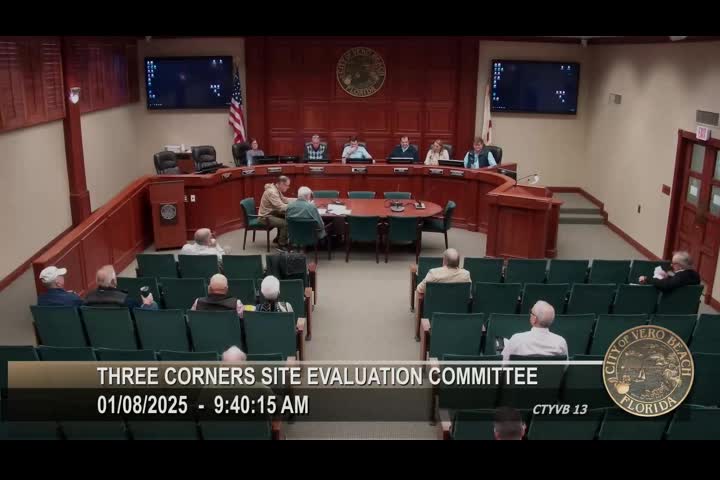
City of Vero Beach staff briefed the appointed selection committee on Wednesday about how it will evaluate two proposals received Dec. 17 for the waterfront RFP, the role outside consultants will play in scoring, and the schedule leading to City Council consideration in April.
The city’s purchasing manager, John O’Brien, told the committee the RFP evaluation uses five criteria and that “there's 5 criteria in which you'll evaluate the proposals and 3 of them will be using their expertise to provide some guidance to, help assist in making your score.” Project manager Peter (Polk/Polkar) said the meeting would place greater emphasis on the written evaluation criteria than in prior rounds: “this time we're gonna focus more on those criteria.”
The nut graf: the committee will compare the two proposals against the city's approved master concept plan and a checklist in section 2.7 of the RFP. Consultants Stantec (design/engineering/planning) and PFM (financial consultants) will provide recommended scores that together account for roughly 50 of the 100 total evaluation points, but committee members retain discretion to deviate from those recommendations if they document reasons.
Most important details
- Scoring framework: The RFP divides 100 points across five factors: developer vision for the site (30 points, with 20 tied to section 2.7 checklist), development team and proposed operator quality (25 points), proposed financial plan (25 points), qualitative partnership factors (10 points), and transactional factors (10 points). O’Brien explained that “about 50 of the hundred, total points will be scored, by Stantec and PFM.”
- Consultants’ roles: Stantec will evaluate design and checklist conformity to the master concept plan and other technical items (including a requested review of parking adequacy against the proposals’ square footage and anticipated uses). PFM will analyze financial plans and cash‑flow assumptions, including how proposals treat possible public funding mechanisms. The committee can request narratives and clarifications from Stantec and PFM in advance of or during the ranking meeting; Peter said he expects the consultants to provide commentary where a proposal is “really amiss.”
- Questions the committee flagged: members asked whether consultants should declare corporate‑level conflicts with any proposer team (not only individual reviewers). The committee asked Stantec to confirm corporate disclosures given the firm’s acquisitions history. Members also asked PFM to clarify assumptions around TIF (tax increment financing), CRA mechanisms and grants, and to show a baseline conventional financing scenario where feasible.
- Schedule and public records: The selection committee’s ranking meeting is scheduled for March 4. Interviews with proposers are scheduled for March 31 (all‑day). O’Brien said proposals will be posted to the city website after the 30‑day public release period (on or after Jan. 16). The committee expects to forward ranked recommendations to City Council, with a target City Council decision in April (city staff indicated April 22 as a likely date). O’Brien told committee members to email questions to purchasing staff in advance so proposers have time to respond.
Context and technical points
The committee emphasized that the master concept plan is a conceptual document; scoring on the developer vision factor measures conceptual consistency rather than construction details. Peter reminded members that some checklist items in section 2.7 are objective (presence/absence of required components) while others are subjective assessments of how well a proposal matches the master concept plan and the city’s waterfront vision. For financial evaluation, PFM is tasked with distinguishing assumptions that depend on third‑party public financing (TIF or CRA) from baseline financing a proposer could obtain without those mechanisms.
Members asked Stantec to perform a practical parking adequacy review tied to proposed room counts and dining seats rather than only comparing to city parking standards. On fiscal mechanisms, the committee noted limits under Florida law: as discussed in the meeting, Chapter 163 restrictions can limit the share of tax increment revenues available (members cited a commonly noted 50% practical limit because school district taxes are excluded from TIF capture). The meeting record shows the committee asked PFM to highlight any material pro forma gaps that depend on expected public assistance.
What the committee directed or plans to do
- Staff will request corporate conflict disclosures from Stantec and confirm whether any corporate‑level relationships exist with proposer teams. - Stantec and PFM will prepare written recommendations and narratives ahead of the March 4 ranking meeting; the consultants will be available online (patched in) for the ranking meeting and interviews. - Committee members were asked to send questions to purchasing staff in advance so clarifications can be given to proposers or addressed by consultants.
Ending
The selection committee will complete initial rankings March 4 and hold interviews March 31; staff expects to forward a recommendation to City Council with a target decision in April. Questions about the RFP process and requests for clarifications should be submitted to purchasing staff (John O’Brien) as directed in the meeting.