Get Full Government Meeting Transcripts, Videos, & Alerts Forever!
Get email alerts on the Trees And Vegetation topic
No spam. Unsubscribe anytime.
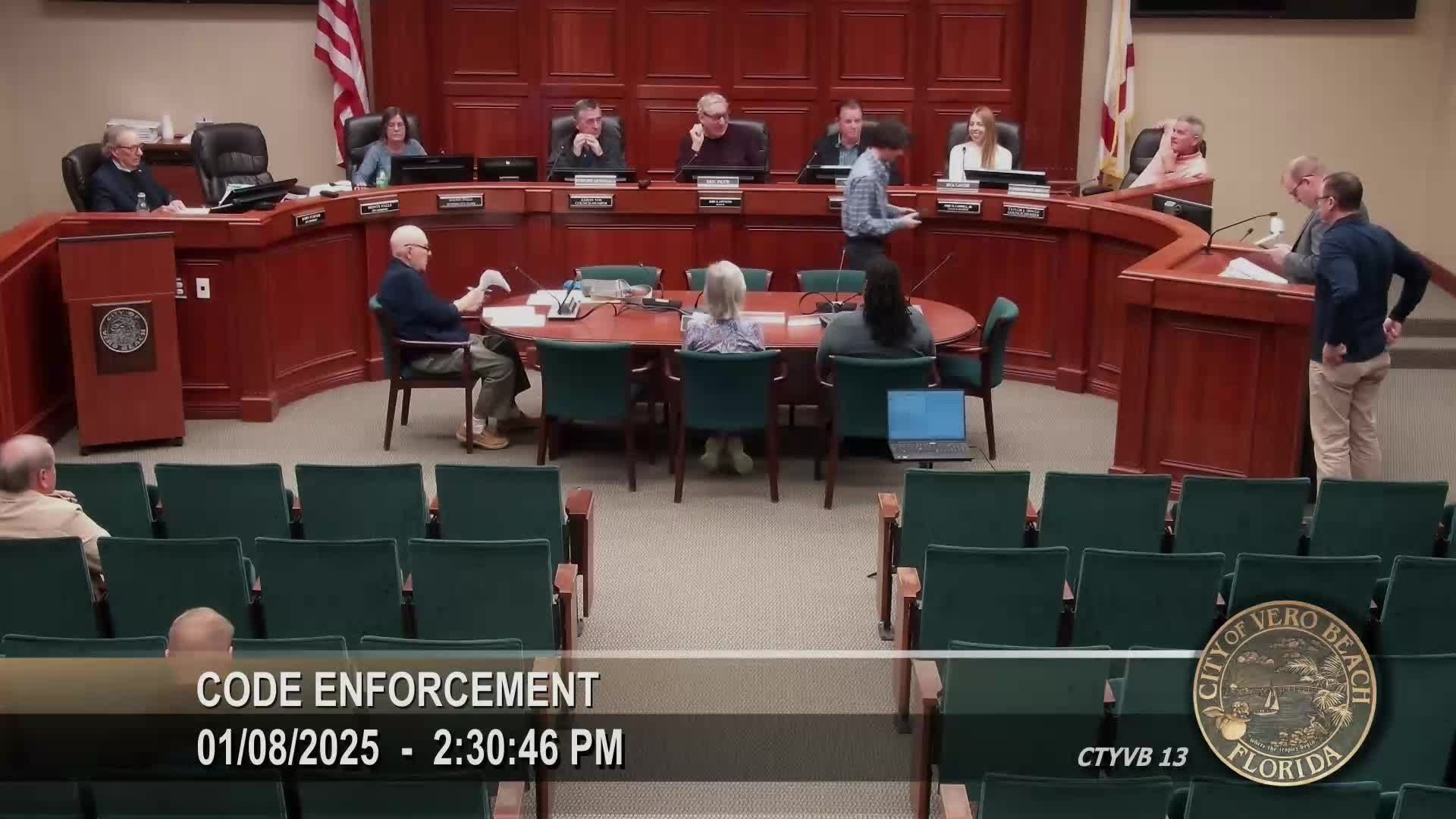
After contested hearing, Code Enforcement Board finds tree removal violated city code and allows 30 days for compliance talks
Summary
The board found a residential property owner violated city code by removing an oak without a county‑accepted tree risk assessment; the owner’s arborist said removal was required to mitigate risk. The board admitted expert review from the city forester that found the submitted form incomplete, declared a violation and agreed to let staff and the
The Vero Beach Code Enforcement Board found that a homeowner removed a large oak tree without the documentation the city requires and declared a violation, but gave the respondent a short window to negotiate a compliance agreement with city staff rather than imposing a finalized fine at the hearing.
The case, 24CE14029, centers on the removal of an oak at 601 East Causeway Boulevard. The homeowner, David J. Matthews, testified he hired an arborist who concluded the tree posed a substantial risk to a driveway, a privacy wall and nearby infrastructure. Matthews and his counsel presented photographs and what they said were arborist assessments asserting removal was the only practical mitigation.
Planning Director Jason Jeffries told the board that the city had reviewed Matthews’ submissions and determined the documentation submitted did not comply with the tree‑risk‑assessment procedures the Florida Legislature referenced in the state statute (Fla. Stat. §163.045). The city had asked for a complete tree‑risk assessment report; when Chen Moore and Associates, the city’s contracted consultant, reviewed Matthews’ materials they concluded portions were not populated or did not use the risk‑matrix approach required by the national best‑management practices the statute cites.
Camille Scalitzy of Chen Moore, the city’s contracted arborist and reviewer, told the board the submitted form listed property damage (lifting pavers, cracking wall) as a “condition of concern” rather than treating defects in the tree as the evaluated failure mode and did not identify targets or quantify the likelihood × consequence matrix in the way the standard requires. She advised the board that the form as filed could not be taken as a complete tree risk assessment under the statute and the nationally‑recognized guidance.
By contrast, Justin Williamson, the ISA‑certified arborist Matthews retained, testified he had reviewed roots and structural conditions on site and judged the tree’s root loss and location made root pruning infeasible and that removal was the only practical mitigation to reduce risk below a moderate level. Williamson said his field work and subsequent follow‑up assessment supported removal; he also confirmed he had traveled to the property and filled the assessment forms later supplemented in August.
The board admitted photographic exhibits and the Chen Moore review into evidence. After hearing argument from counsel, including a defense citation of the First District Court of Appeal decision referenced by the respondent’s counsel (Vickery v. City of Pensacola), the board made two determinations: (1) that a violation — removal of a protected tree without a permit supported by a complete statutory tree‑risk assessment — had occurred; and (2) instead of immediately imposing the city’s computed civil penalty (the city’s paperwork referenced an estimated tree valuation near $40,992.50 plus enforcement costs), the board agreed to continue the matter to allow the property owner and city staff to work toward a compliance agreement.
The board motion to continue directs the city and the property owner to pursue a compliance plan and return to the board with a proposed agreement within 30 days (the board set an administrative follow‑up date to confirm progress). If the parties do not reach a negotiated settlement, staff may present a proposed monetary remedy and mitigation requirement back to the board for final action.
What the record shows
- The city said Matthews initially submitted incomplete materials and planning staff provided comments requesting the fuller risk assessment required by the statute and the best management practices guidance. - Chen Moore concluded the submitted worksheet did not treat tree defects and targets in a manner that allows the required quantified risk determination; that conclusion underpinned the planning director’s denial of the permit application under local code. - Matthews presented two arborist assessments and photographic evidence that the roots had lifted sidewalk pavers, cracked a privacy wall and may have been proximate to an underground propane tank; his arborist testified removal was warranted. - The board admitted Chen Moore’s review into evidence and voted that a violation had occurred.
Why this matters
The hearing illustrates the legal tension created by Florida’s 163.045 residential tree statute (which references tree‑risk‑assessment procedures in the national best‑management practices) and local permitting processes: property owners and their arborists may claim state statutory protection for residential removals if they submit a complete tree risk assessment; local staff and contracted reviewers said the form submitted in this case lacked the structure and targets needed to meet the statutory/technical standard.
Ending
Rather than immediately imposing a monetary penalty, the board provided a short period for the parties to resolve outstanding documentation and mitigation. The board directed staff to return with a compliance agreement or, if none is reached, a proposed order quantifying mitigation and fines. The matter will return to the board if staff and the owner cannot resolve it.