Get Full Government Meeting Transcripts, Videos, & Alerts Forever!
Get email alerts on the Streetlights topic
No spam. Unsubscribe anytime.
Vero Beach panel preliminarily approves new streetlight fixtures with recessed-luminaire requirement and mockup caveat
Summary
The Architectural Review Commission voted to provisionally approve new LED streetlight fixtures for residential, park and commercial districts, requiring recessed luminaires or shielding and on-site mockups before final sign-off; Riomar Bay will get a distinct fixture.
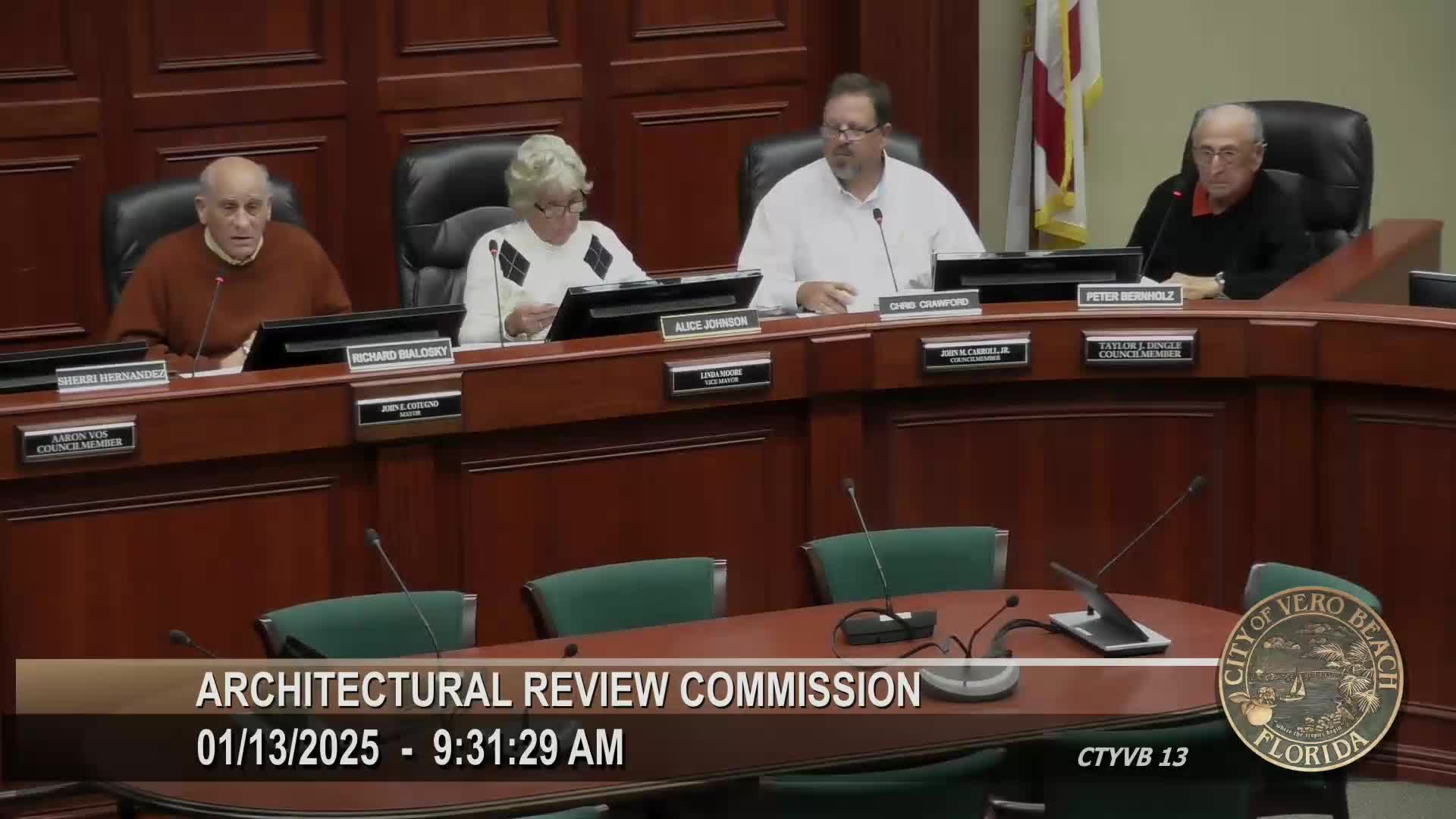
The Vero Beach Architectural Review Commission on Tuesday provisionally approved a set of replacement streetlight fixtures for most residential and park districts and gave conditional direction for a different fixture in the Riomar Bay subdivision, with a separate preference for commercial districts — subject to recessed luminaires or shielding and in-field mockups before final city approval.
Commission members said they were balancing aesthetic consistency, maintenance and dark-sky considerations as the city transitions leased, sodium-vapor fixtures to LED models provided through Florida Power & Light.
Chris, a city staff member presenting the catalog from Florida Power & Light, told the commission that the city leases its street lights from the utility and that the monthly fee covers installation, maintenance and power. “Florida Power and Light will come and convert them…there’s no additional charge,” he said while describing the lease-conversion process. He recommended one fixture family as the standard for residential and park districts, noting that some outliers exist on the city map and that Riomar Bay should be treated separately because of its distinct, higher-end fixtures.
Patrick Mugan, a resident who identified himself during public comment, urged the commission to follow dark-sky guidance. “Current dark-sky recommendations for outdoor lighting…is that no light be emanated more than 80% from nadir, from directly from straight down,” he said, and described the commission’s presented fixture as having a surface-mounted luminaire that could emit light at a 90-degree angle unless the luminaire is recessed or fully shielded.
Commission member Peter said he did not want the luminaire visible from homes: “I don’t wanna see the luminaire,” he said, explaining his preference for recessed or shielded fixtures in residential areas.
After discussion the commission voted to approve the proposed fixture family for residential and park districts on the condition that the selected fixture have a recessed luminaire or equivalent shielding that prevents direct view of the light source. The approval was contingent on staff obtaining clarity from Florida Power & Light about the fixture’s recess/shielding and on-site verification by the commission; staff was directed to request catalog samples and, if feasible, temporary mockups (one shielded and one unshielded installation) so commissioners could inspect real-world installations before final council-level approval.
For Riomar Bay, the commission agreed to choose a different fixture that more closely matches the neighborhood’s existing, higher-end look; commissioners discussed several catalog options (including a model described in meeting materials as the Granville and others) and approved selecting a closer aesthetic match for that subdivision, again with a mockup caveat.
In the commercial districts (areas including Miracle Mile and Ocean Drive side streets), commissioners discussed two main options: a “teardrop” fixture (favored by some for its deep skirt and utility look) and a Holophane-style fixture that better matches existing themed fixtures but — in the catalog shown to the commission — was only available at a 4,000 Kelvin color temperature. The commission ultimately voted to prefer the Holophane-type fixture if Florida Power & Light can supply that model in 3,000 Kelvin; if not, the commission preferred the teardrop option. That motion also included the same contingency requiring staff to secure mockups and catalog verification before final approval.
Commissioners and members of the public raised several technical points during discussion: existing poles are typically about 18–20 feet tall; many of the current fixtures are more than 15 years old and corroding in some locations; the staff presenter said the recommended LED fixtures generally use a 3,000K color temperature for residential settings and that certain fixtures have U0 (no uplight) ratings. Commenters also noted that dark-sky and wildlife concerns (including sea turtle lighting standards for coastal areas) influence acceptable color temperature and shielding; commissioners noted that turtle-friendly amber fixtures (G0 in the catalog) exist but are impractical for some commercial zones.
The commission asked staff to return with the following: catalog confirmations about recessing and shielding on the selected residential fixture; whether the Holophane-style fixture can be supplied at 3,000K; and physical samples or temporary in‑field mockups of representative fixtures (shielded and unshielded where applicable) so the commission can confirm appearance and glare mitigation before the city places bulk orders through Florida Power & Light’s lease program. The presenter said he would take the commission’s feedback to FPL and report back at a future meeting.
The votes were taken by voice and recorded as “all in favor” during the meeting record; no roll-call tallies or individual yea/nay vote records were provided in the transcript.