Get Full Government Meeting Transcripts, Videos, & Alerts Forever!
Get email alerts on the Code Enforcement topic
No spam. Unsubscribe anytime.
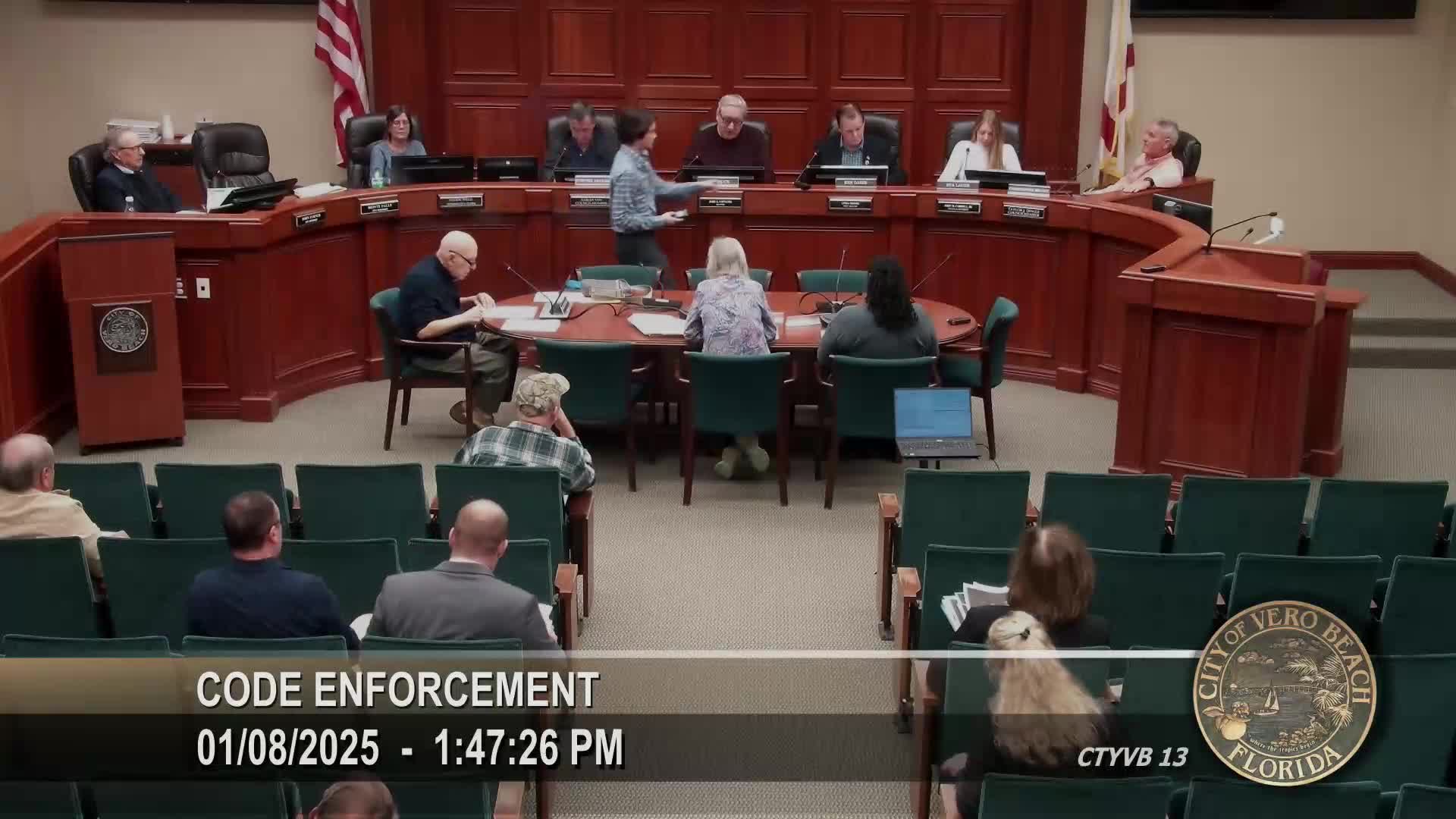
Vero Beach Code Enforcement Board issues orders, sets deadlines in multiple property cases
Summary
The Vero Beach Code Enforcement Board found multiple properties in violation of city rules on issues from unpermitted sheds to erosion controls and tree removal, issuing board orders that set correction deadlines and, in some cases, continuing civil penalties and fines.
The Vero Beach Code Enforcement Board voted to find multiple properties in violation of city code on a range of land‑use and public‑safety issues and issued board orders requiring corrections or payments.
At the meeting the board adopted routine minutes and re-elected its current chair, and then heard a slate of citation matters, issuing deadlines and orders to correct for each property. Most orders gave property owners a short window (commonly 10–60 days) to come into compliance and made clear continuing civil penalties would resume after the original compliance date if the problem remained.
Key outcomes at a glance
- Canterbury Place Apartments (Case 24CE14184): Board found a shed installed without required zoning or building permits. The board issued an order finding a violation and set a 60‑day deadline to correct the violation from the order date; continuing civil penalties of $50 per day and the initial $50 civil penalty were ordered to be paid if not corrected.
- Tree Service Express / 2836 Atlantic Boulevard (Case 24CE14196): The board found a licensed tree company removed an oak without required tree removal permits. The company had paid the $50 civil penalty and submitted a tree removal permit application; the board issued a 10‑day deadline from the board order to secure the permit and stop continued penalties.
- Erosion and sediment control repeat violations (multiple cases, incl. 24CE14210, 24CU14227): Repeat violations tied to silt fence failures, Illicit discharges and failed catch‑basin protections were deemed admitted; inspectors reported partial corrective work. The board issued 10‑day orders to clean basins and finish corrective work and assessed repeat civil penalties of $500 per day beginning after the original compliance dates until corrected. The city engineer was assigned to verify compliance.
- Village Spires Condominium Association (Case 24CU13788): The board found the property in compliance as of Oct. 31, 2024, and ceased continued penalties as of Nov. 1, 2024. The item had a lengthy public exchange about several past lighting citations dating back to 2017 and about the cost and complexity of retrofit work to meet sea‑turtle lighting requirements.
- Canterbury, other compliance closures: The board also found properties in compliance in cases where owners had paid assessed penalties or completed corrective work (for example, 24CU12816, Dale Matthew Albertson) and ceased accrual of continuing penalties.
Process notes and next steps
The board repeatedly framed orders as: correct the violation within the period stated in the board order or civil penalties will continue to accrue from the first day after the original compliance date until the violation is corrected. In several matters the board assigned the city engineer, planning staff or city forester to verify corrective work, and the board cautioned property managers that permits and owner signatures can affect the permitting process and time to compliance.
The board voted unanimously on multiple items; where directed by a property owner or counsel, staff agreed to short continuances to permit permit submittals or to allow witnesses to appear. The board signaled openness to compliance agreements in at least one disputed tree removal case and scheduled an administrative follow‑up so city staff and the respondent could pursue a negotiated resolution before the board reconsidered the matter.
Why this matters
The board’s orders show the city’s code enforcement process in action: when properties lack required permits or their work affects public infrastructure or habitat protections (for example, sea‑turtle lighting), the city issues citations, sets compliance deadlines and, if noncompliance continues, charges ongoing civil penalties. Many cases conveyed the interdependence of departments: planning, building, public works and the city forester all play roles in verifying corrections.
Ending note
Several matters were continued or left open to permit negotiation between city staff and property owners; the board indicated it would revisit unresolved cases at its next scheduled meeting if staff and owners cannot reach agreements.