Get Full Government Meeting Transcripts, Videos, & Alerts Forever!
Get email alerts on the Marine Anchoring Enforcement topic
No spam. Unsubscribe anytime.
Commissioners raise enforcement concerns after abandoned sailboat appears on South Beach
Summary
Members of the Vero Beach Marine Commission discussed a recently washed‑ashore, stickered sailboat, ongoing anchoring problems south of the Seventeenth Street Bridge and gaps in daily enforcement that commission members say have allowed derelict and live‑aboard vessels to accumulate.
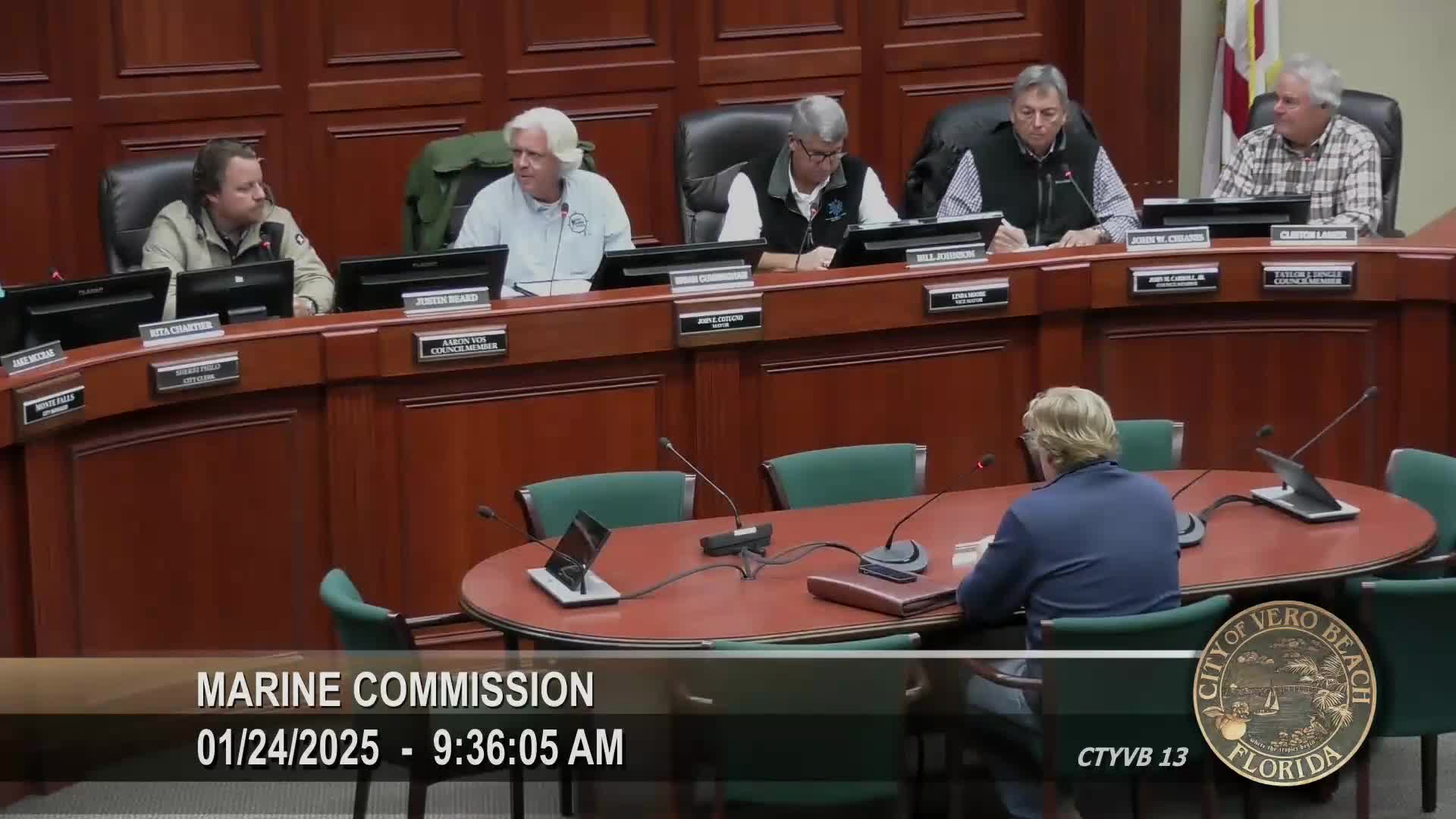
At a meeting of the Vero Beach Marine Commission (date not specified), commissioners flagged an abandoned sailboat that washed ashore on South Beach and renewed calls for consistent enforcement of anchoring rules.
The commission discussed a sailboat described as “stickered” with a red notice that has degraded; the boat reportedly has been partially flooded and lying on its side at high tide. Bridal, a commission member, said the vessel had been visible for “3 or 4 days” and that police and the Florida Fish and Wildlife Conservation Commission (FWC) had been notified. Bridal said, “it was previously stickered, but as far as new business is concerned, want to make sure everybody was aware of that.”
The conversation broadened into a long-standing anchoring and live‑aboard concern near Memorial Island and south of the Seventeenth Street Bridge. Commissioners noted confusion over how long vessels must remain in place before they can be removed: at different points members referenced a 90‑day boundary and, more recently in discussion, a 45‑day enforcement period. One commissioner asked directly whether “we have in place all of the necessary rules, regulations and laws and that their continued presence is simply due to a lack of enforcement,” and was told enforcement responsibility lies with FWC policy while local police are charged with day‑to‑day enforcement.
Sean, identified in the meeting as marina staff, said he had not seen the police patrol boat recently and that it had been “over a month” since he had eyes on the vessel; he warned that the enforcement clock requires near‑daily checks to establish how long a boat has been anchored. “For any of that stuff to work, it’s gonna need to be some sort of mechanism in place to be out there every day or pretty close to it to log all this stuff,” Sean said.
Commissioners and members discussed operational obstacles to regular patrols. Several speakers referenced earlier plans for a police boat doing daily runs through the anchorage; members reported inconsistent evidence that those runs are occurring. One commissioner volunteered to offer a slip so the police boat could remain docked and regularly returned to the water rather than trailered, and said the commission would reach out to Officer Kerensky (police) and Chief Curry (previously present at a meeting) for updates.
Members also expressed concern about water quality impacts from numerous live‑aboards and long‑term anchored vessels. Estimates given during the meeting placed the number of vessels in the anchorage area in the dozens and included several boats described as “prepared to sink.” Commissioners urged clearer feedback from local enforcement agencies and discussed logistical barriers such as the marina lift being out of service, which limits docking options for the police boat.
The commission did not adopt any new enforcement policy at the meeting; members agreed to contact police staff for a status update and to continue monitoring the situation.