Get Full Government Meeting Transcripts, Videos, & Alerts Forever!
Get email alerts on the Floodplain Management topic
No spam. Unsubscribe anytime.
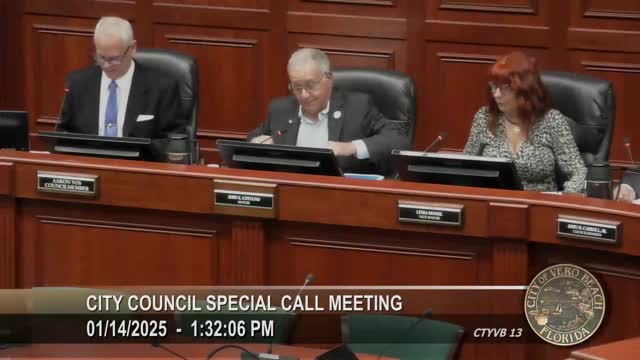
Vero Beach Council directs staff to codify five‑year cumulative substantial improvement rule and request broader floodplain study
Summary
Council members directed staff to draft a code amendment formalizing a five‑year cumulative substantial improvement lookback for floodplain properties and to seek a consultant analysis of actions that could improve the city’s National Flood Insurance Program Community Rating System classification.
The Vero Beach City Council on a consensus basis directed staff to draft a codified cumulative substantial improvement (SISD) ordinance using a five‑year lookback for flood‑zone properties and to commission a consultant to analyze additional steps the city could take to improve its Community Rating System (CRS) classification under the National Flood Insurance Program (NFIP).
Council member John Carroll, who introduced the item, said the city has been applying a 60‑month cumulative approach on a policy basis but that the practice is not written into local code. “Everything should be in writing so that the public knows what kind of requirements that they’re being held to,” Carroll said, noting the issue gained urgency after a recent tornado and that many Florida municipalities already codify the rule.
Jason Jeffries, speaking for city staff, framed the item as tied to Vero Beach’s participation in the NFIP and the city’s CRS classification. “This is about our participation in the National Flood Insurance Program,” Jeffries said, and he explained that adopting a formal five‑year lookback would yield CRS credit (roughly a 20 percent points allotment toward certain CRS measures) while a 10‑year lookback could yield larger credit (noted in discussion as about 40 percent). Jeffries also said the city is currently rated at CRS class 6 and that audits of the program occur on roughly five‑year cycles; the next full evaluation was described as coming in about four years.
Council members and staff discussed how the cumulative substantial improvement rule differs from substantial damage determinations and how market value is calculated for those evaluations. Staff said the usual market‑value baseline is the structure value shown by the property appraiser, plus an adjustment (staff noted a common practice of adding 15 percent) and that private appraisals prepared to FEMA methodology are acceptable when property appraiser values appear outdated. Jeffries described how the city currently reviews permits for work in flood zones and sometimes examines a property’s permit history if a new permit approaches the 50 percent threshold.
The council also debated equity and housing impacts. Several members pressed staff about effects on older multifamily properties and workforce housing, noting that owners who make incremental improvements can be pushed over the 50 percent threshold by later storm damage or by cumulative permit activity. Council members asked whether density protections or grandfathering could be applied to older multifamily sites so redevelopment would not automatically reduce affordable units; staff said the issue intersects with existing affordable‑housing incentives and land‑use regulations and would require further analysis and potential code amendments.
On process, staff recommended two parallel steps: (1) codify the five‑year cumulative lookback in the city code so the practice is clear and yields CRS credit, and (2) hire a consultant (staff referenced a firm the city has used, Coastalwide, and a contact named Denise Boney) to prepare a comprehensive CRS improvement analysis that would identify additional projects, code changes or capital investments that could move the city to a lower CRS class. The council asked staff to present proposed code language to the Planning & Zoning Board and to include public outreach and stakeholder meetings as part of the process.
Council members requested that staff produce maps and an analysis showing which parcels would be affected (flood zones along Indian River, Vero Isles and other coastal fingers were repeatedly cited) and to include a discussion of potential costs and benefits, including likely effects on insurance rates and on redevelopment economics. Staff noted that codifying the administrative review itself is largely an administrative action (with limited direct fiscal cost), but that achieving a lower CRS class typically requires capital projects or program changes that carry costs and would be the subject of the consultant’s menu of options.
The meeting closed with council consensus to proceed with drafting the five‑year cumulative substantial improvement ordinance, to engage a consultant for the broader CRS/resiliency analysis, and to route the code amendment through Planning & Zoning with public hearings and community outreach.