Get Full Government Meeting Transcripts, Videos, & Alerts Forever!
Get email alerts on the Humiston Boardwalk topic
No spam. Unsubscribe anytime.
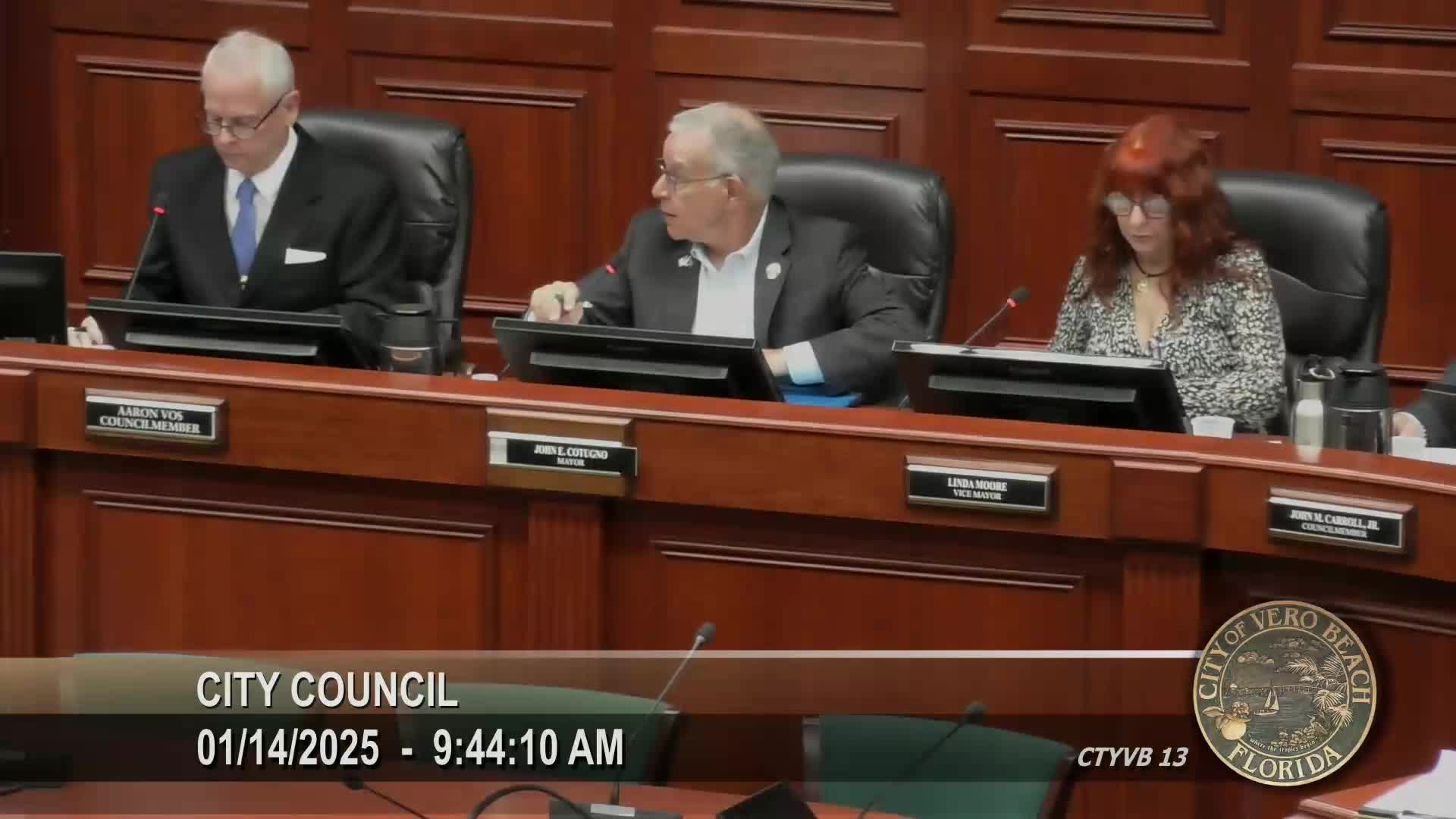
Vero Beach Council rescinds sidewalk plan, approves pursuit of concrete Humiston boardwalk
Summary
After extensive public comment and debate, the Vero Beach City Council voted unanimously to rescind its earlier selection of a sidewalk replacement and move forward with plans to pursue a concrete boardwalk at Humiston Park, ask the county to reallocate $400,000 and authorize the Indian River Community Foundation to collect private donations.
The Vero Beach City Council voted unanimously to rescind its prior selection of a sidewalk to replace the storm‑damaged Humiston Park structure and approved pursuing a concrete boardwalk with specific siting and design parameters.
Council members made the decision after staff presented background on earlier actions and funding prospects and after more than an hour of council discussion and public comment urging a boardwalk. The council also approved a companion resolution authorizing the Indian River Community Foundation to serve as the fiscal agent for private donations to the Humiston Boardwalk Fund.
City staff told the council that the city selected “alternative 3,” a concrete sidewalk, on June 11 following the November 2022 Hurricane Nicole damage. Since then, the county agreed Dec. 17 to commit $400,000 toward the sidewalk option; staff said that commitment would be reduced by any FEMA or other grants the project received. Staff briefed the council on recent public pledges and reported that the Indian River Community Foundation had agreed to collect donated funds on the project’s behalf.
“Staff would recommend a concrete boardwalk alternative as it’s more durable, would have a longer life and require less maintenance than a wood boardwalk,” a city staff member said during the presentation. The staff presentation noted the boardwalk design could include faux‑wood surfacing if the council preferred that appearance, and that consultants would need to produce revised design and permitting schedules if the council selected a boardwalk instead of a sidewalk.
Council members directed staff to pursue three core criteria in design and permitting: place the new structure as close to the footprint of the preexisting boardwalk as permitted; use a concrete foundation and structure; and pursue the most environmentally friendly design feasible under current regulations. The council also asked that alternate drawings include an integrated lifeguard stand as part of an elevated shade structure so lifeguards would have a permanent elevated vantage point and storage capacity. The council asked staff to return with final plans and permit submissions and to seek the county’s approval to reallocate the county’s $400,000 commitment to a boardwalk alternative.
The council first voted 5‑0 to rescind the earlier sidewalk decision and then, after public comment, voted 5‑0 on a motion to approve the boardwalk direction described above.
Public commenters included residents and community advocates who urged a restored boardwalk that preserves the site’s historic character and maintains public access. Thomas Kenny, a county resident, urged the council to “hammer out these questions a little bit further” and stressed concerns about the difference between a recessed concrete wall-style walkway and a traditional elevated boardwalk. Kimberly Flores, a county resident who said she visits the beach weekly, asked the council to pursue temporary repairs while the design and permitting process proceeds, noting lifeguards and beachgoers currently make do with limited access.
Council members and several speakers stressed that permitting constraints — including environmental agency rules and the sea‑turtle nesting season — will affect final placement and construction timing. Staff warned that final permits could require shifting the structure inland from the ocean and that the project cannot be designed to replicate a 1930s boardwalk without current regulatory approvals.
Mayor Catugno said the city has $1 million in the capital budget for the project and that private and county contributions, together with city funding, have created a public‑private partnership to rebuild the site. Staff reported the Indian River Community Foundation and the city had approximately $175,000 in pledges at the time of the meeting and directed residents to the foundation’s donation page (rebuildhumiston.org).
Staff also reported that bids had been received for a temporary beach access project; if approved, temporary access work could be completed by mid‑summer at an estimated cost between $40,000 and $80,000.
The council directed staff to proceed with design and permitting under the approved criteria and to return with more detailed schedules and permit applications. The council asked staff to seek written confirmation from Indian River County that the county will allow its previously committed $400,000 to be applied to a boardwalk alternative if permitted.
Supporters in public comment framed the boardwalk as a project of community identity and tourism value; opponents or cautious commenters urged the council to resolve lingering technical questions on siting, maintenance and long‑term costs before committing. The council said it will continue transparent outreach and keep the community apprised as designs and permitting proceed.
The council’s approvals were procedural directions to design and pursue permits and did not commit the council to a construction start date; staff said it could not guarantee a construction start by any particular date because of permitting constraints and seasonal restrictions tied to sea‑turtle nesting.