Get Full Government Meeting Transcripts, Videos, & Alerts Forever!
Get email alerts on the Airport Tenant Insurance topic
No spam. Unsubscribe anytime.
Vero Beach City Council reviews options after airport tenants face rising windstorm insurance costs
Summary
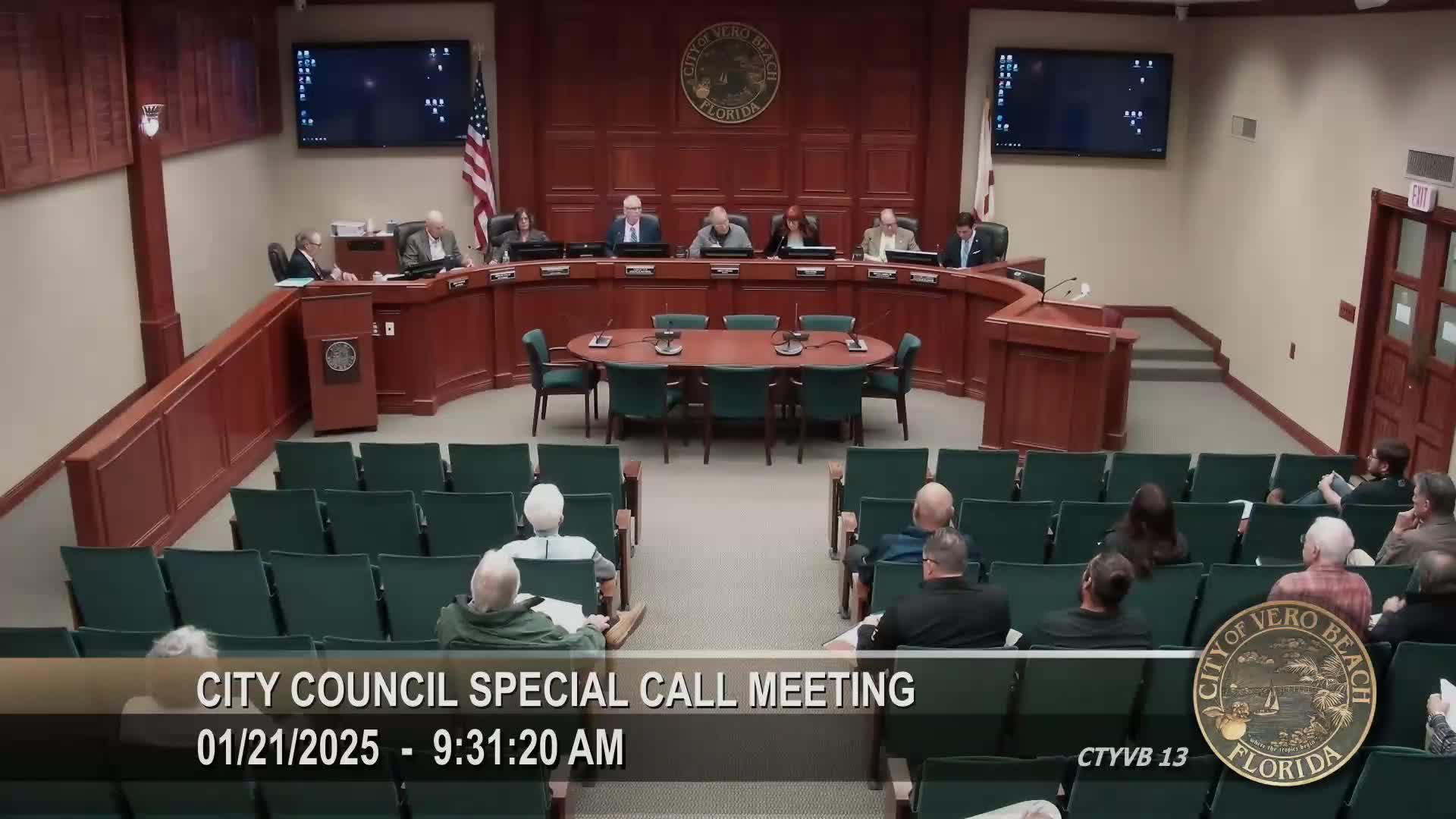
Vero Beach City Council held a workshop on airport tenant insurance where staff, insurance agents and tenants described sharply higher windstorm premiums and discussed options including retaining current lease requirements, switching to land‑only leases that prevent building reversion, raising deductible limits, and escrow/demo guarantees.
Vero Beach City Council held a workshop on airport tenant insurance where staff, insurance agents and tenant representatives described recent, large increases in windstorm premiums and discussed several possible responses, including keeping the current lease requirements, offering new land-only leases that would not revert buildings to the city, allowing higher deductibles, and creating escrow or demo-insurance mechanisms.
The discussion matters because many airport tenants operate older metal buildings that insurers increasingly decline to cover for windstorm or that carry much higher premiums and large deductibles; council members said unresolved insurance gaps could expose the city to unrecoverable costs if damaged buildings revert to the city or sit derelict.
City staff described three principal options under consideration: 1) retain the current lease language and insurance requirements (Attachment B) that generally require tenants to carry windstorm insurance and provide for building reversion to the city at lease end; 2) offer a new land-only lease in which the lessee would retain ownership of buildings for the term and would not have buildings revert to the city at renewal (market rent to be set by appraisal, adjusted by CPI); or 3) permit case‑by‑case departures supported by measures such as escrow accounts, personal guarantees or demolition insurance to ensure the site could be redeveloped if a lessee chose not to repair after a loss. Staff also discussed the industry option known as a “buyback” policy that covers part of a higher deductible for an additional premium.
Todd (Todd, airport director) and Will Howard, assistant airport director, told council that more than 50 tenants hold leases at the airport and that a majority are already land‑only for the initial term; staff has formally asked 11 tenants for recent insurance quotes and invoices and had received some but not all responses. Will Howard said recent land appraisals showed large increases in market value in some areas (three to four times in places), so a new land‑only lease could raise tenants’ land rent substantially, and the Federal Aviation Administration (FAA) must still approve rent changes tied to fair market value rules.
Insurance agents and tenant representatives described why premiums rose and how that affects tenants’ business plans. Kyle Henderson, owner of Henderson Insurance, said insurers are increasingly declining older metal buildings and can impose large deductibles and actual‑cash‑value roof endorsements that materially reduce coverage. He provided sample quotes he had supplied to tenants: for one building, a 5% deductible quote of about $101,000, a 7.5% quote of about $86,000, and a 10% quote of about $78,000 (quotes dated in 2022 and later). Henderson said Scottsdale later quoted roughly $100,000 total with about $13,000 for non‑wind perils (leaving ~ $87,000 for wind) and that roofs on older buildings often receive only actual cash value settlement.
Mike Malone, owner of Walking Tree Brewery, said his business invested roughly $350,000 renovating a World War II–era building and that an $87,000 annual windstorm premium on a roughly $2 million insurable value would threaten continued operations. Malone told council the brewery is open to negotiating a new lease in which the building would not revert to the city if that approach avoids the unaffordable windstorm premium.
Insurance brokers and agents who addressed the workshop echoed that older metal (noncombustible) buildings and older roofs are the key drivers. Devin Pierce of Tom Collins Insurance said many carriers either lack appetite or quote steep rates with 10% deductibles for such buildings. Bob Schlitt, Schlitt Insurance, said markets have loosened somewhat compared with the tightest years but premiums remain far above pre‑market shock levels and are unlikely to return to those earlier prices.
Several tenants proposed alternative ways to meet the city’s interest in a redevelopable site without imposing the current windstorm insurance burden. Options raised in public comment included: tenant‑funded letters of credit or bank lines of credit dedicated to demolition/repairs; a tenant‑specific escrow or bond sized to estimated demolition costs; group coverage placed on the city policy with a pass‑through premium charge to tenants; or allowing a higher deductible (up to 10%) with an escrow or buyback to cover the delta. Bruno Bornino, a prospective master‑lessee, said he obtained a buyback option that was far cheaper than other quotes (about $5,500 to buy back a 5% layer in one example when combined with an existing policy); he also described an equity line and a bank letter to demonstrate financial ability to cover a demo amount.
Council members repeatedly emphasized the city’s fiduciary responsibility. Council member Carroll read Attachment B language that requires insurance proceeds to be used to repair or rebuild and described the current leases’ structure under which buildings generally revert to the city at lease termination. Several council members said evicting tenants would leave vacant, derelict buildings that shift risk to taxpayers and recommended staff return with specific analyses and concrete proposals rather than a menu of disparate exceptions.
Staff and council agreed on next steps. Staff will collect the outstanding tenant insurance quotes and documentation requested of the 11 tenants, prepare detailed cost estimates for demolishing or remediating specific at‑risk buildings, provide revenue impact estimates for converting selected leases to land‑only appraisals (council heard a preliminary figure of about $260,000 pretax annual difference for the items on the staff list), and seek FAA guidance on any rent or lease structure changes that would affect federally required, nondiscriminatory treatment of airport property. Leona Otis, administrative manager, clarified staff would still require property insurance for other perils; the alternative under discussion would remove only the windstorm requirement for land‑only leases.
There were no formal votes at the workshop. Council directed staff to return with consolidated facts and options before the next hurricane season so council can consider formal changes that balance tenant viability and the city’s exposure if a damaged building reverts to municipal ownership.