Get Full Government Meeting Transcripts, Videos, & Alerts Forever!
Get email alerts on the Downtown Revitalization topic
No spam. Unsubscribe anytime.
Vero Beach council directs staff to craft downtown action plan after lighting update and funding briefing
Summary
After an update on a downtown lighting project and a review of financing options including the city's tax increment (TIF) fund, the Vero Beach City Council voted 5-0 to ask staff to prepare a short- and long-term action plan for downtown revitalization.
The Vero Beach City Council voted unanimously to ask staff to prepare a detailed action plan laying out next steps for downtown revitalization, after a workshop that reviewed a downtown lighting project, tax-increment financing and options such as a community redevelopment agency and a business improvement district.
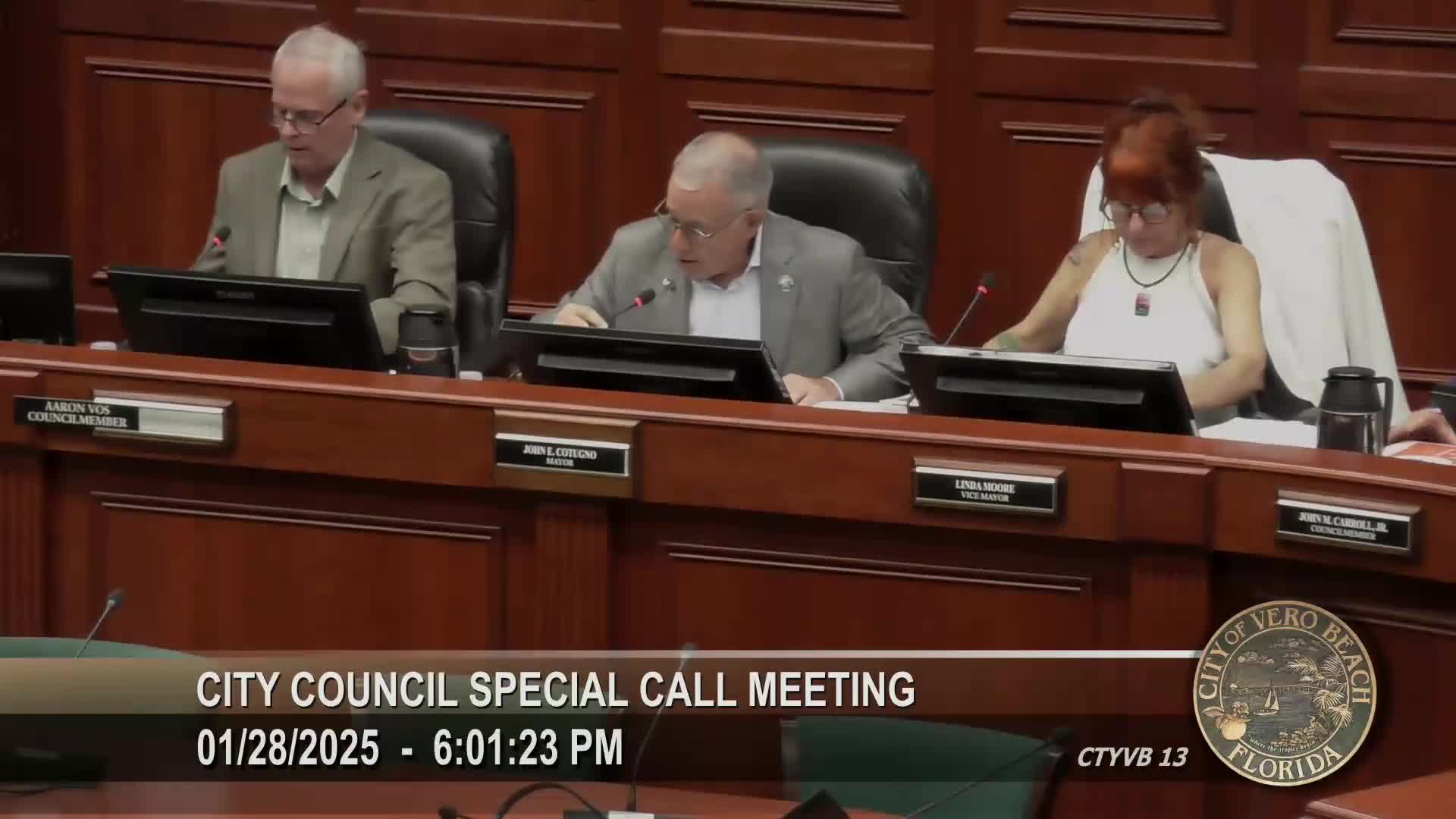
The council approved a motion directing staff, working with the city manager, to prepare an action plan based on the workshop discussion. The motion passed 5-0 (Voss, Dingle, Carroll, Vice Mayor Moore and Mayor Catugno voting yes) at the meeting's close.
Council members opened the workshop with a briefing from city staff and outside partners on the downtown master plan and the status of several near-term infrastructure projects. City Engineer Danessa Chambers updated the council on the city's coordinated lighting work with Florida Power & Light (FPL); FPL's representative said the immediate construction phase should take roughly eight weeks once preconstruction coordination and utility locates are complete.
"Our construction project lead will be reaching out to staff this week to coordinate an on-site preconstruction meeting...Talking with our production lead yesterday, he's confident that a timeline of 8 weeks, possibly less, that project will be complete," said Eric (FPL representative).
Chambers said the city has ordered lights for specified locations and clarified which blocks are included in the current FPL-driven installation and which are part of a separate city-funded design project. "The lights that are covered by this project are going to be 20 First Street ... Fourteenth Avenue from 20 First Street north along Pocahontas Park, and Old Dixie Highway from Nineteenth Place to Eighteenth Street," Chambers said. She added that a separate city-funded project will address the so-called "model block" on Fourteenth Avenue where poles are in particularly poor condition.
Chambers and the FPL representative explained why outlet receptacles for event power are being designed as a separate, metered system: street-lighting service includes a per-pole fee rather than an energy charge, so any additional event power requires separate metering and conduit. Chambers said design work for both the pole replacements and the outlet/metering system is budgeted for the current fiscal year; construction of pole replacements will be coordinated with FPL.
Council members raised funding and timing questions. The city's downtown economic development zone (EDZ) is currently generating roughly $150,000 per year in tax-increment (TIF) revenue; Chambers said the fund balance at the start of the year was about $500,000 and staff estimates roughly $700,000 by the end of fiscal year 2025-26 if current trends hold. The council was reminded that the EDZ was established by resolution (referenced in meeting materials as Resolution 15-12) and that the EDZ sunsets with fiscal year 2025-26 unless the council acts to extend it.
Workshop presenters reviewed three broad approaches discussed during the downtown master plan process: continuing the market-driven approach (updates to zoning and codes while relying primarily on private investment); a "hybrid" approach using the city's existing TIF dollars plus regulatory changes (the path the council pursued earlier and that led to a referendum); and a more aggressive redevelopment model using a community redevelopment agency (CRA) enabled by Chapter 163 of the state statutes, which can capture increment from multiple taxing jurisdictions (county participation is voluntary). Presenters also described the Business Improvement District (BID) model as a near-term tool to fund ongoing maintenance and programming if property owners agree to assess themselves.
Vice Mayor Linda Moore pushed for a pragmatic focus on lower-cost, near-term items instead of additional expensive studies: "I don't wanna spend another hundred grand on a traffic study. I wanna spend some money on making downtown better," she said.
Members of the public and downtown stakeholders supported quick-start improvements. Morgan Reynolds, president of the Main Street Vero Beach board, told the council Main Street can help form a BID and mobilize volunteers and that a set of decorative planting pots already exists in city storage. Lila Blakesley, a gallery owner in the downtown arts district, urged the council to prioritize initiatives that would keep and attract retail and galleries. Robin Berry, executive director of the Heritage Center, offered the center and its lawn for collaborative events.
Council members and presenters identified a set of near- and medium-term tasks that staff were asked to incorporate into the action plan: complete the FPL-coordinated pole replacements and make a schedule public; finish the city-funded lighting/street-scape design; resolve outlet/metering design so seasonal events have reliable power; evaluate EDZ/TIF capacity and timing; study whether to pursue a CRA and what county participation would require; explore a BID to fund maintenance and programming; pursue targeted, low-cost beautification projects (murals, painted planters, pocket streetscape improvements) that could be started with existing EDZ funds; and consider shared-parking and parking-fee-in-lieu options to support longer-term parking needs.
The council motion asks staff to produce an action plan that lays out specific short-term deliverables, costs, funding sources, and an implementation timeline for council review. The council indicated it would use a staff proposal to establish priorities and funding steps, and council members said they expect a follow-up report and milestones before committing funds beyond already-budgeted items.
Chambers and the FPL representative said staff will coordinate with FPL's construction lead on preconstruction meetings and 811 locates this week; once underground locates and any required bore work are complete, crews will set poles, pull wire and energize the system. Chambers said the city will manage the metered outlets portion of the project and that design is scheduled this fiscal year.
Public commenters emphasized the downtown arts and historic resources, urged faster visible improvements to sustain local businesses, and offered volunteer and organizational support for maintenance and programming. The council closed the workshop by voting to direct staff to prepare the action plan.
Votes at a glance: Motion directing staff (working with the city manager) to prepare an action plan for downtown next steps: approved 5-0 (Voss, Dingle, Carroll, Vice Mayor Moore, Mayor Catugno voting yes). Mover and second: not specified in the transcript; the motion was recorded and adopted by roll call.
The council asked staff to return with a written plan and recommended milestones for council consideration; timing for the staff report was not specified in the meeting record.