Get Full Government Meeting Transcripts, Videos, & Alerts Forever!
Get email alerts on the Housing Element topic
No spam. Unsubscribe anytime.
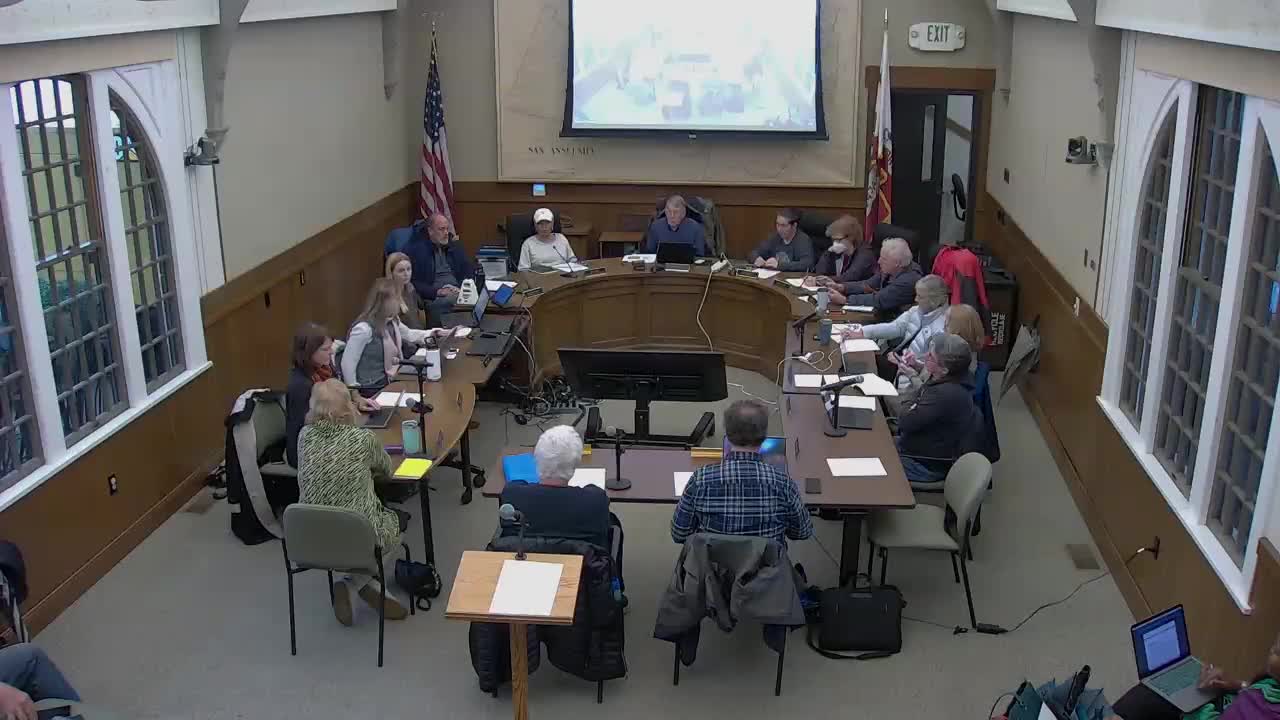
San Anselmo GPAC reviews adopted housing element, discusses implementation and trade-offs
Summary
Town planning staff briefed the General Plan Advisory Committee on the town’s newly adopted housing element, including the 745-unit capacity target, a 20% inclusionary requirement, an in‑lieu fee, and next steps for implementation and the general plan update.
Town of San Anselmo planning staff updated the General Plan Advisory Committee (GPAC) on the town’s recently adopted housing element and the group spent more than an hour questioning staff about implementation, funding and how housing objectives intersect with circulation, conservation and economic development.
The discussion covered why the housing element must be updated on an eight-year state schedule, how the town identified roughly 745 housing units of capacity—largely along arterial corridors—and what programs and regulatory changes have been adopted or are planned to support housing creation.
The housing element identifies sites concentrated near transit and services and allows higher densities in targeted areas. Lindsay (planning staff liaison) told GPAC members the town increased maximum densities in many residential zones from about 20 units per acre to 30 units per acre and that “most” of the state‑allocated housing capacity is within the identified arterial “balloons.” The element also includes an inclusionary housing ordinance requiring 20% affordable units on qualifying multifamily projects and an option for developers to pay an in‑lieu fee instead of constructing units; planning staff said the current in‑lieu fee is roughly $406,000 (indexed annually).
GPAC members pressed staff on what counts toward the Regional Housing Needs Allocation (RHNA) total of roughly 745 units. Staff made a clear distinction: only newly created dwelling units count toward RHNA; shared‑housing arrangements that match renters into existing rooms do not count, while newly constructed accessory dwelling units (ADUs) or junior ADUs would count. Staff also explained that density bonuses under state law can be layered onto inclusionary requirements to allow market‑rate units above an approved baseline; density bonus units do not substitute for the town’s inclusionary requirements.
Committee members asked about environmental constraints (riparian corridors, wildfire risk and flood hazards) and whether those constraints were considered when selecting sites. Staff said environmental and infrastructure constraints were scored during the site‑selection process and that sites with substantial environmental risks received lower scores and in many cases were not selected for the housing inventory. Staff also described local protections such as the town’s watercourse permit and the California Environmental Quality Act (CEQA) process, which will continue to apply when projects require discretionary review.
Multiple GPAC members raised questions about enforcement and the consequences of amending the housing element. Planning staff and the town’s housing reviewer told the committee that substantial amendments to the adopted housing element would trigger a state review process and could render the element temporarily uncertified; while uncertified, a jurisdiction may be exposed to state streamlining provisions, litigation or the so‑called builders’ remedy until the element is recertified. Staff said the town must weigh such risks before making zoning changes that would reopen the housing element to state review.
Members discussed practical measures in the housing element implementation matrix, including an online housing dashboard, sample ADU construction plans (already posted on aducenter.org), and a potential home‑share program modeled on Mill Valley’s matching program. Staff noted some programs are already launched, others are in progress, and some require ongoing budgeting and staff/consultant time.
The committee heard that the town’s housing element certification by the California Department of Housing and Community Development (HCD) preserves access to state grants and local control over planning, and that annual reporting to HCD documents progress on implementation measures. GPAC members asked how the general plan update — a longer, roughly 20‑year document — will incorporate housing goals; staff said the general plan update will use state projections and the housing element as inputs and will explore land‑use alternatives and circulation considerations over the next year.
The meeting also covered schedule adjustments for GPAC topics: economic development was deferred to April, the March meeting was canceled and an extra June meeting was added. Public comment and council members in attendance emphasized the need to balance housing outcomes with local circulation, parks/open‑space and the town’s character.
The session closed with staff outlining next steps: GPAC will review economic‑development materials in April, circulation and noise work in May, and parks/open space in June; associated public workshops and an open house were announced.
Ending: Staff asked GPAC members to review advance materials for the April meeting and to take a circulation survey open through March 7; the committee agreed to reconvene on the revised schedule.