Get Full Government Meeting Transcripts, Videos, & Alerts Forever!
Get email alerts on the Land Use Rezoning topic
No spam. Unsubscribe anytime.
Planners review Blue Ridge Ag LLC request to restore full B‑1 uses amid erosion and entrance concerns
Summary
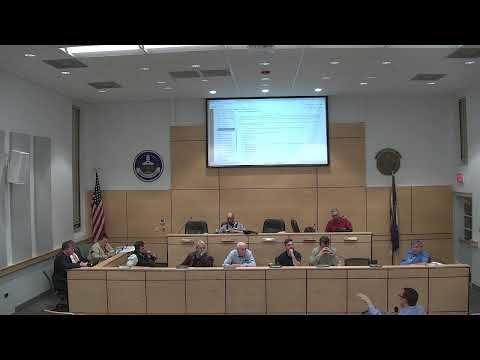
Madison County Planning Commission members met in workshop and considered a request from Blue Ridge Ag LLC to rezone a parcel on South Seminole Trail from B‑1 with conditions to straight B‑1, restoring by‑right commercial uses previously removed by proffer.
Madison County Planning Commission members met in workshop and considered a request from Blue Ridge Ag LLC to rezone a parcel on South Seminole Trail from B‑1 with conditions to straight B‑1, restoring by‑right commercial uses previously removed by proffer.
The application, identified in the meeting as case RZ‑10‑30‑2024‑1 and tax map 32‑102, was presented by county planning staff member Jonathan Nichols. Nichols described the request as a “simple zoning map amendment” to remove the prior conditions so all B‑1 by‑right uses would apply to the parcel. He said the county will consider whether the property is an appropriate location for the B‑1 district and that a public hearing packet would include staff comment and mapping.
Why it matters: Restoring full B‑1 rights would allow a broader set of commercial activities on a parcel along the Route 29 corridor; commissioners said some B‑1 uses may be inappropriate for the site unless the applicant offers limitations.
Discussion and key details: Commissioners and nearby residents pressed the applicant and staff on erosion‑and‑sediment (E&S) controls and on the site entrance to Route 29. A commissioner said he had a “whole stack of pictures” showing silt fence failures and holes; he urged enforcement and was told by Nichols that E&S complaints should be directed to the county E&S administrator for inspection. Nichols said VDOT had reviewed current work and “found what they’re doing currently acceptable,” and he said he had correspondence from VDOT engineers indicating that, at present, a turning lane would not be required.
Applicant Josh Agee (identified at the meeting as the applicant) told the commission he walked the silt fence earlier that day, removed branches and installed a new fence; he said a portion of an older fence remained on site. Agee also said he had met with a VDOT engineer (named Dylan) and with Tim Gray at VDOT’s Culpeper office about signs and entrance work. “We’ve been working with Tim Gray, VDOT out of Culpeper as far as erecting signs in the road. That’s fully in collaboration with him,” Agee said.
Commissioners discussed the legal effect of the prior rezoning and proffers: staff explained that the existing conditional B‑1 is effectively a custom zoning for that parcel and that approval of the new application would remove the earlier conditions. Several commissioners said they were not opposed to B‑1 generally in the corridor but worried that allowing every B‑1 use without restrictions could permit activities they consider inappropriate for the parcel, such as heavy industrial or large public service facilities. One commissioner encouraged the applicant to identify the specific uses he intends so the commission and neighbors can assess impact.
Outcome and next steps: The applicant agreed to work with planning staff to identify and, if he chooses, submit voluntary proffers that would limit specific uses before the public hearing. Jonathan Nichols told the commission that proffers can be updated through the public hearing process and that any more restrictive voluntary proffers submitted prior to the hearing would be considered. No formal vote was taken at the workshop; the case will proceed to advertised public hearing with the expectation the applicant and staff will try to scope or clarify any voluntary restrictions.
Context/limits: Commissioners and staff repeatedly separated the zoning decision from separate compliance/enforcement matters. Nichols and commissioners said E&S and VDOT permitting/enforcement are handled through those regulatory programs and referenced follow‑up inspections and documentation to be provided by the E&S administrator and VDOT. The commission did not find the application noncompliant on its face but asked for clearer information at public hearing.
Ending: The commission set the case for public hearing; the applicant and staff will provide any proposed proffers and supporting correspondence (including VDOT and E&S documentation) to the commission in advance of that hearing.