Get Full Government Meeting Transcripts, Videos, & Alerts Forever!
Get email alerts on the Special Education Budget topic
No spam. Unsubscribe anytime.
South Colonie outlines special education priorities, proposes UPK expansion and staffing requests for 2025–26 budget
Summary
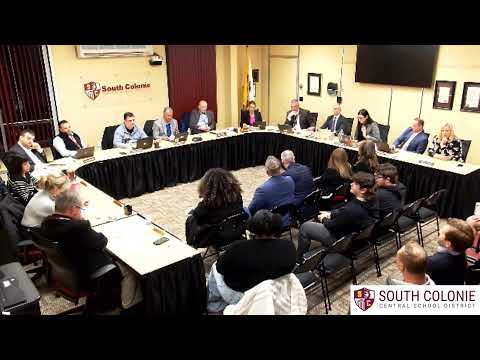
District special education and student support services staff presented priorities to the Board of Education on Feb. 25, highlighting wait lists for preschool services, growth in E&L populations, added therapists, proposed UPK full‑day expansion and several staffing requests to be considered in the 2025–26 budget.
South Colonie Central School District officials presented the district’s special education and student‑support priorities and initial budget requests to the Board of Education on Feb. 25, pressing the need to address preschool service wait lists, out‑of‑district placements and program continuity as the district prepares its 2025–26 budget.
Melissa Willman, director of special education and student support services, told the board the department has focused on consistent practices, data‑driven decision making and recalibration of services after an internal audit. Willman said the district has added two physical therapists and a part‑time school psychologist to integrate services more closely with student teams and said staff conducted an educational‑benefit review of redacted individual education programs (IEPs) that found students were receiving educational benefit but identified areas for refinement.
The presentation outlined several enrollment‑driven issues and proposed responses. Willman said about 30 students are placed outside the district — including one residential placement — and that the district expects 29 of those students to remain in those placements. She said there are wait lists for county‑provided preschool special education services that leave some eligible 3‑ and 4‑year‑olds without early intervention before kindergarten. Willman also said three students are likely to remain in school through the semester of their 20th birthday under current rules.
Supervisors described building‑level priorities and program changes. Kimberly Matthews, supervisor for preK–4 special education, said the district is developing more consistent behavior supports and that district physical therapists are integrating with building teams and helping plan an MTSS (multi‑tiered systems of support) approach in elementary classrooms. Brian Scalzo (supervisor, grades 5–12) and Mr. Boardman (supervisor, E&L and UPK special programs) described efforts to align transitional and work‑based programs, including the PACE lab and a newly launched Wolfie’s Cup at the high school to provide work‑based experiences for life‑skills students.
Budget requests presented to the board include: - Adding an UPK interventionist to help fill preschool service gaps and support transition for students on county wait lists. - Converting a contracted music‑therapy service to a district employee if feasible, to increase schedule flexibility while remaining budget neutral. - Adding a full‑time school psychologist to support growing E&L needs. - Exploring an internal assistive‑technology/speech position to manage augmentative communication devices once current contracts expire.
Willman noted tradeoffs: hiring district staff might shift responsibilities from the county to the district and could increase long‑term costs because county reimbursement rates differ from district salary scales.
Board members asked several operational questions during the presentation. David Kiel asked whether the district conducts the assessments families need to qualify for OPWDD (the New York Office for People With Developmental Disabilities); Willman said the district “does our best” but is not always obligated or able to perform the specific assessments OPWDD requires. Board members asked about TCIS (Therapeutic Crisis Intervention for Schools) training and follow‑up after students leave school; staff said the district participates in New York State’s Indicator 14 follow‑up process to track outcomes after exit.
The presentation also covered proposed UPK changes: district staff said the plan is to move to five 5‑hour UPK classes (one in each elementary building) while retaining two half‑day slots in communities where families have asked for that option. Staff said exact enrollment will be determined by the district lottery.
Why it matters: The requests would affect staffing and the instructional budget if adopted. Students waiting for preschool special‑education services and those placed outside the district represent both service gaps and cost pressures. Board members were advised these items would be considered in the district’s first‑draft budget and in upcoming budget workshops.
Next steps: The district’s budget calendar provided by staff calls for a budget workshop on March 11, a second‑draft community forum on April 8, a final presentation and adoption on April 23, and the budget vote and board elections on May 20, 2025.