Get Full Government Meeting Transcripts, Videos, & Alerts Forever!
Get email alerts on the Budget topic
No spam. Unsubscribe anytime.
Collier County staff outline FY 2026 budget plan, propose limits on operating increases and larger health-insurance reserve
Summary
County finance staff presented a FY 2026 budget timeline and recommended policy settings including a 3% operating control line, a 5% capital maintenance transfer adjustment and a larger health-insurance reserve; commissioners asked for higher capital reserves and more detail on priority budgeting.
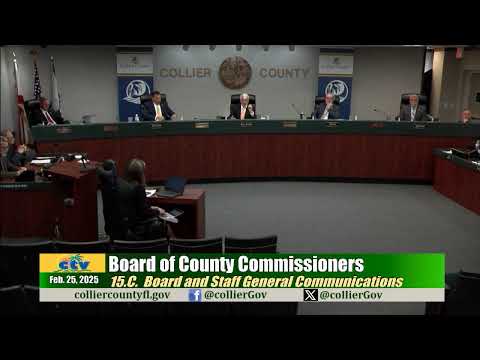
Christopher Johnson, director of corporate finance and financial management services, on behalf of Collier County staff, outlined the FY 2026 budget timeline and recommended policy settings to the Board of County Commissioners during a budget-policy discussion.
Johnson said staff’s planning scenario is built around a 5% projected increase in taxable value and recommended limiting department operating control lines to a 3% increase for current program services. He told the board the county’s net adopted budget for FY 2025 is roughly $2.1 billion, with $691 million in reserves; ad valorem (property) taxes are the county’s largest revenue source at about 47% (approximately $573 million).
The presentation included a proposed pay-plan adjustment of 3% for FY 2026 (a 2.5% cost‑of‑living adjustment plus 0.5% for pay‑plan maintenance) and a staff recommendation to raise the county’s health‑insurance reserve to $25.3 million. Johnson described the fund analysis used to calculate that reserve: a mean estimated claims level of $52.2 million and a 99th‑percentile estimate of $58.8 million, leaving a gap of about $6.6 million staff recommended adding to reach a 99% confidence level. To stabilize the plan, staff recommended a 9% increase in employer and employee contributions, with a possible one‑time fund contribution.
Johnson also summarized capital and reserve policy recommendations: add $5 million to the capital maintenance reserve this year (bringing the planning balance to about $12.6 million under the current scenario) and a 5% upward adjustment to general‑fund capital maintenance transfers. He outlined priority‑based budgeting milestones and the FY 2026 schedule, including a March 4 strategic‑planning workshop with ResourceX and planned adoption of budget policy on March 11.
Several commissioners asked questions and pressed for detail. Commissioner Hall and others said recruiting and retaining project managers and key technical staff remains a county priority; Miss Patterson (county staff) said the county is still struggling to hire certain positions and is using a workforce prioritization pool and other recruitment steps. Commissioners pressed Johnson on the capital maintenance reserve target: Johnson said the planning number is $12.6 million but acknowledged that, depending on taxable value and board direction, the reserve could be larger; commissioners suggested $15–20 million and discussed adding $7.5 million to the reserve annually rather than $5 million.
The board did not adopt the budget policy at the meeting; staff will return with the recommended policy for adoption at the March 11 board meeting after the March 4 workshop. Next steps include program inventory updates, department budget submissions and further work on priority‑based budgeting.