Get Full Government Meeting Transcripts, Videos, & Alerts Forever!
Get email alerts on the Education Interventions topic
No spam. Unsubscribe anytime.
MCPS outlines interventions for students with disabilities, English learners and low‑income students; paraeducators press for funding and staffing
Summary
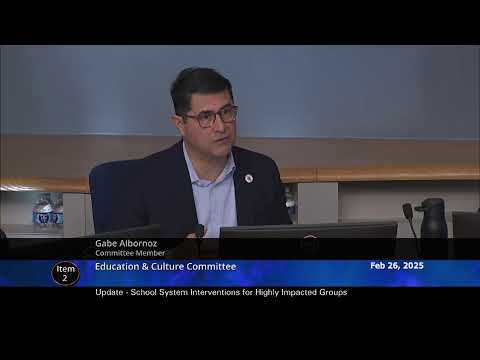
Montgomery County Public Schools briefed the County Council’s Education and Culture Committee on Feb. 26 about interventions for students with disabilities, emerging multilingual learners and low‑income students and emphasized staffing, training and targeted interventions.
Montgomery County Public Schools briefed the County Council Education and Culture Committee on Feb. 26 about interventions and supports for students most impacted by academic and language barriers: students with disabilities, emerging multilingual learners (EMLs) and students who qualify for free and reduced-price meals.
“Specially designed instruction is at the heart of what we do for students receiving special education services,” Diana Wiles, Associate Superintendent for MCPS Office of Special Education, told the committee while reviewing enrollment trends. MCPS reported 24,403 students currently identified for special-education services in its most recent count.
MCPS officials said overall district enrollment has declined while identification of students needing special education has risen by about 3 percentage points over eight years (roughly 4,000 additional students identified since 2017). The district reported using Medicaid billing to recover some costs and said that gaps in certificated staffing reduce its ability to bill for eligible services; MCPS estimated Medicaid reimbursements at about $5,000,000 when staff and billing align.
On English learners, Tamara Hewlett, director of MCPS’ Department of English Learners and Multilingual Education, said 32,587 students were enrolled in English-language development services as of Dec. 31. Hewlett described growth concentrated in middle and high schools and noted that the WIDA ACCESS for ELs assessment sets the state’s monitored growth path: students who score in the 1.0–1.9 range on their first WIDA assessment are typically expected to remain in program several years (the presentation cited an illustrative six‑year trajectory for lower initial scores). Maryland’s exit point for EML services is 4.5 on the WIDA scale, MCPS said.
MCPS showed that while roughly two‑thirds of elementary EML students met their WIDA growth targets last year (66.7%), only 20.5% of middle school and 27.1% of high school EML test‑takers met targets. District staff attributed part of the middle/high school shortfall to less instructional time, older students arriving with limited prior schooling, test non‑completion (an estimated roughly 800 non‑test takers last year) and family refusals of services.
The district described layered supports that include universal-design and differentiated instruction, multi‑tiered systems of support (MTSS), co‑teaching, specially designed instruction, and curricular and vendor‑based interventions for literacy and certain high‑need high‑school courses. Peggy Pugh, Chief Academic Officer, said MCPS uses federal and state accountability and progress measures — including the Maryland special-education report card and quarterly IEP progress reports — to guide corrective actions and professional learning.
Staffing, training and professional learning were recurring themes. MCPS officials and teachers said general-education teachers receive limited coursework on special-education strategies in higher education and that ongoing on-the-job professional learning is essential. The district said it is increasing summer and in‑service training for instructional leadership teams and piloting more school‑based coaching, but emphasized that these efforts are budget‑dependent.
“SPECIAL education paraeducators are the backbone of disability services,” said Sally (Sally) Murick, Vice President of Paraeducators for SEIU Local 500 and paraeducator program manager, who urged the Council to “fully fund the special education services” and to include para reclassification and better compensation in the superintendent’s budget. Murick told the committee MCPS employs about 5,200 paraprofessionals and that 623 of them are temporary part‑time (TPT) positions without benefits; she urged converting TPTs to benefited roles to improve recruitment and retention.
District staff noted a range of programmatic pressures that will affect implementation, including recent literacy and math policy actions from the Maryland State Department of Education that require more immediate notification and collaborative plans for students who are off track, and broader changes that will shape MTSS reporting and monitoring. MCPS also described Title III funds and vendor partnerships used to expand language supports and specialized instruction for content areas such as biology and government in high schools with high EML populations.
Committee members asked for more detail on attendance and chronic absenteeism among EML and special-education students; MCPS staff said absenteeism showed some stabilization in recent monitoring and emphasized family outreach and community‑schools and wraparound supports. Members also raised concerns about staffing shortages, dangerous behavior incidents, and placement disagreements when families and school teams disagree on special-education placements — areas MCPS staff said require legal and school‑level coordination and sometimes “stay put” protections during due‑process disputes.
What the committee heard about next steps: MCPS said it will continue to prioritize training for classroom teachers and targeted interventions for secondary schools, pursue partnerships with higher‑education institutions to grow the workforce, and use Title III and other supplemental funds where allowable. The committee did not take formal action on the briefing; it was informational and will inform budget and policy discussions during the county budget and follow‑up sessions.
Provenance: Committee presentation and discussion began with the item introduction at the Feb. 26 meeting and continued through extended Q&A and public comment; the paraeducator remarks and much of the technical explanation of WIDA and MTSS were given by MCPS central‑office staff and a paraeducator representative.