Get Full Government Meeting Transcripts, Videos, & Alerts Forever!
Get email alerts on the Emergency Services topic
No spam. Unsubscribe anytime.
House approves transfer of Emergency Medical Services programs to Idaho Military Division
Summary
The Idaho House on Feb. 26 approved legislation moving the Emergency Medical Services Bureau from the Department of Health and Welfare to the Idaho Military Division, and passed a companion trailer bill to transfer related statutory language and credentialing provisions.
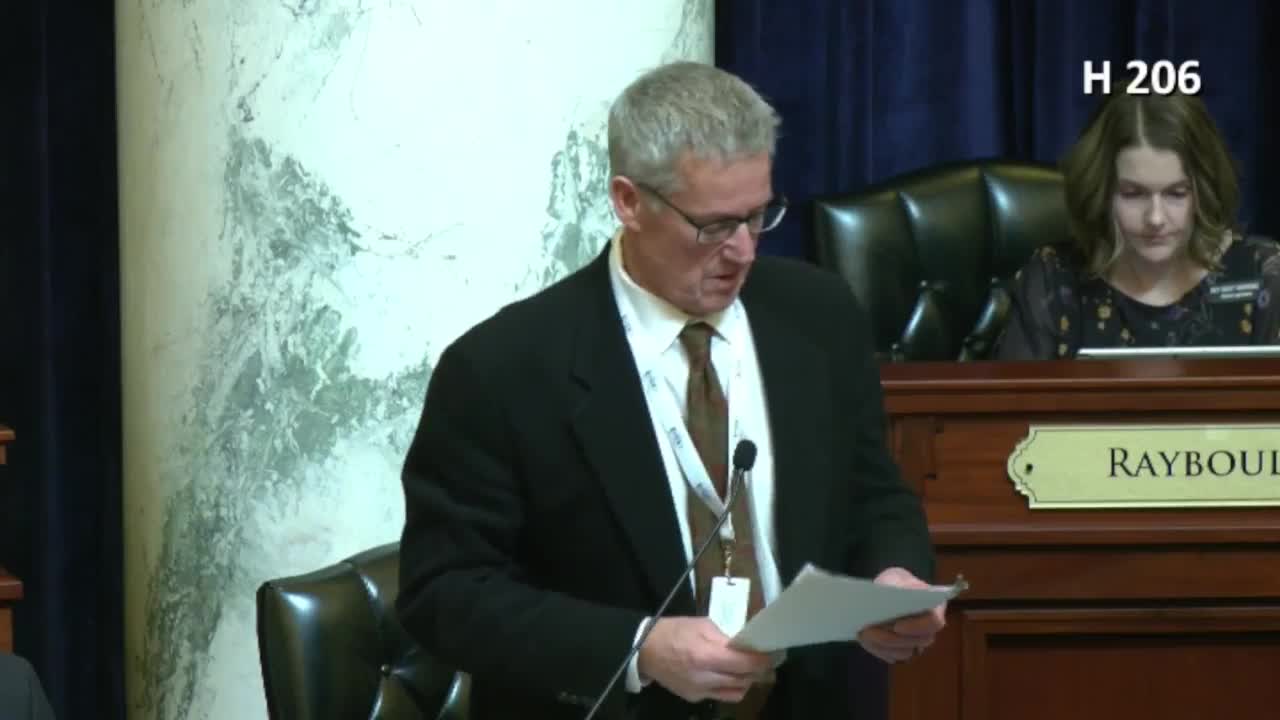
The Idaho House on Feb. 26 approved legislation to move the state Emergency Medical Services Bureau out of the Department of Health and Welfare and into the Idaho Military Division, voting to pass House Bill 206 and a companion trailer bill, House Bill 207.
Representative from District 1, sponsor of House Bill 206, told the chamber the measure “moves the Emergency Medical Services Bureau from the Department of Health and Welfare to the Idaho Military Division” and said much EMS work already coordinates with the Military Division’s Office of Emergency Management. He said the bill consolidates EMS grant and training funds and “does not add additional fees.”
Why it matters: Sponsors and backers said the move will reduce administrative complexity and put EMS alongside the state's emergency management functions; opponents raised questions about civil oversight and the statutory safeguards needed when a civilian health program is placed under the military division.
House Bill 206, sponsors said, transfers most EMS programs from Health and Welfare to the Military Division while leaving public health preparedness with the Department of Health and Welfare. The bill also sunsets EMS program rulemaking authority on July 1, 2027, consolidates EMS revenue funds used for grants for ambulances, training and supplies, and reduces administrative staffing by two full-time positions. Sponsors said a physician commission will be replaced by a part-time physician to help with clinical protocols.
Representative from District 11 asked whether the transfer could allow federal military authorities to “militarize the EMS division” under federal chain-of-command rules. The sponsor responded that the Idaho Military Division is “our own military division, mostly funded with Idaho funds,” and said the governor retains a role in how the division is used.
Supporters included the Idaho Association of Cities, the Idaho Association of Counties and the Idaho Association of Fire Chiefs, the sponsor said. Representative from District 13 spoke in favor, saying the change would reduce bureaucratic delays and constrain rulemaking that had added burdens on local EMS providers.
A separate but related measure, House Bill 207, was described as a trailer bill to transfer statutory language and to recognize national registry qualifications for EMTs, advanced EMTs and paramedics so credentialed personnel can practice across state lines more easily in border communities and during cross-jurisdictional responses, sponsors said.
Votes: House Bill 206 passed the House 53-19 with 2 absent/excused. House Bill 207 passed the House 52-16 with 2 absent/excused.
What didn't change: Sponsors emphasized the bill does not create new line-item fees. They said existing vehicle registration, driver's license and phone fees that support emergency dispatch remain unchanged. Sponsors also said most program text is a statutory transfer rather than substantive policy change.
Looking ahead: Both bills were transmitted to the Senate for further consideration.