Get Full Government Meeting Transcripts, Videos, & Alerts Forever!
Get email alerts on the Cybersecurity Fund topic
No spam. Unsubscribe anytime.
House panel holds cybersecurity and resiliency fund bill for one week amid questions about continuous appropriation
Summary
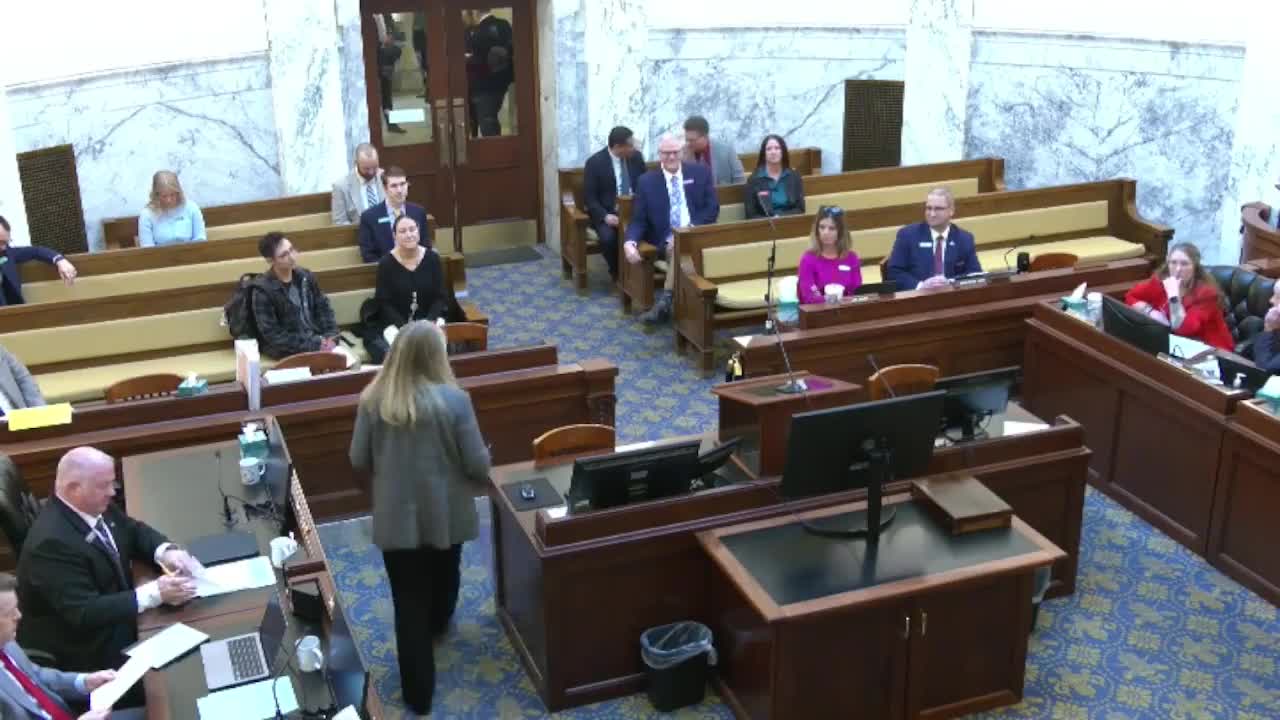
The House Appropriations Committee voted to hold House Bill 168, which would create a cybersecurity and resiliency fund with an ongoing $10 million recommendation, after members pressed for further detail on governance, funding mechanics and itemized requests.
Representative Wendy Horman, sponsor of House Bill 168, asked the House Appropriations Committee to create a cybersecurity and resiliency fund to pay for critical IT hardware replacement and related software and services.
"What we want to do is maintain what is out in the agency still and the centralized operations run by ITS and make sure that we have appropriate cyber protection for the state," Horman said. She yielded time to Director Alberto Gonzales to answer technical questions.
Director Alberto Gonzales told the committee the fund would centralize replacement of critical infrastructure such as firewalls, routers, switches, servers, wireless access points and endpoint devices and would be overseen and managed by the Office of Information Technology Services. Gonzales said recent monitoring showed a high volume of attacks and that the state needed prioritized funding to reduce risk.
"The threat is huge," Gonzales said, and he described recent firewall and email statistics the agency has recorded. He said the fund would be paired with annual reporting and accountability measures.
Committee members raised multiple concerns. Representatives asked whether the fund should be a continuous appropriation, how the proposal would interact with agency budget requests, and how the recommended $10 million figure was derived. Director Lori Wolf explained the proposal is intended to operate similarly to the Permanent Building Fund: funds would be continuously available while projects and replacements would be reviewed and reported to the committee before expenditure.
Gonzales and Wolf said critical-only needs for core ITS and agencies total well above the $10 million recommendation if a strict five-year replacement cycle is used; they cited a roughly $15 million figure for critical items and a $20–25 million estimate for a full five-year cycle. Gonzales said the ITS core request this year would have been about $6–6.5 million absent the new fund and that the fund is intended to fill gaps where agencies did not request needed replacements.
Multiple members said they supported strengthening cybersecurity but were uneasy about a continuously appropriated pool without clearer annual approval mechanics and line-item visibility. Representative Petzke said continuous appropriation "makes me nervous" and voted against the initial motion to advance the bill. Representative Mitchell said he would vote yes in committee but reserved the right to change his position on the House floor pending more detail.
Representative Scott Manwaring (in committee) moved an amended motion to hold the bill in committee for one week to allow staff to provide the requested inventory, 5-year plan and clearer fiscal mechanics; the amended motion passed. The committee set a time certain to reconvene consideration on March 5.
No public testimony was offered at the hearing.
Ending: The committee left the bill in committee pending additional detail on the continuous-appropriation mechanics, the prioritized inventory of critical replacements and a clearer reconciliation of current agency IT requests with the fund proposal. Representative Horman said she would correct the fiscal note language and supply the requested materials.