Get Full Government Meeting Transcripts, Videos, & Alerts Forever!
Get email alerts on the Brady Giglio Disclosure topic
No spam. Unsubscribe anytime.
Senate committee holds informational hearing on Brady‑Giglio rules; stakeholders push for uniform process
Summary
The Senate Judiciary and Public Safety Committee held an informational hearing Wednesday, Feb. 26, 2025, on competing proposals to clarify how prosecutors and law enforcement should identify and disclose Brady and Giglio material.
The Senate Judiciary and Public Safety Committee held an informational hearing Wednesday, Feb. 26, 2025, on competing proposals to clarify how prosecutors and law enforcement should identify and disclose Brady and Giglio material, the constitutional evidence and impeachment rules that can affect witness credibility in criminal trials.
The hearing centered on two legislative vehicles: Senate File 599, introduced by Senator Seaburger, for which committee members were given a House “delete everything” amendment that stakeholders negotiated; and Senate File 1813, introduced by Senator Westlund. Both bills would create procedures for identifying potential Brady/Giglio material, notify affected officers and their employers, and provide a mechanism to seek reconsideration of a prosecuting agency’s designation — but they differ in wording and in how far they would limit employment actions or require court review.
Why it matters: Brady and Giglio obligations are constitutionally rooted duties prosecutors must meet to preserve a defendant’s right to a fair trial. At the same time, witnesses who are law‑enforcement officers can face career consequences from prosecutorial determinations about their credibility. Committee members heard competing descriptions of the problem and divergent proposals for solutions.
Supporters from police associations and labor groups said the bills would bring much‑needed uniformity and due‑process protections for officers. "This is a due process issue for public employees who have a constitutional right to continued employment with due process," said Kevin Beck, a labor attorney in St. Paul who represents public‑employee unions. Beck told the committee the drafts would provide an avenue for judicial review and bar an employer from terminating an officer solely because of a Brady designation, while still allowing discipline based on the underlying conduct.
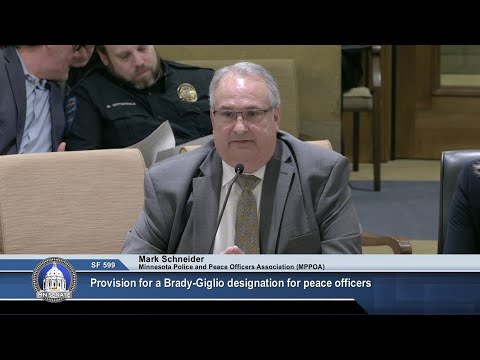
Mark Schneider, general counsel at Law Enforcement Labor Services, said the proposals are not intended to "shield the truth or to prevent a fair trial," and described the bills as an effort to create a uniform process for prosecutors and chiefs to determine whether an officer should be treated as Brady‑impeachable. Schneider testified that the bills would allow reconsideration within the prosecuting agency and, if that office maintains its position, a district court could review the designation.
Law enforcement leaders emphasized coordination and notice. Eric Warner, chief of police for Maple Grove and a past state chiefs president, said chiefs want a transparent process that lets agencies work with prosecutors to meet disclosure obligations. "The decision to designate officer Brady impaired rests solely on a prosecutor and can have career ending consequences for an officer," Warner said, urging statutory safeguards and clearer mechanisms for pretrial review.
County attorneys and staff raised constitutional and practical concerns about statutory mandates. Brad Johnson, Anoka County attorney, speaking for the Minnesota County Attorneys Association, said county attorneys are drafting statewide policy guidance and urged caution about placing procedural Brady rules in statute without the prosecution community’s input. He warned that creating statutory processes that mandate district court review of prosecutorial decisions could raise separation‑of‑powers and unintended constitutional issues.
Officials from prosecuting offices stressed that timely access to law‑enforcement personnel files and nonpublic investigative data is the immediate practical problem. Claire Deagle, director of Professional Standards at the Hennepin County Attorney’s Office, said Hennepin has a three‑person Brady team and, in the past six months alone, filed 393 motions seeking court orders to review nonpublic personnel data. "When we don't have access, that affects the defense, that affects law enforcement, it affects our victims and it affects our courts," Deagle said, adding that one recent homicide motion required review of materials for 27 officers.
Public‑defense officials urged caution about measures that could delay disclosure. Bill Ward, state public defender, said the bills as drafted risk impeding defendants’ constitutional rights and the timely disclosure prosecutors must deliver. "These bills actually infringe our ability to also represent our clients as well as I believe they are unconstitutional on their face," Ward said, warning that multi‑step statutory procedures could produce delays that harm defendants’ speedy‑trial rights.
Several witnesses cited the 2019 Cloquet (Carlton County) matter as an example of conflict between local employers and prosecuting offices: testimony described an officer designated by a newly elected county attorney and later the subject of arbitration. Witnesses also noted that other states, including Iowa, have adopted statutory responses to similar litigation.
On specifics, supporters said the House delete‑everything draft circulated for Senate File 599 includes provisions to treat certain findings from internal investigations (for example, findings of mistake, inadvertence or not‑sustained complaints) as not qualifying for Brady designation, requires written notice to the employing agency and officer when a credibility finding arises in court, and includes a reconsideration process that can lead to de novo district court review. Senator Seaburger told the committee the delete‑everything language represents an agreement between the Minnesota Police and Peace Officers Association and the chiefs’ association.
Opponents urged a different path: county attorneys said they have created an MCAA Brady/Giglio work group and are drafting recommended statewide policies and best practices; they recommended continuing that interagency work rather than imposing statutory requirements that could introduce new litigation or create conflicting duties. Prosecutors also raised data‑access obstacles under the Minnesota Government Data Practices Act and pointed to a separate House bill (HF1576) that would amend data‑sharing rules to enable quicker, court‑supervised access to nonpublic personnel and investigative records.
Committee members asked about timelines and how proposed reconsideration processes would work in practice. Witnesses described a range of local approaches: some offices have a designated Brady/Giglio point person and memoranda of understanding with law‑enforcement agencies; others rely on ad hoc requests and subpoenas. Several county attorneys and chiefs urged standard operating procedures and clearer communication between agencies to reduce disputes.
No committee action was taken. Chair Latson opened the hearing by saying the goal is to "take some action this year because a lot of people want some clarity on what the rules and the policies are." At the close, the chair reiterated a desire to continue stakeholder talks and said it was the committee's intention to return to the issue later in the session.
Votes at a glance: This was an informational hearing; no votes were taken.