Get Full Government Meeting Transcripts, Videos, & Alerts Forever!
Get email alerts on the California Current Ecosystem topic
No spam. Unsubscribe anytime.
California Current 2024: El Niño, delayed upwelling produce mixed ecosystem and fishery outcomes
Summary
Mary (presenter, California Current IEA team) and Andy (presenter, California Current IEA team) presented the California Current Ecosystem Status Report for 2024 at a Pacific Fishery Management Council briefing, reporting a year of contrasting signals for ocean conditions, marine life and coastal communities.
Mary (presenter, California Current IEA team) and Andy (presenter, California Current IEA team) presented the California Current Ecosystem Status Report for 2024 at a Pacific Fishery Management Council briefing, reporting a year of contrasting signals for ocean conditions, marine life and coastal communities.
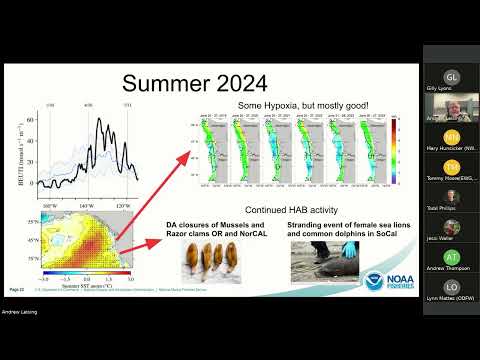
The report found that a strong El Niño in winter–spring 2024 suppressed early-season upwelling but gave way to a rapid, strong spring upwelling that supported a diverse and relatively abundant forage community in many regions of the California Current. Mary said the report drew on “over 90 individuals from, over 23 institutions, contributing to this report.”
Why it matters: the mix of late-winter heat, spring productivity and recurring harmful algal blooms (HABs) produced both biological winners and losers and affected fisheries and coastal communities. The report links these ecological patterns to management outcomes including a second consecutive California salmon fishery closure in 2024 and spatial or gear restrictions in the Dungeness crab fishery to reduce whale entanglement risk.
Key findings
- Physical drivers: Andy summarized the year as an early, strong El Niño that “suppresses the early season upwelling,” followed by a rapid transition to strong upwelling in April that boosted plankton and forage species. He noted a top-10 marine heat wave that stayed largely offshore for much of the year but occasionally approached the coast in the fall.
- Forage and predators: Survey programs (JSOS, the Southwest Fisheries Science Center rockfish survey, and CalCOFI) reported high abundances of juvenile rockfish, anchovy and, in some areas, larval Pacific hake. Central California krill abundances were near average despite El Niño conditions, and larval hake abundance reached the highest value in its time series in 2024. At the same time, adult anchovy and market squid declined in some regions.
- Seabirds and marine mammals: Several seabird colonies in Oregon and Washington showed below-average fledgling production in 2024; central California colonies had mixed productivity with Brandt’s cormorant productivity lower than average. Mary and Andy linked some breeding losses to poor prey availability associated with winter–spring conditions.
- Whale entanglements: Preliminary 2024 entanglement reports were below peak years of 2015–2018 but slightly higher than 2023, with humpback whale entanglements increasing in 2024 while reports for gray and killer whales declined. The report attributes higher entanglement risk to habitat compression combined with elevated nearshore forage.
- Fisheries and human well-being: Total coastwide landings fell 12% in 2024 relative to 2023, driven largely by a 31% decline in Pacific whiting landings. Commercial fisheries revenue rose 3% coastwide, driven primarily by market squid and strong crab revenue. The California salmon fishery was closed again in 2024 for low returns. The Ecosystem Status Report’s human-wellbeing measures show declines in fishery diversification since the 1990s and increases in social vulnerability in some fishing communities (for example, Westport, WA; Winchester Bay, OR).
Management implications and outlook
- Dungeness crab: The report documents spatial closures and management measures (gear and depth reductions) in 2024 intended to lower entanglement risk; Central California saw fishery closures while Northern California, Oregon and Washington implemented gear and depth restrictions.
- Salmon outlooks: Indicator-based stoplight tables and a quantitative model from the Northwest Fisheries Science Center suggest average returns for some Chinook and coho stocks in 2025, but outlooks vary by basin and stock; the report flagged remaining uncertainty for Klamath River fall Chinook as dam-removal effects continue to be assessed.
- Forecasts: Presenters noted neutral-to-weak climate forcing for the coming year, with model ensembles favoring neutral or La Niña conditions and continued risk that offshore marine heat waves could approach the coast in fall months.
Quotes and sources
- “We had over 90 individuals from, over 23 institutions, contributing to this report,” Mary said, describing the report’s multi-institutional input. - Andy summarized the early-year climate state: “It was 1 of the strongest we’ve had in sort of the modern recorded era,” referring to the 2023–24 El Niño and its role in suppressing early upwelling.
What presenters asked of the council and next steps
Presenters said the California Current IEA team is expanding use of survey data (including eDNA), developing targeted indicator summaries for specific stocks and pilot-testing fisherman–scientist roundtables to incorporate on-water observations. They invited follow-up questions and encouraged stakeholders to use the report’s interactive tools and to engage with the team at upcoming in-person meetings.
Ending
Presenters closed by answering questions from council participants about port selection for social-indicator analyses, the fisheries participation network, and the limitations of the underlying data. Mary and Andy said they would attend the council’s March meeting and welcome additional input from stakeholders.