Get Full Government Meeting Transcripts, Videos, & Alerts Forever!
Get email alerts on the Municipal Service Districts topic
No spam. Unsubscribe anytime.
Town council and Downtown Strong meet to review MSD spending, board appointments and intern proposal
Summary
A joint session between the Town of Nashville council and the Downtown Strong advisory board reviewed Municipal Service District (MSD) revenue and expenses, disputed recent appointment and diversity practices, and tabled a $5,000 intern proposal until March 24 while agreeing to improve communication about future recommendations.
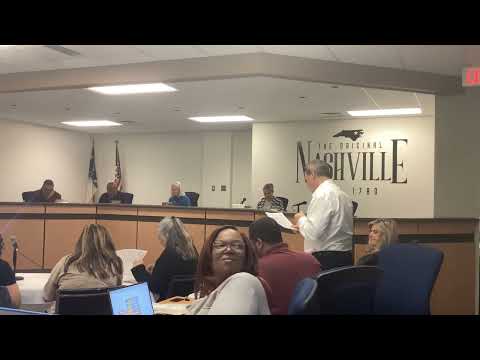
Town of Nashville council members and the Downtown Strong municipal service district (MSD) advisory board met in a joint work session to review MSD funding, recent board appointments and a proposed 300‑hour intern to help implement the downtown streetscape plan.
The advisory board summarized the MSD’s purpose and recent spending and asked for clearer expectations and more frequent joint meetings. "We pay for our own Christmas decorations, our flowerpots, our power washing," Downtown Strong member Amy Deasley said, arguing that businesses inside the MSD bear costs she said are not shared by other areas of the town. Sean, a Downtown Strong member who presented the packet, reviewed the MSD’s purpose and boundaries and described the board’s request for clearer communication with council.
The discussion followed an informational review of MSD finances. According to the materials presented, the MSD receives a small tax assessed within the district and a recently added Nashville Junction area now brings in about $40,000 a year. The packet also reported year‑to‑date MSD revenue of $48,666 and budgeted MSD expenditures of $60,000 for fiscal year 2025; $12,708 of that budgeted total had been spent year to date. Mr. Sean (advisory board member) said some expenses reflected attorney review, a design contest, tote bags and repairs for a rail repeatedly struck downtown; insurance reimbursement for that rail repair was expected in March or April. Advisory board members and several council members disagreed about whether some purchases — notably decorations and consultant work — had delivered tangible results for downtown improvements.
Board membership and recruitment practices drew sustained debate. Several advisory board members said the board previously required members to be property or business owners inside the MSD and said opening applications to townwide applicants damaged business owner representation. "If you do not own a business or operate a business in the MSD district, then you are not on the committee because you're not spending your tax dollars," one advisory board member said. Other council members and staff said the rule had been relaxed because of a lack of applicants and that the council could prioritize business owners on future applications. Councilwoman Kate asked for applications and more context before appointments are finalized and apologized for poor communication about candidate materials.
Council members also pressed for more frequent joint meetings and clearer written recommendations from the advisory board. "When we received your recommendation ... there wasn't any deliberation given. There wasn't any reason," a council member said, urging a one‑paragraph justification from the advisory board when it sends funding or appointment recommendations to council.
The advisory board proposed hiring a part‑time intern to provide outreach, funding research and follow‑through on the downtown streetscape plan and other near‑term projects. The proposal described a 300‑hour internship intended to be a focused, part‑time project (roughly 20–25 hours weekly over several months) and cited East Carolina University master’s candidates as a source. The total cost cited in discussion was $5,000; advisory board presenters asked the MSD to fund the position but said they expected the cost could be split with parks and recreation or other entities. Council members and board members agreed the concept could provide a ‘‘champion’’ for downtown work but wanted more detail and a plan for cost‑sharing.
The MSD board’s proposal to hire an intern was tabled for further discussion at the advisory board’s next meeting, scheduled for March 24. Joanne (staff member) and Sean both indicated they would return with more specific scope and funding proposals; Council members asked that Parks and Recreation be approached about cost‑sharing and that the advisory board provide a brief written statement of the intern’s tasks and measurable goals.
Before adjournment, the council indicated a need to move into closed session under North Carolina statute to discuss a real estate purchase and negotiation; a motion to go into closed session was seconded on the record. The transcript records the motion and second but does not include the vote tally in the public portion of the session.
The meeting surfaced recurring themes the council said it will work to address: clearer written recommendations from the advisory board when funding is requested, more frequent joint meetings to prevent misunderstandings, and an application process that either prioritizes MSD business/property owners or explicitly states the board’s selection criteria. Council members repeatedly thanked advisory board volunteers for their service while acknowledging the need to improve communication.
The council and advisory board did not adopt new policy in the public session. The intern proposal was tabled to March 24 for a decision; the closed‑session motion to discuss real estate purchase was made and seconded.