Lifetime Citizen Portal Access — AI Briefings, Alerts & Unlimited Follows
Commander outlines Joint Global Strike Operations Center mission, structure
Loading...
Summary
Major General Jason Armaghust described the Joint Global Strike Operations Center's mission to sustain U.S. strategic deterrence, its subordinate centers and personnel, and ongoing bomber-force modernization.
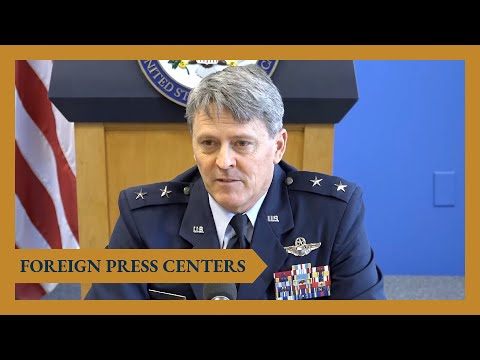
Major General Jason Armaghust, commander of Eighth Air Force and commander of the Joint Global Strike Operations Center (JGSOC) at Barksdale Air Force Base, outlined the center's mission and organization during a briefing at the New York Foreign Press Center.
"The mission of the JGSOC is to conduct strategic deterrence operations, and on order, neutralize the enemy through global strike to protect The United States Of America," Armaghust said. He described the JGSOC as "the war fighting air component to the United States Strategic Command and the operational arm of US bomber forces and NC3 assets."
Armaghust said the JGSOC was activated on 08/24/2018 to meet modern long-range air-operations needs and that, within JGSOC, three subordinate centers perform specialized roles: the 608 Air Operations Center (AOC), the Joint Nuclear Operations Center (JNOC) and the Standoff Munitions Application Center (SMAC). "The JNOC coordinates strategic bomber command and control, intercontinental ballistic missile alert generations, and performs Air Force-level nuclear command control and communications reporting," he said, noting the JNOC was activated on 10/15/2018.
He gave workforce and structure figures: the Eighth Air Force commands roughly 24,000 airmen supporting global long-range strike missions; the 608 AOC includes more than 175 active-duty, civilian and contractor positions spanning divisions such as combat planning, combat operations, air mobility, strategy, intelligence, surveillance and reconnaissance, and air communications. SMAC, Armaghust said, "is responsible for planning and integrating cruise missiles and joint fires into operational war plans, deliberate planning efforts, and contingency operations."
On force modernization, Armaghust said the Air Force currently fields about 140 bombers across the B-1, B-2 and B-52 fleets and is modernizing the B-52 (a modernization he referred to as a B-52J program for engines, avionics and select subsystems). He said the B-21 will eventually replace the B-1 and B-2, yielding a two-bomber-family fleet in the longer term. "We are globally postured, trained, ready, and fully capable of enabling full spectrum dominance for the Department of Defense," he said.
Armaghust also described routine global employment patterns: roughly 60% of the command's recent operations took place outside the continental U.S., with recurrent activity in Europe, the Indo-Pacific and occasionally in Central Command areas. He emphasized habitual work with partner nations, saying routine interaction and planning with allies increases readiness and interoperability.
The briefing was on the record and followed by a question-and-answer session with international reporters.