Get Full Government Meeting Transcripts, Videos, & Alerts Forever!
Get email alerts on the Early Learning topic
No spam. Unsubscribe anytime.
Education Department outlines early‑learning grants, screening and readiness data for House subcommittee
Summary
Department of Education officials described early learning programs funded through the Alaska Reads Act, pre‑elementary and early education grants, assessment systems and preliminary readiness data; committee members asked for longitudinal and program‑specific outcome data to guide FY2026 funding decisions.
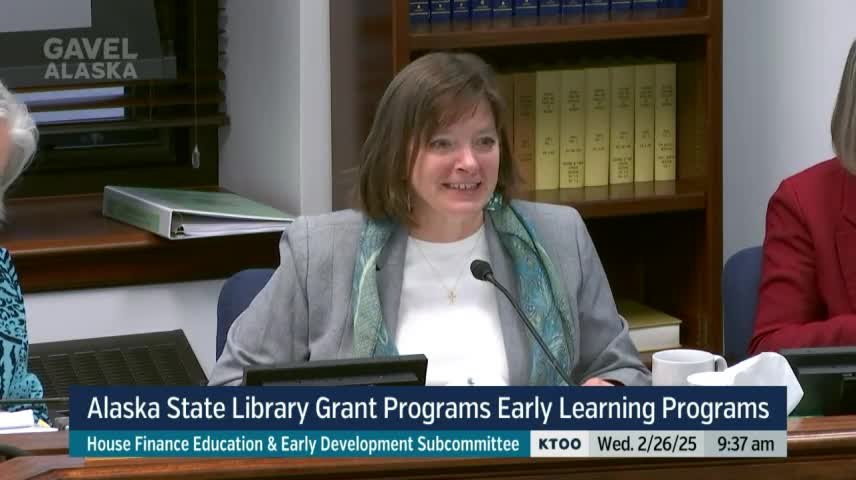
Juneau — Deborah Riddle, division operations manager for the Department of Education and Early Development’s Division of Innovation and Education Excellence, told the House Finance Education Subcommittee on Feb. 26 that the department supports multiple early‑learning grant programs, coordinates Head Start partnerships and collects assessment data intended to measure kindergarten readiness.
The department said it funds early learning through four components: early learning coordination, pre‑elementary grants (three‑year awards), early education program grants (aligned to the Alaska Reads Act standards) and foundation‑formula support under the Reads Act. The department also supports Best Beginnings, the Imagination Library book program and a quality recognition system called Learn and Grow.
Why it matters: Early‑learning investments and program design affect children's school readiness and K‑12 outcomes. Committee members asked for more detailed, longitudinal and comparative data to evaluate whether the programs meet stated goals.
Riddle said the pre‑elementary grants currently support nine grantees in a three‑year cohort and that the early education program grants target the schools or districts in the bottom 5 percent of the accountability ranking — those the department judged most in need of support. She described efforts to align the early education standards with Head Start while removing barriers that prevented some school districts from qualifying for foundation formula funding tied to the Reads Act.
Assessment and outcome data: Riddle said all grantees for the early education program, Head Start grantees and pre‑elementary grantees participate in Teaching Strategies GOLD, an observational assessment that monitors social, emotional, physical, language, cognitive, math and literacy development. She also reported results from the Alaska Developmental Profile (ADP): roughly 30 percent of children consistently demonstrated at least 11 of the ADP’s 13 goals at kindergarten entry while the remainder did not meet that benchmark, a point she raised to illustrate ongoing gaps in readiness.
On literacy screening, Riddle listed the state‑required tools — Amplify mCLASS DIBELS8 among them — and said the department had 8,869 students assessed in DIBELS with 2,873 not assessed (some of those were pre‑K students). She said the department provides training and materials for Teaching Strategies GOLD and that the department has trained early educators in the science of reading and phonics interventions tied to the Reads Act.
Riddle also cited other federal funding that supports early‑childhood special education (IDEA Part B section 619) and described partnerships with Head Start, the Alaska Head Start Association, Alaska Mental Health Trust Authority and health providers to form a statewide leadership team for early childhood services.
Committee members pressed for more outcome data. Representative Story asked the department to provide historical trend reports showing multi‑year progress on the ADP and other readiness measures. Representative Bynum asked whether grants were targeted to communities most in need; Riddle said the early education program grants are selected from the schools identified as most in need and that the department prioritizes districts where the funding will have the greatest impact, moving from the lowest‑ranked schools upward until available funding is allocated.
Commissioner Bishop, who joined remarks during the hearing, described the Alaska Reads Act as a major recent education reform: “The Alaska Reads Act … made the most significant impact in public education that I have seen in my 35 years,” the commissioner said, citing the statute’s focus on evidence‑based reading instruction and alignment across programs.
The committee asked for further materials on program outcomes, including detailed usage of screening tools, longitudinal analyses and the number of children served by Best Beginnings’ Imagination Library. Riddle said a department report was in the approval process and would be provided to the committee once finalized.
Ending: The subcommittee said it will review the department’s follow‑up materials and continue the early‑learning discussion at its next scheduled meeting.