Get Full Government Meeting Transcripts, Videos, & Alerts Forever!
Get email alerts on the Wastewater Treatment topic
No spam. Unsubscribe anytime.
Southborough leaders begin formal study of Route 9 wastewater plant to attract commercial development
Summary
Select Board member Al Hamilton presented preliminary findings that a municipal wastewater treatment system could make Route 9 more developable, help shift tax burden from residents to businesses and enable re-use of treated effluent; group will seek committee formation and further study.
Al Hamilton, a Select Board member, told the Southborough Planning Board on Feb. 24 that a small working group has begun evaluating the feasibility of a municipal wastewater treatment plant aimed principally at enabling commercial development along the Route 9 corridor.
Hamilton said the motivation is fiscal: the town’s tax base has shifted toward residential properties and residents now carry a larger share of the tax burden. “This is really about our tax burden,” Hamilton said, adding that Southborough is currently at about 83.7 percent residential assessment and would need roughly $150,000,000 of new commercial and industrial assessed value to return to an historic 80/20 split.
The point of the study, Hamilton said, is to make parcels along Route 9 — which he estimated at about 167 acres of undeveloped or underdeveloped frontage (excluding certain exempt parcels) — more attractive and buildable. He told the board that wastewater availability is a frequent blocking issue for restaurants, groceries, biotech and manufacturing firms and that developers have told him the lack of municipal sewer has cost Southborough opportunities.
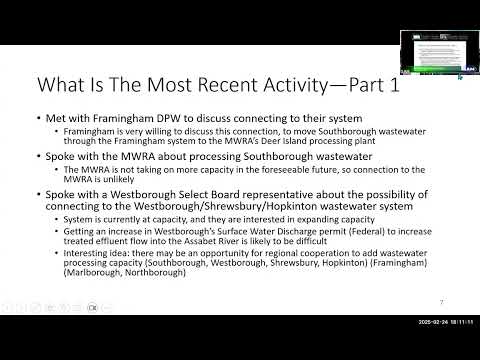
Hamilton described prior outreach and technical work: three wastewater studies done in the past 18 months; consultations with Weston & Sampson (engineering consultant), the Massachusetts Department of Environmental Protection (MassDEP) and neighboring municipal utilities; and a meeting with Veolia, a private operator, which suggested a model in which a plant could be run as a regulated utility under contract. Hamilton said ground-discharge (subsurface) disposal and systems designed to expand incrementally are the most practical technical paths for Southborough.
Consultant and resident Paul Carter, who identified himself as a consulting engineer, urged the board to have Weston & Sampson prepare a focused scope and ballpark estimate for the comprehensive-plan-level study and recommended early involvement of the DPW superintendent to ensure constructability and long-term operations considerations are captured.
Hamilton outlined near-term next steps: forming a formal committee (a charge to form one was scheduled before the Select Board the next day), seeking funding for a comprehensive-plan-level study and continuing engagement with Framingham, Westborough and Marlborough about possible regional connections or partnerships. He said the MassDEP had been “positive and willing to help,” but that interconnection to existing systems (including MWRA-connected systems) faces capacity, permit and peak-flow constraints.
Hamilton cautioned that the work remains early-stage and that several regulatory and siting constraints remain, including the practical need for 10–15 acres for a treatment and disposal footprint in suitable soils, permitting limits on surface discharge, and economies of scale that favor regional solutions. He proposed exploring use of treated effluent for irrigation — for example, golf-course irrigation — to reduce potable water demand.
The Planning Board and members of the public asked technical and fiscal questions about potential locations, timelines, ownership and how existing properties would be connected. Several board members urged caution and called for more detailed, data-driven analysis of demand, costs, and likely development patterns before committing to capital outlays.
Hamilton emphasized financing options under review, including user-fee models, betterment assessments and public-private partnerships. He said private operation as a regulated utility was one model the group plans to continue exploring, but that many details remain unresolved.
The town heard multiple community perspectives during the discussion: technical advice from a local engineer, questions about zoning and market demand, and comments about the long-term tradeoffs of sewer infrastructure in a suburban town.
The working group will formalize its committee structure and pursue a one-stop funding application and comprehensive-plan study funding request in the next funding cycle, per Hamilton’s presentation.