Get Full Government Meeting Transcripts, Videos, & Alerts Forever!
Get email alerts on the Agency Updates topic
No spam. Unsubscribe anytime.
State natural-resources agencies brief Senate committee on produced water, well plugging and federal rule impacts
Summary
The Texas Senate Committee on Natural Resources on Tuesday heard situational updates from three state agencies on produced water, orphan and inactive wells, carbon sequestration permitting and the effect of recent federal environmental rules.
The Texas Senate Committee on Natural Resources on Tuesday heard situational updates from three state agencies on produced water, orphan and inactive wells, carbon sequestration permitting and the effect of recent federal environmental rules.
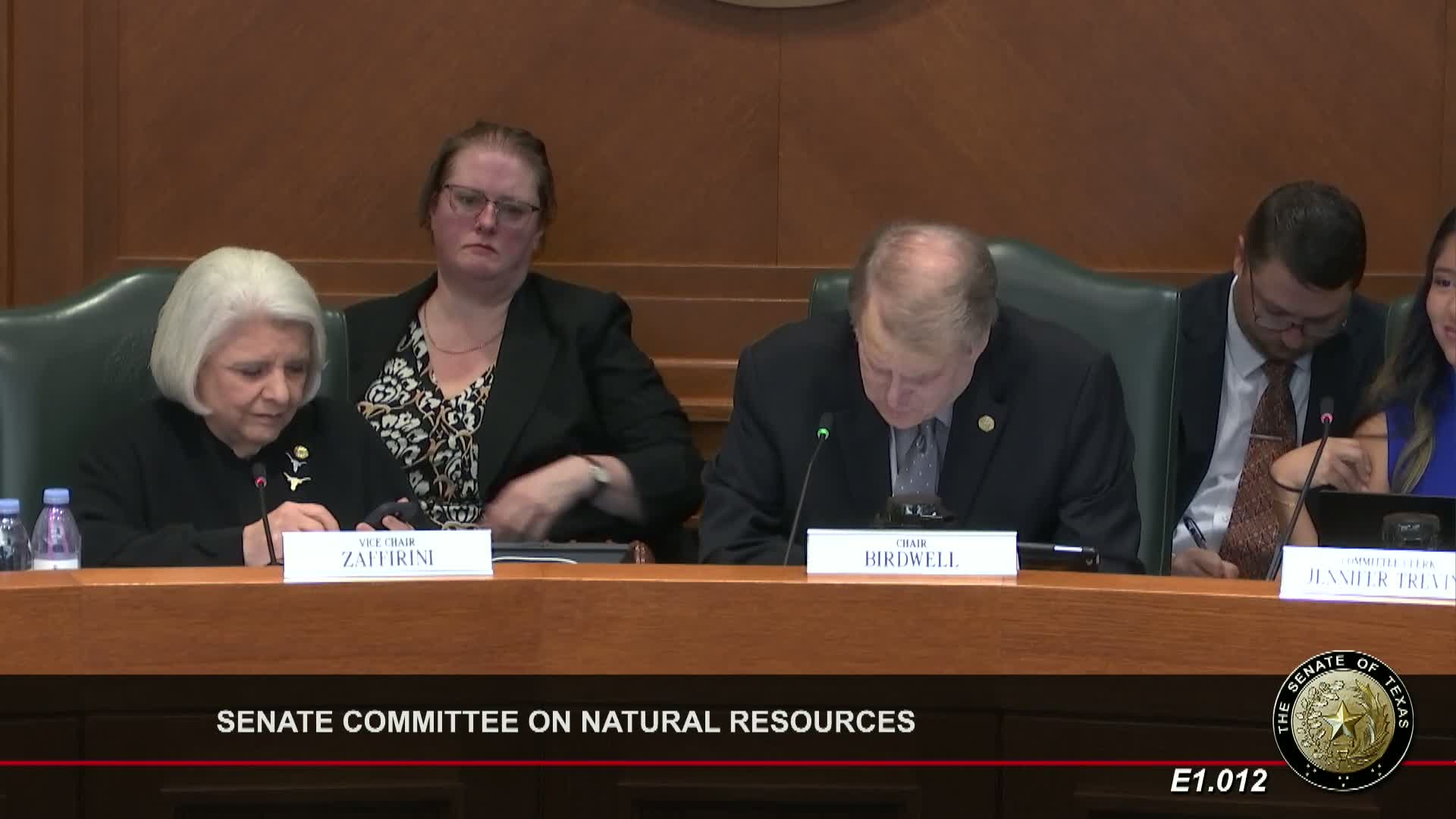
The committee’s chair, Senator Brian Birdwell, opened the hearing and called for reports from Dawn Buckingham, Texas land commissioner and head of the General Land Office; Christie Craddock, chair of the Railroad Commission of Texas; and Kelly Keel, executive director of the Texas Commission on Environmental Quality (TCEQ). The committee adopted its standard committee rules by unanimous consent before testimony began; no member objected.
Why it matters: Produced water from oil and gas operations, leftover wastes, and federal environmental standards affect state revenues, public health protections and how Texas manages scarce water resources for agriculture and industry. Agency officials told senators they need additional staff and clearer statutory direction to implement new federal drinking-water and air-quality requirements, expand beneficial uses of produced water, and accelerate plugging of wells that pose environmental risk.
General Land Office: revenue and carbon projects Dawn Buckingham described the General Land Office’s (GLO) mineral-lease activity and efforts on carbon sequestration and produced-water projects. Buckingham said the office manages roughly 13,000,000 acres of mineral rights and that mineral activity generated about $3.5 billion over the last two years for public education. She highlighted a large land lease she described as a roughly 500,000-acre carbon sequestration lease that produced $130,000,000 in a single day and estimated an approximate $10,000,000,000 return over 10 years. Buckingham said the GLO is pursuing both geologic and soil carbon sequestration and is “part of the produced water consortium” working to find beneficial uses for large volumes of produced water.
Railroad Commission: geothermal, brine mining and orphan wells Chair Christie Craddock summarized recent rulemaking and program changes at the Railroad Commission. She said the commission adopted rules implementing SB 786 to transfer regulatory authority for closed-loop geothermal injection wells to the Railroad Commission from TCEQ, and adopted a statewide rule implementing SB 1186 to clarify the commission’s jurisdiction over brine mining and associated injection wells (including lithium extraction). Craddock also described a significant overhaul of rules governing oil-and-gas waste management facilities, calling it the first major update in approximately 40 years and saying it includes enhanced oversight and staff dedicated to permit compliance.
On orphaned and inactive well plugging, Craddock said the commission’s list includes about 8,500 wells and that the agency aims to plug roughly 1,000 wells per year. She said the commission received about $22,750,000 per year in the most recent biennium for plugging and that the average cost to plug a well has risen—she estimated the current average near $50,000 versus about $15,000 eight years earlier. Craddock said the commission prioritizes wells based on environmental risk and that emergency responses this year have already required roughly $9,000,000 for two emergency wells.
TCEQ: federal rules, staffing and public engagement Kelly Keel told the committee that TCEQ implements delegated federal programs under the Clean Air Act, Clean Water Act, Safe Drinking Water Act and the Resource Conservation and Recovery Act. Keel said TCEQ regulates more than 7,000 public water systems and administers 12 grant programs under the Texas Emissions Reduction Plan (TERP), noting the agency has awarded approximately $1.8 billion in TERP funding since the program began.
Keel urged the committee to consider additional staff and salary funding to meet increased demand for permitting, compliance and public engagement as federal standards evolve. She cited recent EPA-driven requirements—including an oil-and-gas methane rule, new fine particulate (PM2.5) standards and new drinking-water standards—that increase technical complexity and workload. Keel said TCEQ has implemented over 75% of prior sunset recommendations and is working on the remaining items.
Questions and priorities Senators pressed the panel on items they expected to be legislative priorities this session. Buckingham said the GLO is closely watching disputes and proposed legislation concerning ownership of pore space and that changes could affect revenue to the Permanent School Fund. Craddock and Keel both asked the legislature for clearer statutory direction on produced-water reuse and for adequate funding to implement programs and federal requirements.
The panel also discussed the Gulf Coast Protection District and the Coastal Spine project, with Buckingham noting the project requires a state funding share and coordination with the U.S. Army Corps of Engineers.
Discussion vs. action Committee business produced one formal action: committee rules were adopted by unanimous consent. No other motions or votes on bills occurred during this hearing; agency comments were situational updates and questions from committee members.
Next steps Committee members signaled interest in legislation clarifying produced-water authority, increasing plugging funds or prioritization for orphan wells, and providing TCEQ and the Railroad Commission resources to meet federal implementation deadlines. Agency officials said they are prepared to work with the legislature and with federal partners to refine rules and funding requests.