Get Full Government Meeting Transcripts, Videos, & Alerts Forever!
Get email alerts on the Advisory Body Procedures topic
No spam. Unsubscribe anytime.
Pacific Fishery Management Council staff brief new advisory members on rules, travel and digital tools
Summary
Council staff reviewed advisory body roles and conduct rules, termination and alternate policies, travel and stipend procedures, meeting platforms (RingCentral) and expense filing (Concur) during a recorded advisory body briefing.
Kelly Ames, deputy director of the Fishery Management Council, Pacific, opened a recorded advisory body briefing on council procedures and platforms and asked members to keep cameras and microphones off during the presentation.
The presentation covered the council’s operating procedures and ground rules, attendance and termination criteria for advisory subpanels, stipend and travel/reimbursement procedures, and the digital tools members will use for meetings and expense claims.
The briefing matters because advisory bodies supply the technical and sector-specific input the council uses when developing recommendations under federal law. Merrick Burden, the council’s executive director, told attendees the council relies on advisory bodies because “we literally couldn't do this without you,” and urged members to familiarize themselves with the council’s rules, reporting procedures and online resources.
Council operating procedures and meeting decorum
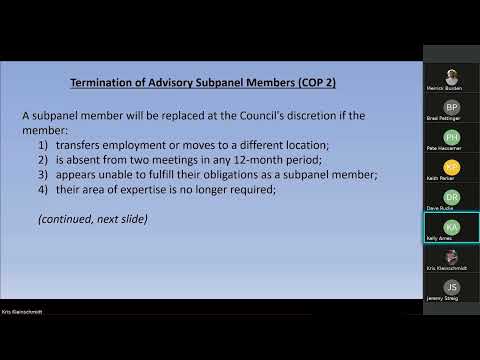
Kelly Ames summarized the council operating procedures (COPs) and advisory body ground rules available on the council website, noting COP 1 covers day-to-day operations. Ames said termination criteria for advisory subpanel members include transferring employment or residency, missing two meetings in any 12-month period, inability to fulfill duties, or violating the council’s conduct rules. She also said the council chair, in consultation with the executive director, may remove a member for just cause and cited examples such as felony convictions or investigated reports of harassment.
Ames said the COPs require advisory bodies to work collaboratively with diverse stakeholders, including commercial and recreational fishermen, processors, conservation groups, and federal, state and tribal fishery managers. She added that all council and advisory body meetings are open to the public, draft statements may not be distributed without chair permission, and final reports will be posted to the council website.
Attendance, alternates and stipends
Ames said advisory body members are expected to attend meetings and that the COPs generally allow two absences per year for members of advisory subpanels. She summarized the process for approving alternates: requests must be submitted to the deputy director and approved by the executive director at least 30 days before the first day of the advisory body meeting or the council meeting held with it; the council will strictly enforce that 30-day requirement going forward.
Ames said stipends may be paid, subject to appropriations, to advisory body members who are not federal or state marine fisheries agency employees. Stipends are tied to attendance records and require timely submission of forms in response to council staff inquiries.
Travel, per diem and reimbursements
Ames explained that official meeting invites constitute travel orders and will be sent from a noaa.gov account; invites will include hotel details, authorized travel dates, per diem rates and committee start times. She said members who wish to drive or choose alternate hotels must seek prior approval from the administrative officer, Patricia Herring, and that the council will reimburse the lowest-cost option determined by a cost-comparison review.
Platforms and document access
Chris Kleinschmidt, IT manager, walked members through the council website, the meeting briefing book pages, the e-portal for public comment, and archive resources including recordings and transcripts. He described a “briefing book” page on each meeting’s dedicated site that holds agendas, briefing materials and links to the e-portal for public comment and oral testimony.
Kleinschmidt said the council posts recordings to its YouTube channel with timestamps for agenda items so users can jump to specific sections. He also described a “Fast Facts” meeting page with practical logistics and said the council uses Mailchimp and social platforms for announcements.
RingCentral and hybrid meeting procedures
Kleinschmidt explained the council’s use of RingCentral Video for day-to-day meetings and RingCentral Webinar for council meetings. He demonstrated common functions — mute/unmute, screen share, chat, hand-raise and device audio settings — and described the attendee/participant distinction used in hybrid meetings. He explained members usually join as attendees and can be promoted to participants when given permission to speak or present.
Concur expense system
Kleinschmidt reviewed the Concur expense and travel booking system used for travel reservations and reimbursements. He said members must set up a Concur profile, attach a bank account for reimbursements, and enable multi-factor authentication. He recommended using the Concur website rather than the mobile app for full claims, but noted the app can be useful for photographing receipts.
Harassment reporting and decorum
Ames highlighted the council’s harassment reporting procedures and said harassment or retaliation will not be tolerated; complaints should be reported to the executive director or council chair for investigation. She emphasized that advisory body officers (chairs, vice chairs or co-chairs) are responsible for upholding COPs and meeting decorum and that when consensus is not reached, reports to the council should identify agreements and areas of disagreement to inform the council’s decisions.
Next steps and resources
At the close of the presentation, Ames asked members to review the website and to return intent-to-serve forms if they had not already done so. She reiterated that council staff listed on the website stand ready to help with questions about committee assignments, travel, or the online tools. The recorded briefing will be posted on the council website for reference.