Get Full Government Meeting Transcripts, Videos, & Alerts Forever!
Get email alerts on the Advisory Body Procedures topic
No spam. Unsubscribe anytime.
Pacific Fishery Management Council outlines advisory-body conduct, attendance and removal rules
Summary
Council staff reviewed Council Operating Procedures, advisory-body ground rules, attendance and alternate requests, stipend eligibility and harassment reporting during the Pacific Fishery Management Council dvisory-body briefing.
The Pacific Fishery Management Council detailed standards of conduct, attendance rules and removal procedures for advisory-body members during a briefing for newly appointed members.
The guidance, delivered during the council dvisory-body briefing, emphasized the Council Operating Procedures (COPs) and the advisory-body ground rules as the primary references for member responsibilities and decorum. Kelly Ames, deputy director of the Pacific Fishery Management Council, told participants, "Please take the time to familiarize yourself with our website," and reiterated that COPs and related policies are published on the council website.
Why it matters: advisory bodies provide the council with technical and community input used to shape recommendations to the National Marine Fisheries Service under the Magnuson-Stevens Fishery Conservation and Management Act. The council said clear expectations help preserve public confidence in a process that includes commercial and recreational fishermen, processors, charter operators, conservation groups and federal, state and tribal managers.
Council executive director Merrick Burden thanked appointees for their service and said, "We literally couldn't do this without you," framing advisory members as essential to the council process. Council Chair Brad Pettinger and Vice Chair Pete Hassimer asked advisory members to act as ambassadors for the fisheries and sectors they represent and to maintain respectful conduct in both formal meetings and informal interactions outside meeting rooms.
Key rules and procedures summarized
- Council Operating Procedures and advisory-body ground rules: Ames said the COPs (COP 1 and others) govern day-to-day operations and that advisory-body members should review the COP that applies to their appointment. The guidance includes procedures for reporting, meeting decorum and public access to meeting materials.
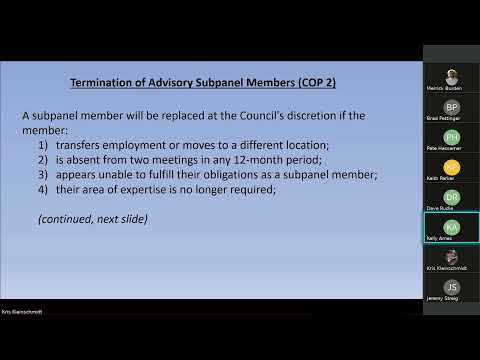
- Termination and removal: Ames said members of advisory subpanels can be replaced at the council's discretion for reasons that include employment transfers, relocation, being absent from two meetings in any 12-month period, inability to fulfill obligations, loss of requisite experience or violation of rules of conduct. The council chair, in consultation with the executive director, may remove a member for just cause; examples cited include violation of a marine resource regulation, felony convictions, or reported harassment.
- Harassment reporting: Ames pointed that harassment is not tolerated and identified a harassment reporting procedures policy on the council website that explains how to report and how investigations proceed. The council said it will not tolerate retaliation against those who report harassment.
- Attendance, alternates and stipends: The COP allows up to two absences per year for advisory-body members, and alternates may be approved. Ames said requests for alternates for advisory subpanels must be submitted to the deputy director and require the executive director's approval at least 30 days before the first day of the advisory-body meeting or the associated council meeting. She noted the 30-day requirement will be strictly enforced going forward. Stipends may be paid, "subject to the availability of appropriations," to nonfederal and nonstate-employed advisory members and are tied to attendance records and timely submission of required forms.
- Scope of engagements: The presentation stressed that advisory bodies should document areas of agreement and areas of disagreement when consensus cannot be reached so the council receives the full range of viewpoints.
Discussion vs. formal action
The briefing was informational and did not include formal votes. Staff repeatedly framed the material as procedural guidance and resource information for new appointees. Ames and other staff directed members to consult the council website for the COPs, harassment reporting procedures, travel and reimbursement rules, and the specific COP for each advisory body.
Additional administrative notes
Ames directed members to use official travel invites sent from a noaa.gov account for travel orders and deadlines; she also said members should promptly respond to staff emails. Patricia Herring was named as the administrative officer to contact for itinerary changes and cost-comparison decisions for alternate travel or lodging.
Ames concluded by reminding members to return intent-to-serve forms and to contact their assigned staff officer with questions. Staff remained available on the line after the recording stopped to answer follow-up questions.
The briefing materials, COPs and the harassment reporting procedures are posted on the council website.