Get Full Government Meeting Transcripts, Videos, & Alerts Forever!
Get email alerts on the Hotel Occupancy Tax Chamber Agreement topic
No spam. Unsubscribe anytime.
El Campo council approves Chamber of Commerce hotel-occupancy tax agreement after deleting administrative cap language
Summary
The council approved Resolution R2025-12 authorizing an agreement with the El Campo Chamber of Commerce to use hotel-occupancy-tax (HOT) funds for tourism and publicity; council removed language (section 6.5) that would have explicitly allocated 35% of HOT proceeds for chamber overhead.
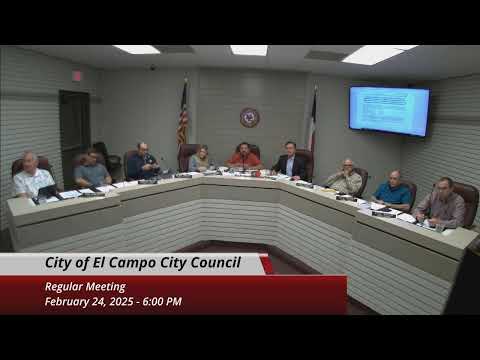
The El Campo City Council voted on Feb. 24 to approve Resolution R2025-12, authorizing an agreement between the city and the El Campo Chamber of Commerce for use of hotel-occupancy-tax (HOT) funds for publicity and tourism.
City staff said the agreement — discussed at a workshop two weeks earlier — includes provisions for use of city facilities and requires the chamber to provide an annual audit and quarterly financial reports. Staff said the agreement runs through the rest of the fiscal year and will renew if council provides funding in the budget; staff noted the intended payments are quarterly at $13,500 but that payments depend on council budget action.
During discussion a council member moved to approve R2025-12 but to delete section 6.5, which the mover described as language calling for 35% of HOT receipts to be used for the chamber’s normal overhead. Other council members questioned whether such an allocation would be legal under state rules governing HOT funds. The city’s legal counsel advised that state law allows the allocation of up to 35% of HOT receipts for administrative expenses in some circumstances; staff also said the agreement specifies that mandated tourism spending limits apply and that funds can only be spent if included in the city budget.
After the mover withdrew the initial motion and refiled it to reflect the council’s instructions, council members voted to approve the resolution with the deletion of section 6.5. The mayor announced the motion passed.
City staff said payments would be quarterly and could be revisited if HOT revenues change; the council asked staff to return with any budget amendments required to pay earlier quarters if the council later chooses to do so.