Get Full Government Meeting Transcripts, Videos, & Alerts Forever!
Get email alerts on the Innovation Park Remediation topic
No spam. Unsubscribe anytime.
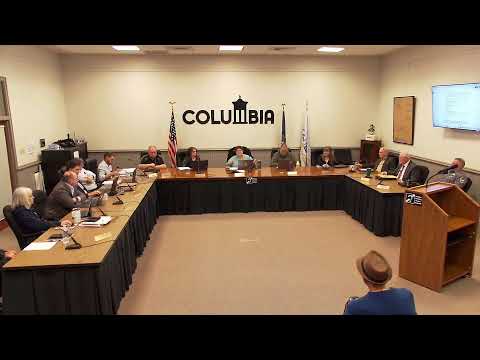
Columbia council hears detailed plan to remove buried fill, stabilize soil at McGinnis Innovation Park
Summary
Consultants told Columbia Borough Council on Feb. 25 that an NPDES permit has cleared the way to bid soil‑remediation work at the former airfield; staff and residents pressed for clarity on financing, timing and neighborhood notice.
Columbia Borough Council on Feb. 25 received a technical update on remediation and site‑preparation work at the former McGinnis Innovation Park property, where consultants said they have obtained the necessary NPDES permit, drafted bid documents for Phase 1 soil stabilization and expect contractor work to take about three to four months once a bidder starts.
The briefing matters because the work — removing buried fill, addressing organics and contaminated material, and creating a uniformly compacted subsurface — is intended to make the site buildable for future commercial uses and increase the borough’s tax base. Council and residents debated who will pay for remediation, whether the borough should draw on an $8 million BIOS loan and how neighbors will be notified before heavy equipment arrives.
Jason Best, a consultant with ELA, told council the team’s immediate focus is “getting that soil stabilization ready for some future development, whatever that could be.” He said geotechnical borings and surveying are complete, a subdivision plan has been recorded, and the borough received the NPDES permit in January. Best and other consultants described Phase 1 as a contractor‑led effort to strip fill, sift and recompact acceptable material in lifts, chip and remove organics as needed, and restore a vegetative cover and runoff patterns at completion.
Derek, an engineer on the project team from CS Davidson, described how the work excludes low, unfilled drainage areas and the quarry at the southern end: the team plans to focus remediation on the filled runway and adjacent areas. “We want this to be a blank canvas,” Derek said, adding that the center two‑thirds of the runway are suitable for building after stabilization but the outer ends likely will be left at a lower level of stabilization because the cost to make them building pads would be high.
Heather (borough staff) told council that the borough’s BIOS application includes public‑improvement items such as streets, utilities and stormwater and that the BIOS award is structured as a combination of grant and loan. She summarized the program as an $8,000,000 package that is “part grant, part loan — it’s a 40% grant, 60% loan.” Council asked county advisor John B. Miller to clarify what conditions attach to closing the BIOS loan and whether the borough can draw only a portion of the award for Phase 1.
On financing, staff repeatedly said the remediation will likely require either buyer financing or use of the borough’s allocated funds: “The remediation is being paid for through the buyer’s line,” a staff member said, adding that if the borough chose to fund Phase 1 directly, staff would not recommend that approach. Councilmembers and the mayor urged staff to report back with options, including whether BIOS funds can be used only for site stabilization (not all infrastructure) and whether the BIOS commitment is transferable if a private buyer takes the project forward.
Council and residents pressed for procedural and neighborhood protections. Mary Wickenheiser and other neighbors asked when residents would be notified about the timing, noise and dust. Staff replied that the project will follow the borough’s bidding and contracting process — the work will be advertised, council will open bids and award the contract — and that personal notices could be added though they are not required by the NPDES permit. An Act 2 environmental report prepared by ECS was discussed; staff said the report is not finalized but will be made public once complete.
On sequencing and scope, consultants said demolition of remaining vertical structures (hangars and accessory buildings) will be advertised separately and that concrete floors would largely remain in place with “piercing” to improve subgrade drainage. Best said the team has prepared draft bid documents for remediation work and recommended separating demolition (vertical structures) and earthwork (remediation and compaction) into distinct procurements.
Timing estimates offered to council were modest: consultants said that when permits are in place and a contractor is selected, the active remediation work is “months” — likely three to four months if crews work five days a week — and that beginning late spring or early summer would allow vegetative stabilization during the growing season. Staff said that, if the borough closes on BIOS funding and draws the funds for Phase 1, the next 12 months will require additional decisions about infrastructure, final site design and whether the borough will sell the property as a single parcel or install public improvements and sell pads.
Council directed staff to continue work on procurement documents, to obtain written advice from John B. Miller about BIOS conditions and to return with cost estimates tied to alternative approaches (sell whole parcel, sell pad sites, or partner with a developer). Staff also agreed to make the Act 2 report public when finalized and to include neighborhood notification steps in the procurement plan if council requests them.
For now, the project remains in a preparatory stage: permitting and bid documents are complete enough to advertise remediation, but final site design, financing strategy and formal contract awards remain pending decisions by council and county advisors.
Votes at a glance
During the meeting council approved routine and permitting items that will affect other borough projects. Motions passed with the recorded movers and seconders as listed below; each motion was approved by voice vote with “Aye.”
- Authorize bill payments — motion by Councilperson Giese, second by Councilperson Murphy; outcome: approved. - Charge 2024 permit fee rate for the Chip Factory Hotel project (fee set at $20.24) — motion by Councilperson Kaufman, second by Councilperson Giese; outcome: approved. Staff noted the borough’s commercial fee schedule may need review at a future work session. - Reschedule the March 25 council meeting to March 27 and authorize advertisement — motion by Councilperson Giese, second by Councilperson Kaufman; outcome: approved. - Certificate of appropriateness for construction of a five‑unit townhouse at 440 North Fourth Street — motion by Councilperson Kaufman, second by Councilperson Murphy; outcome: approved. - Facilities‑use request: Ashley Tabernacle annual baptism at River Park Boat Launch Area, Aug. 10, 2025, contingent on certificate of insurance — motion by Councilperson Kaufman, second by Councilperson Giese; outcome: approved. - Facilities‑use request: Ashley Tabernacle block party/yard sale on South Fifth Street (June 14, 2025), contingent on certificate of insurance — motion by Councilperson Kaufman, second by Councilperson Murphy; outcome: approved. - Approve destruction of aged borough documents (per adopted records‑retention schedule) — motion by Councilperson Kaufman, second by Councilperson Murphy; outcome: approved. - Approve destruction of used police equipment and outdated technology (police list in packet) — motion by Councilperson Bergard, second by Councilperson Kaufman; outcome: approved.
What’s next
Staff said it will advertise the demolition and remediation procurements, seek county guidance on BIOS loan conditions and return to council with cost estimates and procurement recommendations. Residents who asked about notice and impacts were told the borough will hold bid openings and contract award votes in public meetings and that the borough can add direct resident notification if council requests it.
— Columbia Borough Council, Feb. 25, 2025