Get Full Government Meeting Transcripts, Videos, & Alerts Forever!
Get email alerts on the Beach Ordinance topic
No spam. Unsubscribe anytime.
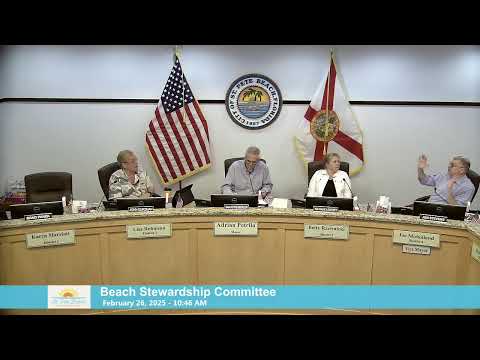
Beach Stewardship Committee asks City Commission for more public review before second reading of beach ordinance
Summary
The St. Pete Beach Beach Stewardship Committee voted to advise the City Commission to seek another round of public feedback before the ordinance's second reading on March 10, after hotel operators and residents raised concerns about setbacks, chair-storage rules, enforcement and economic impacts.
The St. Pete Beach Beach Stewardship Committee voted at its meeting to advise the City Commission to provide an additional round of public feedback before the ordinance’s second reading on March 10.
The recommendation followed more than an hour of public comment from hotel owners and managers who said they had little advance notice of the ordinance’s first reading and raised detailed concerns about proposed setbacks, daily removal of chairs and cabanas, enforcement practices and potential economic impacts.
Ayako, the committee’s staff liaison, presented the ordinance portion of a draft goals document and noted the second reading date. “Someone need to present these recommendations, provide a summary of the committee’s recommendations to the city commission in advance of the second reading which is going to be taking place on, March 10,” she said during the presentation.
Hotel operators described operational and financial risks they say the draft ordinance could cause. Joe Smith, identifying himself as owner of the Tradewinds, said the proposed setbacks and other provisions could reduce available beachfront and, he estimated, “50,000 less room nights … a reduction of over $30,000,000 in hotel revenue” and about $10,000,000 in lost chair-rental revenue. Those figures were offered by Smith as an estimate during public comment.
Travis Johnson, representing properties at 5500–6000 Gulf Boulevard, said parts of the proposal “aren’t fully ready to go” and urged a workshop so businesses and the city could find reasonable, site-specific solutions. Sean Kukalski, managing director for Bellwether and Beachcomber Resorts, said the hotels had been blindsided by the ordinance process and asked the commission to “meet with us” to help shape a business-impact analysis that is due before March 10.
Speakers also raised operational and safety questions that the committee said should inform ordinance drafting. Multiple commenters said fire and emergency medical services do not—and in some cases cannot—drive full-size fire trucks on the sand; several hotel speakers described using gators or smaller vehicles for emergency access. “Fire trucks and ambulances will sink and will not get out,” said Mitch Sheads, noting that hotels have designed hardscape access for emergency vehicles. Other commenters said sheriff SUVs and marine or gator units do patrol and respond on the sand in some incidents.
Several speakers addressed the proposed shift from nightly presetting of hotel chairs and cabanas to a single-use or daily-removal model. Operators said presetting reduces staff movement on the sand, lowers employee injury risk and limits disturbance to nesting habitat; Robert Cezanne of Plaza Beach Hotel and a later letter quoted by Parker Harvey of the Don Cesar said municipalities that moved to single-use reported spikes in workplace injuries and operational costs.
Committee members and staff also discussed the city’s recently announced pilot “0 tolerance” enforcement policy and a parallel code-enforcement ordinance that increases penalties for repeat violations. Members said changes in enforcement philosophy make clarity and community outreach more important: if warnings decline and enforcement becomes stricter, stakeholders need clear notice and time to adapt.
After public comment and discussion, the committee voted on a motion advising the City Commission to provide another round of public feedback from community members and businesses prior to the second reading of the beach ordinance. The motion passed on roll call with four yes votes.
The committee did not amend the ordinance language itself; members instead asked staff and the clerk to pass the committee’s recommendation to the commission and to pursue a follow-up workshop or public forum so residents and business representatives can deliver site-specific input before the March 10 second reading.
Votes at a glance: The committee carried the motion to request additional public feedback before the second reading (roll call: Member Looney — yes; Member Kirsman — yes; Vice Chair Stevens — yes; Chair Rothenberger — yes).