Get Full Government Meeting Transcripts, Videos, & Alerts Forever!
Get email alerts on the Climate Action topic
No spam. Unsubscribe anytime.
Pacifica council green-lights consultant to finish Climate Action and Adaptation Plan; defers priority ranking to implementation body
Summary
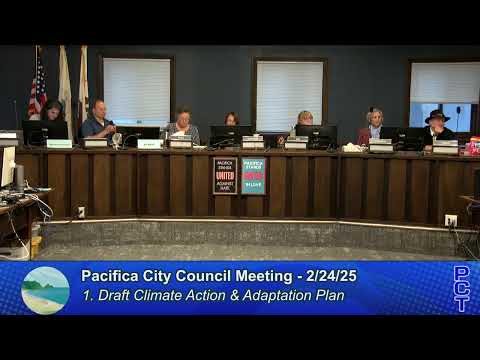
The Pacifica City Council on Feb. 24 signaled support for hiring a consultant to complete the Climate Action and Adaptation Plan but declined to require an immediate, consultant‑prepared prioritization of the draft actions, preferring implementation and prioritization to be handled by a proposed environmental commission and staff.
The Pacifica City Council on Feb. 24 signaled support for hiring outside consultant help to complete the Climate Action and Adaptation Plan (CAP), after hearing the task force present a draft of five years of recommended actions across sectors including energy, transportation, food/consumption and resilience.
The council’s majority supported using consultant time to finalize greenhouse‑gas numbers and tidy the draft document for adoption. Council members also said they preferred leaving a final prioritization of the plan’s many actions to the implementation phase — through a recommended environmental commission and a staff sustainability coordinator — rather than ordering a consultant-driven three‑tier ranking before adoption.
Why it matters: The CAP lays out dozens of near-, medium- and long-term changes the city could take to reduce emissions and increase resilience. Council direction on funding and implementation affects staffing, fiscal planning and the city’s ability to pursue state and federal grants that often require “shovel ready” components.
What council acted on and why The task force described the draft as a five‑year menu of actions developed by subcommittees and community outreach. Staff and task‑force members framed immediate items (Tier 1) as having high greenhouse‑gas reduction potential, alignment with existing city goals and existing or secured funding; Tier 2 items as requiring new resources; and Tier 3 items as requiring policy changes or regional coordination.
City Manager Kevin Woodhouse asked council to confirm two items: whether to hire consultant help to ‘‘push the CAP over the finish line’’ and whether the council wanted staff or the consultant to apply a formal prioritization framework before adoption. Multiple council members said yes to consultant support and said they preferred to leave prioritization for the proposed environmental commission and staff to manage during implementation rather than imposing an up‑front ranked tiering now.
What task‑force presenters said Presenters recommended immediate work with Peninsula Clean Energy to boost household electrification outreach and increase participation in utility programs. Task‑force outreach chairs described public engagement at local events and surveys, and recommended a permanent environmental commission plus a city sustainability coordinator to carry the plan forward and maintain a resource website for residents.
Participants flagged equity and cost concerns: members asked how heat‑pump retrofits would affect fixed‑income seniors; task‑force presenters replied that Peninsula Clean Energy and income‑qualified programs, zero‑interest loans and rebates could mitigate costs. The draft notes buildings account for over 40% of Pacifica’s greenhouse‑gas emissions and highlights methane from gas appliances as an air‑quality and short‑term climate issue.
Numbers and implementation details cited - Draft plan: five‑year action list, with sectoral subcommittees. - Peninsula Clean Energy participation cited at roughly 98% participation for customers; presenters urged increased outreach to approach full participation. - Electric‑vehicle charging projections cited by consultants: an earlier estimate of 500 chargers by 2045 was revised by Rincon to roughly 900 by 2035 and 1,800 by 2045 to accommodate expected adoption. - Staffing and budget examples discussed: CivicSpark fellowship (11 months) previously cost the city roughly $30,000; current part‑time staff budget figure for an implementation aide was cited at about $45,000 for the fiscal year.
Public comment and partners Public commenters and community groups urged adoption of the plan and supported an urban tree‑canopy goal in the resilience section. The Pacifica Land Trust announced a state Coastal Conservancy grant to study nature‑based coastal resilience opportunities and asked the city to coordinate that work with the CAP.
Next steps Council members gave majority direction to engage consultant support to complete technical final edits and greenhouse‑gas accounting. They also asked staff to return with implementation details and options for forming an environmental commission and a sustainability coordinator position; the council did not adopt final prioritization tiers at this meeting and expects implementation planning to guide near‑term project selection.
Ending note Task‑force members stressed the draft is intended to be a living document: the group proposed regular updates, continued public engagement, and a city role in maintaining an accessible resource hub for residents seeking electrification and resilience programs.