
West Oso ISD board approves targeted improvement plan for junior high after TEA review
Get AI-powered insights, summaries, and transcripts
Sign Up Free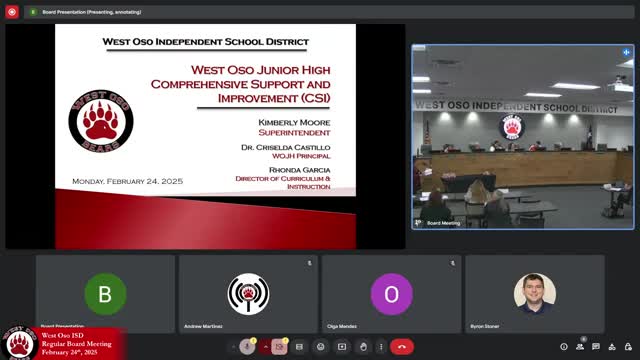
Summary
Board approved a TEA-required targeted improvement plan for West Oso Junior High after the campus was identified for comprehensive support and improvement; district and ESC coaches will support implementation.
The West Oso Independent School District board on Monday approved a targeted improvement plan (TIP) for West Oso Junior High after state accountability data placed the campus in the Texas Education Agency’s Comprehensive Support and Improvement (CSI) category.
The plan, presented to the board by district staff, lays out a small set of prioritized, research-based strategies the campus will implement with coaching from Education Service Center (ESC) Region 2 and support from district leadership. The board voted 7-0 to approve the TIP, with a motion by Trustee Liz Gutierrez and a second by Trustee Oscar Arredondo.
"Today, we will be presenting the comprehensive support and improvement plan for West Oso Junior High School," said Rhonda Garcia, the district’s designated coordinator for school improvement, in the board meeting. She described the identification process under TEA’s accountability system and said the campus earned a 42 on the Closing the Gaps scale score in 2024 against a 45 cutoff used by TEA.
The plan responds to that diagnostic. District staff described supports already underway: scheduled advisories and computer-based supports (IXL) for targeted students, after-school high-impact tutoring (ACE), a math lesson-study grant through ESC Region 2, weekly coaching for math teachers, and district training on the Texas color-band system that tracks individual student growth. Dr. Castillo, the junior high principal, told the board that the campus has participated in rapid, intensive training and that ESC Region 2 conducted an Effective Schools Framework diagnostic and a superintendent consultation with TEA in November.
Board members pressed for clarity on measures and implementation. Trustee Oscar Arredondo asked how STAR (STAAR) results feed into the three accountability domains; district staff explained that student achievement, school progress (growth), and closing-the-gaps measures are all derived from STAAR results and cohort/individual growth metrics. Trustees asked about teacher training, curriculum alignment, and supports for classroom management; staff said ESC coaching and on-site behavior supports would be provided.
The district emphasized a short, focused planning approach: TEA officials requested a concise plan with a few strategies implemented with fidelity rather than a long document of many initiatives. District leaders said the TIP will remain the working document for both the remainder of this year and the 2025–26 school year while ESC coaches and district leaders track fidelity and outcomes.
Ending: The board’s 7-0 approval moves the plan to formal submission to TEA. District staff said follow-up diagnostics, ESC coaching visits and implementation checks will continue and that the board will be updated on progress at future meetings.