Sumner staff begin 2025 hazard-mitigation plan update, flag battery storage as emerging risk
Summary
Sumner’s emergency management coordinator outlined a 2025 hazard-mitigation plan update required by FEMA, highlighted battery energy storage systems as a new local risk to assess, and described a community outreach and review timeline that will go to Pierce County, the state and FEMA before council consideration.
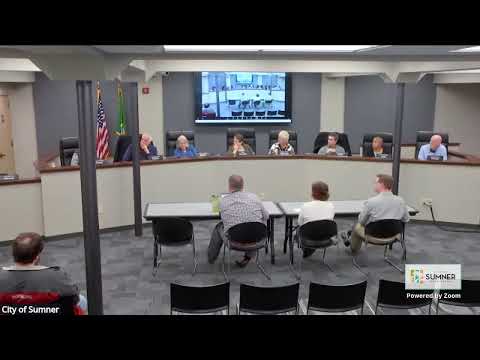
Sumner’s Emergency Management and Safety Coordinator Evan Brazitas told the City Council at a Feb. 24 study session that the city is preparing an update to its hazard-mitigation plan required every five years by federal emergency management rules.
The plan update will collect local data and an annex for Sumner and then be submitted with other jurisdictions’ addenda to Pierce County, which compiles a regional document for the state and FEMA. "Federal regulations from FEMA state that we need to do this every five years," Brazitas said, adding the process is necessary to maintain eligibility for post-disaster grant reimbursements.
Brazitas said staff are revising sections of the plan and will focus this cycle on newly relevant risks and community priorities. He identified battery energy storage systems (BESS) — both large commercial installations and smaller residential units — as a hazard the city expects to add to its risk assessment, and said Sumner will record that risk in the plan’s risk assessment and mitigation strategies sections.
"It is something that we identify as a risk because it's out there not just in that big capacity, but it's also out there in the small units of electric vehicles as well as people have those battery storage systems in their houses for the residential units," Brazitas said. He described how other jurisdictions and utilities are preparing their own sections: Puget Sound Energy and an industry partner are developing plans for large-scale systems, while East Pierce and Central Pierce fire agencies are creating related mitigation sections.
Brazitas described the drafting and review workflow: staff prepare local sections and submit them as an annex to Pierce County; the county forwards the regional plan to the Washington State Emergency Management Office; the state performs checks and sends a preapproved plan to FEMA; FEMA completes its review and returns the city a preapproved plan that the council would then vote to adopt. He gave an anticipated schedule: the city’s annex will be compiled and sent around March, the county will forward to state in second quarter, and FEMA review is expected by late second quarter or third quarter, barring delays.
He said the plan will incorporate FEMA guidance on social equity and climate adaptation and will use hazard layers such as USGS fault maps and FEMA flood maps to prioritize mitigation measures. The outreach program includes a QR-code survey open for about a month, presentations, work with community partners (including the YMCA and food bank) and in-person events to reach people who may not see online notices. "I'm opening this up now. It's gonna be open for a month so we can get community feedback from everyone," Brazitas said.
Council members asked how the plan would relate to tactical emergency response. Brazitas and other staff emphasized the distinction: the mitigation plan is a strategic, multi-year document focused on reducing long-term risk and ensuring eligibility for federal reimbursement; tactical incident response and unified command exercises remain the responsibility of operations partners such as fire, police and mutual aid partners. Deputy Mayor Debbie Mayer Bowman and others noted the role of EPIC partners and Pierce County Department of Emergency Management for surge resources when local capacity is overwhelmed.
Brazitas said the city is updating its Hazard Identification and Vulnerability Assessment and will expand sections 1, 2 and 5 initially, then revise section 4 (risk assessment) and return to other sections as needed. He also noted planned additions such as critical-facility seismic evaluation updates and possibly adding additional shelter or school sites to assessments.
No formal action or vote was taken. Next steps: staff will continue drafting the Sumner annex, conduct outreach through the community survey and partners, and return the plan documents through the county-state-FEMA review chain for FEMA preapproval before a council adoption vote.
AI generated
The text on this page is AI generated. Summaries, highlights, analysis, and video transcripts are all produced from the original source material.
AI can make mistakes, so if you spot one, and we will fix it for everyone.
Note: the source content is unaltered by us. Any content source we link to, be it a video, an audio recording, or a document, is presented exactly as its publisher released it. That publisher is usually a government body, sometimes an individual official or another organisation.