Citizen Portal

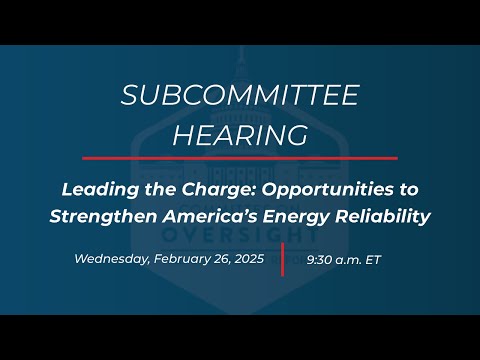
House subcommittee clashes over energy reliability, permitting and the future role of renewables

2398820 · February 19, 2025

Get AI-powered insights, summaries, and transcripts

Subscribe
AI-Generated Content: All content on this page was generated by AI to highlight key points from the meeting. For complete details and context, we recommend watching the full video. so we can fix them.

Summary

At a House Oversight and Reform subcommittee hearing, lawmakers and four witnesses disputed whether the U.S. should prioritize fossil fuels and nuclear to preserve grid reliability or accelerate renewables, storage and transmission — with permitting reform and federal subsidies a central point of contention.

At a hearing of the House Oversight and Reform Subcommittee on Economic Growth, Energy Policy and Regulatory Affairs, Chairman Burleson pressed witnesses on how the nation will meet sharply rising power demand, while Ranking Member Frost warned that climate-driven outages are already costing families and communities.

"Power demand is expected to grow dramatically," Chairman Burleson said in his opening statement, asking, "Where will this additional power come from?" He cited the Reliable Grid Act of 2024 and said the committee will examine regulatory and permitting barriers to new generation and transmission.

Four witnesses gave competing prescriptions. Alex Epstein, president and founder of the Center for Industrial Progress, told the subcommittee that the United States faces "an electricity crisis" driven, he said, by policies that restrict reliable generation and by policies that he characterized as artificially increasing demand. "We are artificially restricting the supply of reliable electricity, and we are artificially increasing the demand for reliable electricity," Epstein said, urging rescission of certain EPA rules, reform of permitting and elimination of subsidies he said favor intermittent generation.

Mandy Gunasekara, former chief of staff at the U.S. Environmental Protection Agency, also urged reducing permitting delays and what she called "unnecessary red tape." She told the panel that recent policy choices had raised household energy costs and left some families unable to pay utility bills. Gunasekara said policymakers should protect baseload sources that provide grid stability while pursuing domestic mining and manufacturing for energy technologies.

Alex Hergot, founder and president of the Permitting Institute, focused on permitting timelines and private investment. He described a backlog of project reviews, said many federal statutes governing reviews are decades old, and warned that lengthy uncertainty has left “hundreds of billions of dollars” of private investment on the sidelines. Hergot told members that process and litigation reform are needed to speed construction of transmission, generation and other infrastructure.

Dr. Rachel Cleetus, policy director for the Climate and Energy Program at the Union of Concerned Scientists, argued the opposite balance. She said the fastest path to consumer savings and a resilient grid is to modernize the system with more renewables coupled with storage and transmission. "Ramping up renewable energy, energy efficiency and storage, investing in a modernized, more resilient electric grid will help cut power bills," Cleetus said, noting recent growth in renewable capacity and federal investments under the Inflation Reduction Act and the Infrastructure Investment and Jobs Act.

Witnesses and members cited multiple pieces of evidence and policy instruments. Chairman Burleson and Epstein raised concerns about EPA actions and the social cost of carbon as regulatory drivers affecting generation; Cleetus and Frost cited North American Electric Reliability Corporation (NERC) assessments and statistics on recent renewable buildouts to support faster deployment of clean energy and transmission.

Members repeatedly flagged near-term reliability risks tied to extreme weather and to anticipated demand growth from data centers and artificial intelligence. Some members urged a pause on any federal action that could threaten reliability; others warned that doubling down on fossil fuels would raise long‑term costs and public health burdens and would risk U.S. competitiveness in clean technology manufacturing.

No formal legislation was voted on at the hearing. Chairman Burleson closed by asking members to submit written questions and materials for the record and said the subcommittee will continue oversight of permitting, EPA regulations, and grid reliability.

Ending: The hearing brought sharply contrasting views on how to balance immediate reliability needs, long‑term climate risks, and the pace of clean energy deployment. Lawmakers and witnesses agreed on the urgency of addressing permitting and transmission bottlenecks, but disagreed on whether policy should tilt toward protecting fossil fuel baseload and nuclear capacity or accelerating renewables, storage and transmission.