Lifetime Citizen Portal Access — AI Briefings, Alerts & Unlimited Follows
House Financial Services hearing spotlights economic, technology, energy and illicit‑finance tools to counter China
Loading...
Summary
Lawmakers on the House Financial Services Committee heard witnesses from industry and think tanks who argued that U.S. efforts to "counter China" must combine stronger domestic economic policy, targeted export and investment controls, trade and development financing and tougher anti‑money‑laundering enforcement.
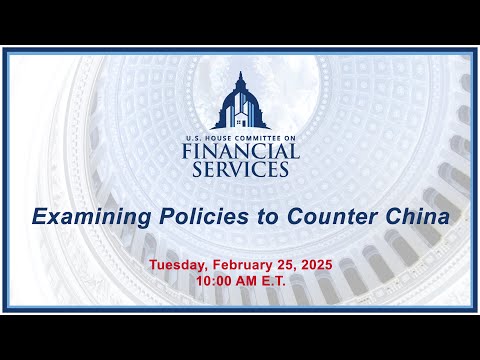
House Financial Services Committee Chairman Patrick T. McHenry (Chairman Hill in the hearing transcript) convened a hearing titled "Examining policies to counter China," calling for a whole‑of‑economy approach that pairs security measures with policies to keep the United States commercially competitive. Witnesses from industry and foreign‑policy think tanks recommended bolstering U.S. investment in foundational technologies, modernizing export and development finance, strengthening multilateral debt transparency, and stepping up anti‑money‑laundering enforcement tied to the fentanyl trade.
The hearing matters because, witnesses said, narrow actions such as sanctions or export controls will not succeed unless U.S. markets, tax and regulatory policy, and financing tools enable American companies to commercialize advanced technologies and compete abroad. "If we edge out China in artificial intelligence, but Washington prevents our companies from commercializing it, what happens?" Chairman Hill asked in his opening remarks.
Witness panelists stressed four overlapping priorities. John Miller, senior vice president for policy, trust, data and technology and general counsel at the Information Technology Industry Council (ITI), urged policies that sustain private‑sector innovation while narrowly targeting security risks. Miller said economists and policymakers should avoid measures that "impede domestic and overseas investment in and by U.S. companies," and recommended targeted investment‑review criteria, trade leadership to open markets, and incentives for R&D and semiconductor investment.
Nicholas "Nico" McMurray, managing director for international nuclear policy at ClearPath, framed energy finance as a core economic‑security tool. "China currently has 57 operating nuclear reactors and 28 reactors under construction," McMurray noted, and argued that export and development finance (EXIM Bank and the U.S. International Development Finance Corporation, DFC) should be modernized and reauthorized to help U.S. firms compete on large infrastructure projects and to derisk private capital for nuclear, LNG and other energy technologies.
Retired Treasury special agent John Cassara (transcript: Casara) and other witnesses tied illicit finance to public‑health harms and geopolitical weakness. Cassara told the committee that Chinese‑enabled money‑laundering networks are integral to the fentanyl trade and to other forms of transnational crime, and cited U.S. seizures: "In calendar year 2023 alone, the DEA seized more than 77,000,000 fentanyl pills and nearly 12,000 pounds of fentanyl powder," he said, urging stronger follow‑the‑money enforcement, beneficial‑ownership transparency, and better use of suspicious‑activity reporting.
Martin Muhlleisen, formerly of the International Monetary Fund and now with the Atlantic Council, urged a firmer multilateral response to China‑backed lending in low‑income countries. Muhlleisen recommended that the U.S. press the IMF and other multilaterals to use existing debt‑restructuring tools more robustly and to insist on greater disclosure from Chinese lenders so debtor countries and private creditors can negotiate sustainable workouts.
Dr. Rush Doshi, a senior fellow who directs the China Strategy Initiative at the Council on Foreign Relations, emphasized the scale of Beijing's industrial strategy and its implications for technology and defense competition. "The PRC has a grand strategy to displace U.S.‑led order," Doshi said, and outlined Beijing's three‑part approach of acquiring technology, protecting domestic champions, and deploying industrial policy and subsidies to underwrite sustained market expansion.
Members of the committee pressed witnesses across several crosscutting themes: export controls and the enforceability of controls on compute hardware and semiconductors; outbound investment screening and a "red light / green light" approach to distinguish beneficial allied investment from capital that strengthens Chinese military or dual‑use capabilities; reauthorization and reform of EXIM and DFC to support U.S. exporters in energy and infrastructure; stronger Bank Secrecy Act implementation and beneficial‑ownership disclosure to counter money‑laundering related to fentanyl; and whether multilateral institutions should require greater transparency from China.
Where the committee heard disagreement: witnesses generally agreed U.S. policy should be targeted and multilateral where possible, but they differed on emphasis. Industry witnesses warned that overly broad restrictions would undermine U.S. competitiveness. National‑security and law‑enforcement witnesses urged tougher enforcement on illicit finance and careful outbound investment screening. Energy witnesses pressed for expanded EXIM/DFC tools to match subsidized Chinese financing abroad.
The hearing produced policy ideas but no formal committee actions. Members said they would pursue statutory fixes — for example, clearer outbound‑investment rules through legislation rather than executive action — and some members signaled intent to press for EXIM/DFC reauthorization and stronger anti‑money‑laundering resources. The committee allowed five legislative days for members to submit additional materials to the record, and witnesses were asked to respond to follow‑up questions by March 31, 2025.
Ending: The wide range of testimony made clear that lawmakers see "countering China" as an economic, diplomatic and enforcement challenge, not solely a military one. Committee members said any successful strategy must combine targeted controls and sanctions with domestic investments that preserve U.S. innovation, manufacturing and financing capacity.