Get Full Government Meeting Transcripts, Videos, & Alerts Forever!
Get email alerts on the Debanking Crypto Regulatory Oversight topic
No spam. Unsubscribe anytime.
House subcommittee hearing exposes dispute over whether regulators pressured banks to cut crypto firms off
Summary
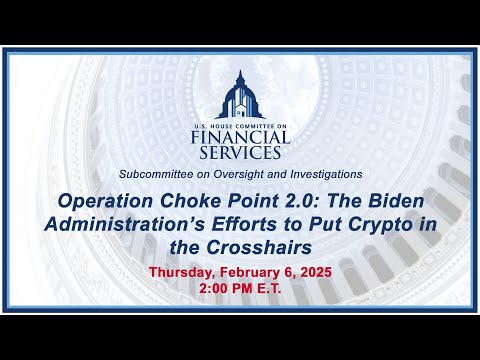
The House Financial Services Subcommittee on Oversight and Investigations held a contentious hearing in which witnesses and lawmakers disputed whether federal bank supervisors pressured banks to refuse services to cryptocurrency companies as part of an alleged campaign called "Operation Chokepoint 2."
The House Financial Services Subcommittee on Oversight and Investigations heard sharply divided testimony about an alleged regulatory campaign — referred to by some witnesses and members as “Operation Chokepoint 2” — that they say pressured banks to stop providing basic services to cryptocurrency companies.
The dispute played out across opening statements and witness testimony from Austin Campbell, Paul Grewal, Fred Teal and Shana Oleshuk, who described conflicting views of whether federal prudential regulators used supervisory letters, examinations and reputational pressure to push banks away from the digital-asset industry or whether regulators were responding appropriately to real financial and consumer risks.
Why this matters: Access to deposit accounts, payment services and credit are essential for ordinary business operations. Witnesses who said banks were pressured argued that denial of those services effectively prevented some digital-asset firms from operating in the United States. Other witnesses and Democratic members said the regulators’ stronger posture followed a period of high-profile crypto firm failures and large losses to consumers, and that stronger guardrails — not unfettered access — are needed.
Austin Campbell, introduced as acting CEO of WSPN USA and an adjunct professor at NYU Stern, told the subcommittee that regulatory supervision can be opaque and therefore vulnerable to abuse. "This is a vehicle for abuse," Campbell said, arguing that subjective supervisory components such as management and reputational risk can be used to exclude entire industries in private and that banking guidance should be written and public.
Paul Grewal, chief legal officer at Coinbase Global Inc., described litigation and Freedom of Information Act requests his company used to obtain supervisory documents. Grewal said a federal court ordered the FDIC to produce redacted letters and that, "just yesterday ... the FDIC finally released a more complete set of 175 documents totaling over 700 pages" that, he said, show regulators repeatedly pressed banks with examinations and questions that led banks to discontinue services for crypto customers.
Fred Teal, chief executive officer of Mara, a publicly traded bitcoin miner, told the panel that financial exclusions were harming U.S. investment and jobs. He said Mara invested nearly $2,000,000,000 in the U.S. in 2024 and that forced exits or offshore moves reduce domestic employment and tax bases. "The financial debanking of digital asset ecosystems represents an existential threat to American leadership and technology, economic competitiveness, and national security," Teal said.
Shana Oleshuk, director of banking policy at BetterMarkets, offered a contrary perspective: regulators must protect consumers and the financial system from risky or illegal conduct. Oleshuk cited wide losses and fraud in crypto markets and warned that some crypto firms "have put themselves in the crosshairs by choosing to engage in or enable these activities." She said failures involving crypto exposure contributed to a dangerous strain on banks and that regulators have duties to promote safety and soundness.
Committee members pressed witnesses on specific episodes and evidence. Republican members repeatedly referenced FDIC "pause" or "non‑objection" letters and the CAMELS supervisory framework; witnesses and members said those tools were used to convey an informal ‘‘no’’ even where no legal prohibition existed. Democratic members and some witnesses emphasized the role of major crypto collapses and the failure of banks such as Silvergate and Signature Bank in 2023, saying heightened regulatory scrutiny followed real losses and systemic concerns.
The hearing did not produce a formal committee vote or new rule. Witnesses and some members recommended several responses that Congress or regulators could pursue: require written and public supervisory guidance, limit use of subjective supervisory categories such as management and reputational risk, increase disclosure for banks about reasons for account denials, implement inspector general recommendations and pass statutory guardrails to give the industry clearer rules.
What was in the record: witnesses cited a January 2023 joint statement by federal banking regulators, an FDIC inspector general report, and the court-ordered production of FDIC supervisory documents (described in testimony as 175 documents totaling over 700 pages). Witnesses also referenced the Bank Secrecy Act framework, FinCEN registration, and agency interactions with the Securities and Exchange Commission and the Commodity Futures Trading Commission.
The hearing underscored competing priorities: several witnesses and Republican members said regulators had used confidential supervisory processes to "debank" lawful firms, while Democratic members and other witnesses said regulators were responding to fraud, money‑laundering risk and the financial fallout from major crypto failures. Committee leaders and witnesses urged continued oversight and legislative action to clarify the rules for digital-asset businesses and banking regulators.
There were no formal actions taken by the subcommittee at the hearing; the chair said members would have five legislative days to submit additional written questions and requested witness responses by March 31, 2025.