Senate subcommittee advances bill to speed utility storm securitization after Hurricane Helene
Loading...
Summary
A Senate subcommittee voted to send legislation that would let utilities use estimated costs and a streamlined schedule to securitize storm-related debt — including costs from Hurricane Helene — to the full committee, while members pressed for guardrails to protect ratepayers.
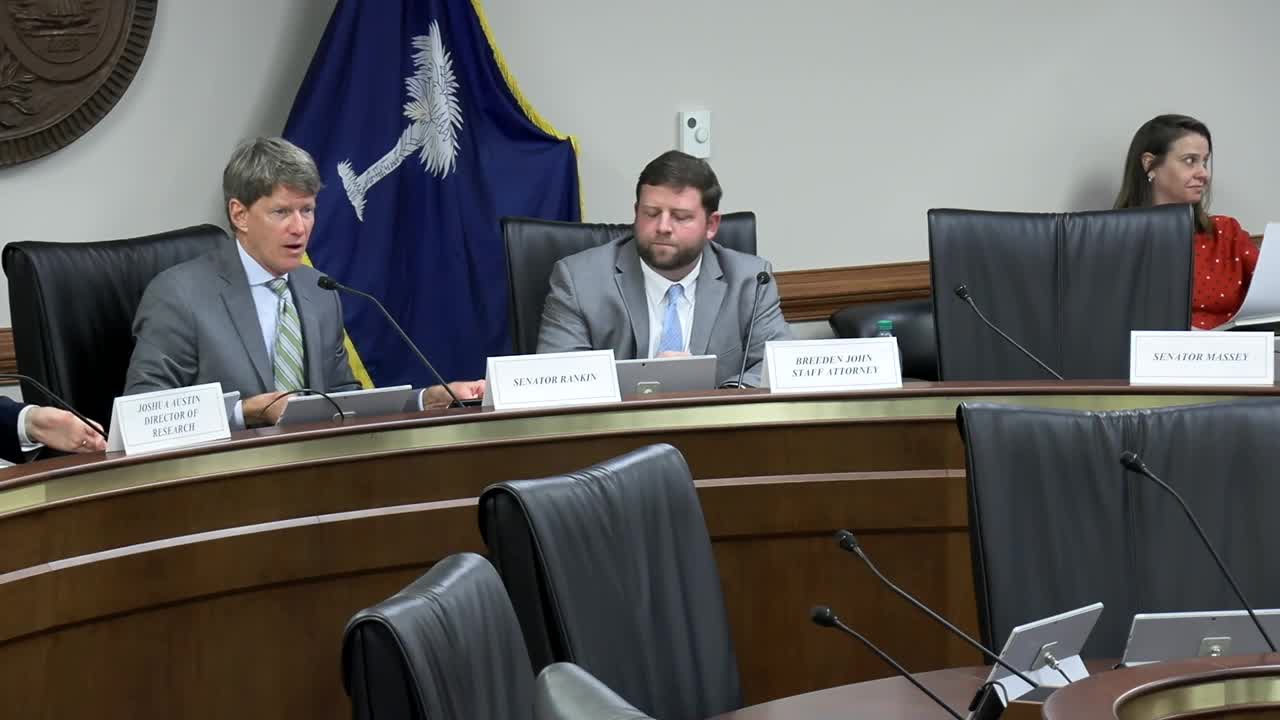
A Senate Judiciary subcommittee voted to move S.157 (also referred to in the hearing materials as S.1507) to the full committee after hearing testimony about changes that would speed the securitization of storm-recovery costs for utilities and tighten consumer protections.
The measure would allow utilities to begin a financing order based on estimated storm costs and shorten the timeline that currently delays issuance, supporters said. President Alexander told the panel that the 2022 securitization law previously “saved the consumers by the use of this some over $30,000,000 maybe $35,000,000 that was saved.”
The bill’s proponents said the changes are intended to address unusually large, recent storm costs tied to Hurricane Helene and to reduce the time utilities carry debt on their books. A proponent identified in the hearing as Tiger said the proposal “will really streamline the securitization process” and estimated the measure could shorten issuance time from about 15 months under current law to about nine months by allowing an initial financing order based on estimates.
Andrew Bateman, interim director of the Office of Regulatory Staff (ORS), said the process still requires multiple checks before bonds can be sold. “The company initially files this petition and makes that assertion. ORS then conducts its review, then the PSC, not later than a hundred and thirty-five days later, issues a financing order,” Bateman said, adding that an independent third-party certification is still required before issuance advice is granted.
Several senators pressed about consumer protections if estimated costs prove too high. Senator Massey asked whether customers would be refunded for any over-collection; Bateman confirmed that a subsequent proceeding would reconcile actual costs and that any over-collection would be returned, subject to the commission’s determinations. Bateman summarized a protection built into the process: if an over-collection is found, the utility would repay the excess and interest as determined by the Public Service Commission in the later proceeding.
Questions focused on three contested items: (1) defining and selecting the qualified independent third party (QITP) that certifies quantifiable net benefits, (2) whether the bill should fix the cost-of-capital calculation to the utility’s actual short-term interest rate or leave language that could permit later recalculation, and (3) explicit time limits or mechanisms for an expedited true-up if estimates prove inaccurate.
ORS and witnesses explained the QITP role would be statutorily defined in this bill and that the commission, not the utility, would designate and retain the QITP. Bateman told the subcommittee that having a statutorily defined QITP is “one additional layer of protection” because the independent reviewer will separately affirm whether “there are quantifiable net benefits.” Swain Whitfield, a former Public Service Commissioner who testified as an independent regulatory consultant, described securitization as a “boutique” market but said prior securitization under Act 228 produced tangible consumer savings and allowed utilities to be made whole.
On the cost-of-capital question, proponents said the Helene-related short-term debt carried an interest rate of about 6 percent and that the bill ties the securitization issuance to that rate so the ratepayer would not pay more than that “ceiling.” Senators warned that deleting language such as “determined by” from the bill could limit later Commission review; Bateman and others acknowledged the phrasing could affect how parties argue the appropriate rate in a later true-up.
After discussion, Senator Massey said he would seek staff help drafting an amendment tightening true-up timing and interest on any over-collections, but he supported reporting the bill out to the full committee. The subcommittee approved a motion to send the bill to the full committee by voice vote; no opposition was recorded.
The subcommittee did not adopt final amendments on the floor; members left open the possibility of additional cleanup language at full committee or on the Senate floor.