Get Full Government Meeting Transcripts, Videos, & Alerts Forever!
Get email alerts on the Criminal Justice Drugs topic
No spam. Unsubscribe anytime.
Subcommittee advances fentanyl- and drug-induced homicide bills after victims, law enforcement testify
Summary
The South Carolina Senate Judiciary subcommittee gave favorable reports to two bills that would create or expand drug-induced homicide offenses after victims' family members, solicitors and law enforcement described rising synthetic-drug deaths and investigatory gaps.
The South Carolina Senate Judiciary Subcommittee on (date not specified) voted to give favorable reports to two measures aimed at making it a felony to provide drugs that cause a user's death, after family members, solicitors and law enforcement urged lawmakers to move quickly.
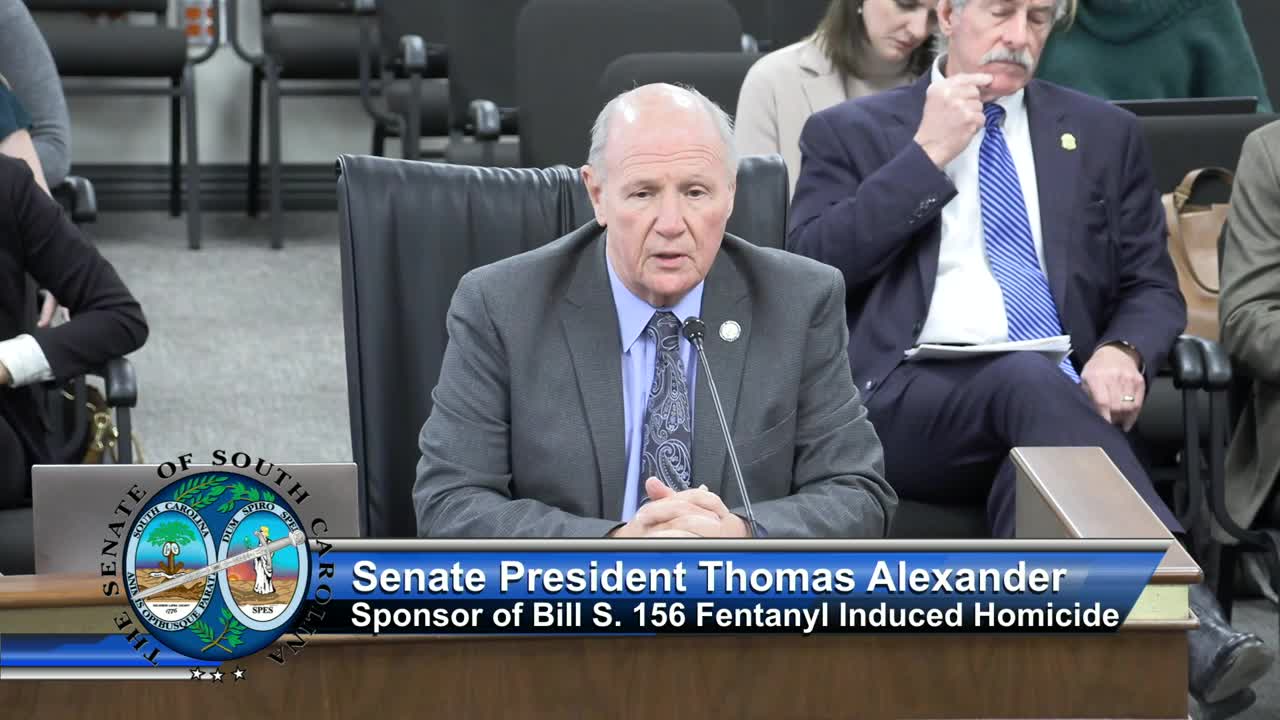
Senator Alexander, who brought the bills before the panel, told members he was “so proud of the Senate for its commitment” and said he looked forward to getting the legislation to the governor's desk this year.
The proposals considered were Senate Bill 156, described to the committee as a fentanyl‑induced homicide offense, and Senate Bill 183, described as a broader drug‑induced homicide measure covering multiple synthetic substances. Both bills would create felony penalties when a person knowingly delivers a controlled substance in exchange for value and that delivery is the proximate cause of the recipient's death; the drug‑induced draft also includes language intended to capture analogs and newly appearing synthetics.
Why this matters: family members of overdose victims said current criminal law leaves a gap that often prevents prosecutors from holding suppliers to account when defense attorneys argue the supplier lacked intent. Victims' advocates called for a statute that removes that loophole and gives solicitors tools to pursue people who supply lethal substances.
Testimony and evidence
Julie Stutts, who said she lost her 24‑year‑old son on 06/16/2024, told the committee she and local law enforcement were confident who provided the fentanyl but were told prosecutors could not prove intent. “Our hands are tied,” she said. “There is nothing we can do. It is very frustrating.”
Kat Orr of Charleston described losing her 23‑year‑old daughter to an illicit pill she said was sold as oxycodone. Orr told the committee, “A drug induced homicide is no different than a murder, because drug induced homicide is murder,” and urged lawmakers to keep the bill “tight” so that suppliers are held accountable.
Solicitors and law enforcement urged passage of the broader and the fentanyl‑specific bills. Solicitor Barnett of the Seventh Circuit said he supported Senate Bill 183 because it would avoid a recurring defense that a distributor “didn't know” fentanyl was present: “If you're selling drugs, period, you know it's a drug,” he said, arguing the broader language would help capture changing synthetic threats. Chief Keel (title not specified) cited Drug Enforcement Administration figures provided to the committee, saying DEA seized 80,000,000 fentanyl‑laced pills and 12,000 pounds of fentanyl in 2023.
Committee members discussed thresholds and defenses. One senator said she planned to offer an amendment to make the fentanyl measure's delivery language mirror the drug‑induced bill’s “in exchange for anything of value” phrasing, to ensure the statutes target commercial sellers rather than people who might share drugs in noncommercial settings. Solicitors and advocates said the bills as drafted already interact with the state's Good Samaritan law and that investigators typically can differentiate cases where distribution and value exchange are present from roommate or co‑user incidents.
Votes and outcome
The subcommittee moved both measures forward by voice votes with no recorded opposition; members made and seconded motions and the chair called the favorable reports to the full committee.
Discussion vs. decision
The record shows extensive public comment and law‑enforcement testimony supporting passage and several senators signaled readiness to refine bill language in full committee. The committee's action was a procedural favorable report; no changes to statute text were made by the subcommittee on the record.
What the bills would do and next steps
According to staff summary presented to the subcommittee, the fentanyl bill would make knowingly delivering a controlled substance in exchange for value that proximately causes death a felony and would foreclose defenses that the decedent consented or contributed to the death (except on narrow suicide evidence). The penalty described in the summary would include up to 30 years' imprisonment and classification as an exempted felony. The broader bill would extend coverage to other synthetics and analogs and was described by prosecutors and law‑enforcement witnesses as important because new compounds are appearing that can be as or more deadly than fentanyl.
The bills were reported favorably to full committee and will return for additional consideration, including the potential technical amendment to align the exchange‑for‑value language.