Get Full Government Meeting Transcripts, Videos, & Alerts Forever!
Get email alerts on the Water Rights Data topic
No spam. Unsubscribe anytime.
State board details $60 million Cal Waters modernization and linked SB 88 measurement rule updates
Summary
The State Water Resources Control Board heard an update on the Upward/Cal Waters water-rights data modernization project — a $60 million effort to digitize records, add a public-facing GIS and user portal, and support updated SB 88 measurement and reporting rules — and previewed timelines for public testing, enrollment and rule alignment.
The State Water Resources Control Board on Feb. 19 received a progress update on the Upward/Cal Waters project, a multi-year, $60 million effort to replace legacy water-rights information systems, digitize paper records and build a public-facing portal and geospatial tools to improve reporting and access to water-rights data.
Board members and division staff said the new platform is designed to make water-rights records searchable online, improve the quality and usability of measurement data and align reporting with upcoming revisions to the state’s water measurement regulations (SB 88).
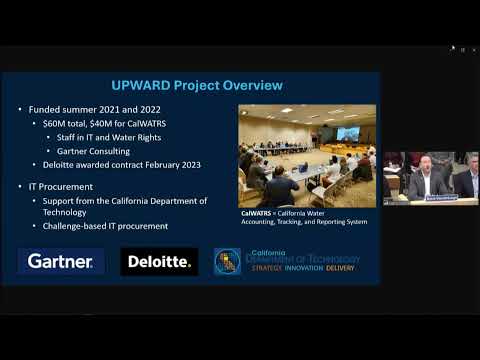
The project team told the board the investment is split with roughly $40 million earmarked for IT systems and the remainder for staff and implementation support, and that Deloitte was contracted in February 2023 to build the system with advisory input from Gartner and oversight from the California Department of Technology.
“This is a really important moment for us as we embark in this organizational change management and really begin to socialize our project to the public, to the board,” said Brent Vandenberg, supervising geologist and project director for Upward California. He described a user portal that will let water-right holders see and manage their records in one login and new GIS tools to plot points of diversion and upload spatial files.
Jeff Parks, product owner for Cal Waters, told the board the current system “has no front end user interface,” and said users will be able to log in and see everything tied to their organization in a single profile — a capability long missing from the legacy database.
Division staff said digitization is already under way: the digitization team has scanned more than a half-million records so far and will tag documents with metadata to make them retrievable. They cautioned the archive is large — more than 7 million documents in total — and full population of the portal will be incremental.
The board heard details about how the new platform will interact with a concurrent regulatory update: staff from the Division of Water Rights explained proposed revisions to the water measurement and reporting regulations, commonly referred to as SB 88 updates. Pablo Ortiz, an environmental scientist on the team, summarized the measurement threshold in current rules: “If a diverter diverts over 10 acre feet of water per year, they must install a measurement device or implement a method to measure their diversions and submit their measurement data to the board with their annual water use reports each year.” Staff said the SB 88 update aims to standardize uploads and make data machine-readable for modeling and administration.
Sierra Kennison, an engineer on the regulation team, described the rule rewrite as primarily structural: “We basically struck out the whole thing and rewrote it,” she said, noting that the revised regulation will (1) remove an outdated distinction between measurement methods and devices, (2) align groundwater reporting to the water year, (3) require standardized templates for data uploads, and (4) clarify who must meet telemetry or large-diversion reporting requirements.
Staff briefed the board on outreach and testing plans: an Upward Advisory Group (UAG) of water-rights interests has met three times, and staff expect hands-on UAG testing of the system in May followed by a planned go‑live for enrollment in July. Because the state’s water year ends in October, staff said formal reporting using Cal Waters would begin after that annual cycle. The team also described organizational-change work with large, complex reporters to prepare enrollment and mapping of organizational branches and offices.
Staff emphasized that Cal Waters will not instantly clean up 110 years of inconsistent records. The division described efforts to establish data governance and metadata standards so future entries are consistent, and said some legacy cleanup will require outreach to rights holders to confirm identities and records.
Why it matters: water-rights administration and near-real-time measurement data are central to managing water availability, adjudicating competing claims and protecting senior water rights and environmental flows. Board members repeatedly framed the project as foundational to better decision-making during droughts and floods.
Next steps and timeline: staff expect UAG hands-on testing in May, an enrollment go‑live in July and ongoing digitization and tagging through 2026 and beyond. The division said it will continue outreach to medium and smaller right-holders to assist enrollment and expects to finalize the SB 88 regulatory package through the normal rulemaking process so that reporting templates align with the Cal Waters platform.
Board discussion included questions about public access, data warehouse capabilities for researchers and the project’s role as a template for other state enterprise IT projects. Staff said the public-facing GIS and document viewer will be available without login, that a data warehouse will enable more granular access for advanced users, and that the project’s Salesforce-based build could create licensing and integration efficiencies for future systems.
The board did not take a formal action on the Upward project at this meeting; staff will return with demonstrations, public testing opportunities and rulemaking steps tied to SB 88 in coming months.