Get Full Government Meeting Transcripts, Videos, & Alerts Forever!
Get email alerts on the Groundwater Management topic
No spam. Unsubscribe anytime.
State board pauses decision on Kern subbasin; continues hearing after staff warns of remaining plan deficiencies
Summary
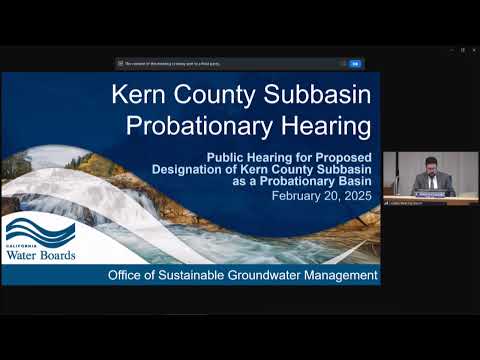
The State Water Resources Control Board on Feb. 20 voted to continue its hearing on whether to declare the Kern County groundwater subbasin probationary under the Sustainable Groundwater Management Act after staff reported unresolved technical deficiencies in locally adopted sustainability plans.
The State Water Resources Control Board on Feb. 20 voted to continue its hearing on whether to place the Kern County groundwater subbasin under a probationary designation under the Sustainable Groundwater Management Act (SGMA), after staff urged the board that the subbasin still has “‘key deficiencies’” in groundwater-sustainability plans that could justify state intervention.
The board’s action adopts an alternative draft resolution continuing the hearing to a date certain and directing staff to keep working with local groundwater sustainability agencies to resolve outstanding issues. The board’s move came after a full day of staff presentations, technical testimony from the Department of Water Resources and local agencies, and several hours of public comment from tribal leaders, city officials and community members who offered sharply differing views on whether more local time would fix the problems or whether immediate state action is needed.
Staff director Natalie Stork summarized the technical case for state attention: the subbasin’s adopted 2024 sustainability plans still contain unresolved deficiencies in five areas the State identified — coordination among local agencies, groundwater-level thresholds and monitoring, land subsidence, groundwater quality, and consideration of interconnected surface water. The staff report cited long-term trends: an estimated sustainable yield of about 1.3 million acre-feet per year versus average pumping of roughly 1.5 million acre-feet and an average annual overdraft of roughly 274,000 acre-feet. The report said that subsidence has been measured and that some monitoring networks are incomplete, limiting confidence in mitigation plans.
Local groundwater agencies — represented at the hearing by a multi-agency panel that included Semitropic Water Storage District and other Groundwater Sustainability Agencies (GSAs) — argued the 2024 plans represent an unprecedented, coordinated approach across the enormous Kern subbasin. Those agencies told the board they had consolidated multiple plans, expanded monitoring and adopted new minimum thresholds and mitigation programs, and asked for more time to finalize missing details and to demonstrate implementation. Semitropic and other GSAs said their modeling shows the subbasin can reach sustainability under the plan and asked the board to continue the hearing to an agreed date so agencies can complete data gaps and finalize project schedules.
Tribal and community speakers took opposing positions. Octavio Escobedo Tercero, president of the [unnamed] tribal council, asked the board not to designate the subbasin as probationary, saying tribal agreements with local districts are providing access to water needed for development and community projects. In contrast, multiple residents from Shafter, Buttonwillow and surrounding communities urged immediate state action. Saúl Ruiz, reading a statement for a community group, said: “Es la agua que usamos para cocinar, para beber y para bañarnos, no para hacernos ricos.” Resident testimony stressed concerns about well failures, cancer and other health problems they link to water quality, and fear that delay would worsen impacts on domestic wells and disadvantaged communities.
Staff and DWR speakers provided technical details the board cited in its discussion: DWR estimated the subbasin’s sustainable yield at about 1.3 million acre-feet per year and described historical overdraft and subsidence patterns, including localized subsidence as large as 2.5 feet within the subbasin (and higher measurements in adjacent areas). The staff recommended two formal options for the board: (1) designate the subbasin as probationary and impose reporting and fee requirements (with potential exclusions considered), or (2) continue the hearing to a later date (staff proposed Sept. 17, 2025) and require GSAs to submit revised materials and milestones by specified interim dates.
After discussion, a board member moved to adopt the alternative draft resolution continuing the hearing and the motion passed. The resolution continues the public record and requires continued technical coordination between state staff and local GSAs. Staff will review revised GSP submissions and any exclusion requests, and the board retained authority to revisit a probationary designation if deficiencies are not resolved.
What happens next: the continuation gives local agencies a timetable to submit revised plans and additional monitoring and mitigation details for staff review. The board’s decision preserves the staff’s findings in the public record and preserves the board’s option to impose reporting, metering and fee requirements or to designate the subbasin as probationary later if the problems remain unresolved.
Votes at a glance
- Motion: Adopt alternative draft resolution continuing hearing on the Kern County subbasin and related staff direction. Mover/second: not specified in the public record. Outcome: approved (voice vote).