Get Full Government Meeting Transcripts, Videos, & Alerts Forever!
Get email alerts on the Groundwater Sustainability topic
No spam. Unsubscribe anytime.
State Water Resources Control Board hearing on groundwater plans continued after staff flags deficiencies
Summary
The State Water Resources Control Board on May 28 heard presentations and public comment on multiple Groundwater Sustainability Plans and related technical reports, and staff said some basin plans were incomplete or contained deficiencies; the board continued the hearing to a later date in September for further review.
The State Water Resources Control Board on May 28 heard presentations and public comment on multiple Groundwater Sustainability Plans (GSPs) and related technical reports, and staff said some basin plans were incomplete or contained deficiencies; the board continued the hearing to a later date in September for further review.
Board staff and GSA (Groundwater Sustainability Agency) presenters told the board that draft plans show ongoing groundwater-level declines in parts of the basin, evidence of land subsidence and water‑quality concerns — including elevated arsenic, nitrate and uranium in localized areas — and recommended additional monitoring and mitigation steps. Staff said some plans did not adequately demonstrate sustainable groundwater management and noted required annual reporting to the Department of Water Resources (DWR) and a 60‑day public‑comment window for the staff report (the transcript references a final staff report entry dated 05/02/2024).
The continued hearing and staff findings matter because the board can use its authority to require corrective actions and oversight when local plans do not meet required technical or reporting standards, which affects drinking‑water reliability and long‑term water supplies for communities and agriculture in the basin. Presenters underscored tradeoffs among recharge, pumping, infrastructure investments and funding shortfalls.
Presentations described monitoring gaps the GSAs are working to fill, and staff urged additional, representative water‑quality monitoring networks and data‑gap analyses. Presenters and several public commenters called for coordination across GSAs and with state agencies to address groundwater decline, recharge, and the risk that subsidence and water‑quality degradation will impair infrastructure and drinking‑water systems.
Public commenters — including small‑district managers, irrigation‑district representatives and community members — emphasized local impacts. A speaker identifying herself as Miss Luis, representing local community interests, said the community supported plan development but pressed the board and local agencies for “solutions, we need actions, and inclusions to protect our water so that we can make beneficial use and our human rights.” Other commenters representing irrigation districts and small community water systems described financial constraints for implementing monitoring and mitigation measures and urged state funding and technical support.
Board staff described next steps including additional technical review and coordination. In the hearing transcript staff noted that some GSPs had been submitted to the board on May 28 and that one plan had adopted a final plan on or about Dec. 16, 2024 (as stated in the record). Staff repeatedly recommended that GSAs expand water‑quality monitoring (surface‑water interconnection and groundwater wells), refine subsidence triggers, and develop cost‑sharing or project agreements for subsidence remediation or recharge projects.
The board formally recorded that it would continue the hearing to a later date in September for further consideration of the identified deficiencies and to allow additional staff and public review. The transcript references “September” and specifically mentions “September 17” in the hearing record; the board did not announce a fully specified calendar date in the parts of the transcript used for this article.
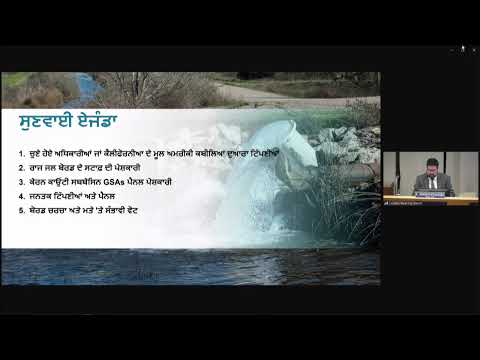
The hearing included technical panels and community panels, with simultaneous interpretation noted for Spanish and Punjabi speakers and a 60‑day public‑comment window for the staff report. Board staff also described coordination with the Department of Water Resources (DWR) and GSA technical meetings to resolve outstanding data gaps and modeling issues. No final enforcement order or adoption vote resolving the listed deficiencies appears in the portion of the transcript reviewed; the board’s next steps were recorded as further review and continued hearing.
A fuller list of staff recommendations and the GSA responses will be available in the board’s staff report and subsequent meeting materials; the board indicated it would reconvene the hearing in September to consider the remaining technical issues and public comment.