Get Full Government Meeting Transcripts, Videos, & Alerts Forever!
Get email alerts on the Professional Licensing Accountancy topic
No spam. Unsubscribe anytime.
Subcommittee backs changes to CPA licensure pathway, exam deadline and firm-ownership language
Summary
The LCI professions and occupations subcommittee approved amendments and reported S.176 favorably, advancing changes to the CPA licensure pathway (bachelor's route), reciprocity/mobility, a 36-month exam window, and narrow trust-ownership language with a June 30 effective date.
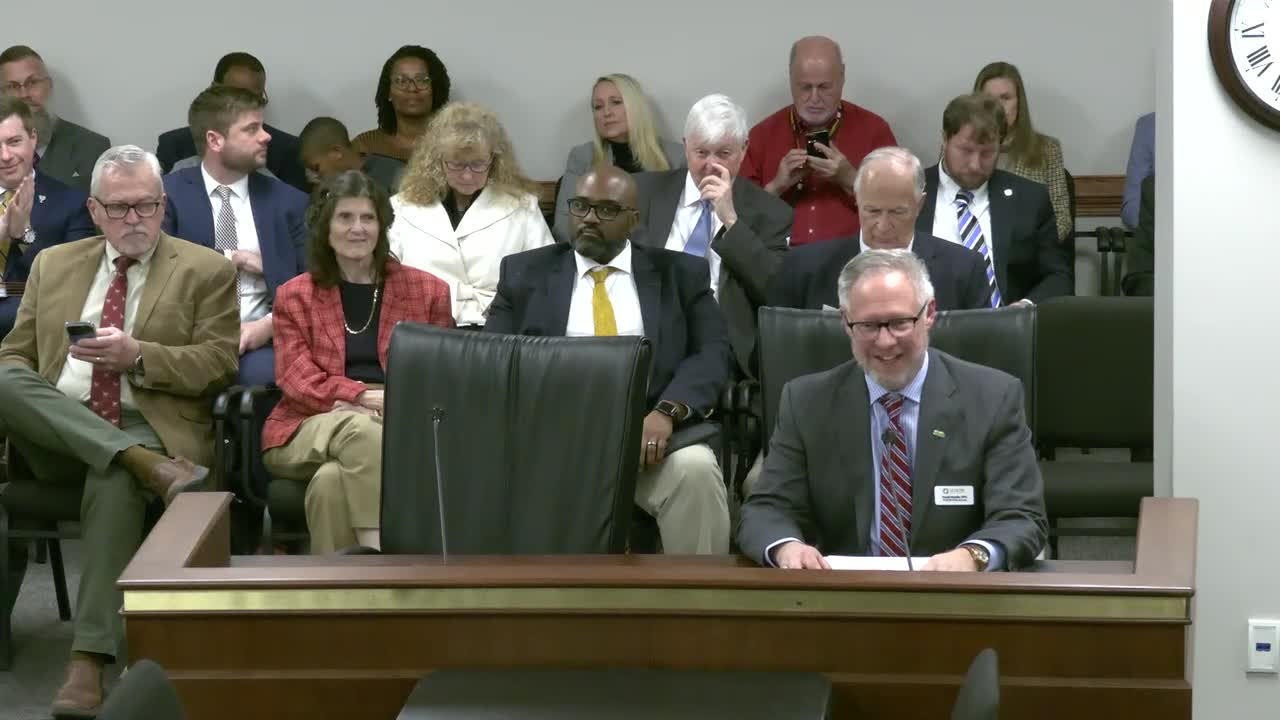
The Labor, Commerce and Industry Professions and Occupations Subcommittee voted to approve S.176, a multi-part bill from the South Carolina Association of CPAs that changes CPA licensure pathways, exam time limits and firm-ownership language, and reported the bill favorably to the full committee.
David Noble, past chair of the South Carolina Association of CPAs, described three central components: (1) create a pathway to licensure based on a bachelor’s degree plus passing the CPA exam and two years of experience (where the current pathway requires a master’s degree and one year of experience); (2) align reciprocity with mobility so CPAs licensed in other states under a bachelor's pathway can obtain South Carolina licensure; and (3) extend the time candidates have to complete all parts of the CPA exam from 18 months to 36 months.
"This bill adds a pathway to licensure. That pathway is a bachelor's degree, the passing of the CPA exam, and two years of experience compared to the current pathway of a master's degree, passing the exam and one year experience," Mr. Noble said. He said the coursework requirement in accounting and business (24 hours each) does not change between pathways and that the change is intended to reduce costs for prospective CPAs.
The South Carolina Board of Accountancy, represented by Ken Whitener, board chair, and Miss Wetzel from the Department of Labor, Licensing and Regulation, expressed general support but raised operational questions. Mr. Whitener asked for clarification about language allowing ownership to be "held in a revocable grantor trust," noting the practice act defines "owner" as a person and asking how the board should regulate an entity owner if a trust became irrevocable.
Mr. Noble responded that the bill’s intent was narrow: to permit a revocable grantor trust treated as a disregarded entity during the CPA’s lifetime for estate-planning only, and not to create entity ownership that would change regulatory responsibilities. To address the board's concern the subcommittee voted to add explicit language allowing only revocable (not irrevocable) trusts to hold ownership in the manner described; that amendment passed by voice vote.
The board also requested a 90-day window to update forms and online systems if the bill becomes law. Committee members and stakeholders discussed implementation timing because a COVID-era accommodation currently extends some candidates’ exam window to 36 months but is set to expire on June 30. Mr. Noble and LLR urged a prompt effective date to avoid a lapse that could require some candidates to retake exam parts. The subcommittee amended the bill to set the effective date at June 30 to avoid that interruption; the amendment passed by voice vote.
Committee members asked technical questions about coursework parity, continuing professional education (CPE) requirements, and whether expanding the exam window could produce less-competent licensees. Mr. Noble and Mr. Whitener replied that the exam content and experience requirement remain unchanged and that continuing education and on-the-job experience serve as safeguards.
After adopting the technical and timing amendments the subcommittee voted to report S.176 favorably to the full committee. The transcript records no opposition on the record.