Get Full Government Meeting Transcripts, Videos, & Alerts Forever!
Get email alerts on the Land Use Rv Storage topic
No spam. Unsubscribe anytime.
Panama City approves ordinance loosening rules for RVs and boats on residential lots, adds visibility and setback limits
Summary
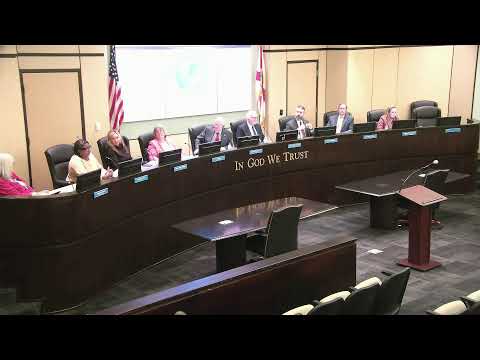
The Panama City Commission on Feb. 25 adopted Ordinance 32-60, a change to the Unified Land Development Code that allows limited recreational vehicle (RV) and boat storage on residential property while adding design and sightline safeguards.
PANAMA CITY, Fla. — The Panama City Commission on Feb. 25 adopted Ordinance 32-60, a change to the Unified Land Development Code that allows limited recreational vehicle (RV) and boat storage on residential property while adding design and sightline safeguards.
The change came after a second and final public hearing and roughly an hour of public comments and commissioner questions about safety, visibility and neighborhood character. The ordinance passed by a 4-0 roll call vote; Commissioner Street was absent.
City staff told the commission the revision was intended to provide flexibility for residents who already keep RVs and boats at home while preserving pedestrian and driver sight lines. Joanne Haley, planning and zoning division manager in the development services department, summarized the ordinance’s limits: the vehicle may be stored in the front yard if it meets the code’s “required visibility triangle,” is perpendicular to the street (not parallel), is not located in the right-of-way and maintains at least a three-foot setback from rear or side property lines. Haley said the visibility triangle used in the city code applies perpendicular to the front lot line and within 15 feet of a side lot line or required side yard, but “not on both,” noting the rule prevents vehicles from being parked in the middle of a yard.
Several nearby residents urged greater clarity and stricter limits. “Tonight, my biggest concern about the RV parking and the new code is a visibility triangle, safety for our children,” said resident Eric Wimberly, who brought photographs of an RV and pickup truck that he said blocked sight lines on his street. Another resident, Russell Reynolds, said existing parking patterns — including vehicles parked across sidewalks — are part of the problem and urged consistent enforcement.
Commissioners and staff repeatedly emphasized that the ordinance allows only one recreational vehicle or boat per residential property under the conditions set in the code. City staff also noted the city can enforce violations if vehicles block sidewalks or create unsafe sightlines; such complaints are handled through code enforcement and, when applicable, law enforcement.
Mayor Michael X. Rowan Sr. framed the ordinance as an attempt to “marry up the expectation that people have” with reasonable limits, saying commissioners wanted to allow some property use while preventing multiple RVs or vehicle hoarding that could harm neighborhood character or property values.
The ordinance amends section 105-11 of the Unified Land Development Code to provide “major recreational equipment design standards on residential property” and updates definitions in section 116-3. Staff said the ordinance also references an existing visibility-triangle standard elsewhere in city code.
The commission took formal action at the meeting to adopt Ordinance 32-60; the roll call recorded Commissioners Granger, Hallagus and Lucas and Mayor Rowan voting yes. The meeting record does not state an effective date; the ordinance text in the city’s packet provides for codification and an effective date but that date was not announced during the hearing.
What was discussion vs. decision: The meeting record shows sustained public comment raising safety and sidewalk-blocking concerns and a detailed staff explanation of the ordinance’s geometrical limits. The commission’s vote approved the text as presented by staff. Further interpretation of the visibility triangle and any site-specific conflicts will occur through code enforcement and staff review when complaints are filed.
What's next: Enforcement questions and appeals would be handled through the city’s normal complaint and code-enforcement channels. Staff and commissioners indicated they expect follow-up calls from residents and will address specific problem locations on a case-by-case basis.