Get Full Government Meeting Transcripts, Videos, & Alerts Forever!
Get email alerts on the Mitigation topic
No spam. Unsubscribe anytime.
SCORE outlines mitigation portfolio: CDBG‑MIT funds, stormwater projects and voluntary buyouts
Summary
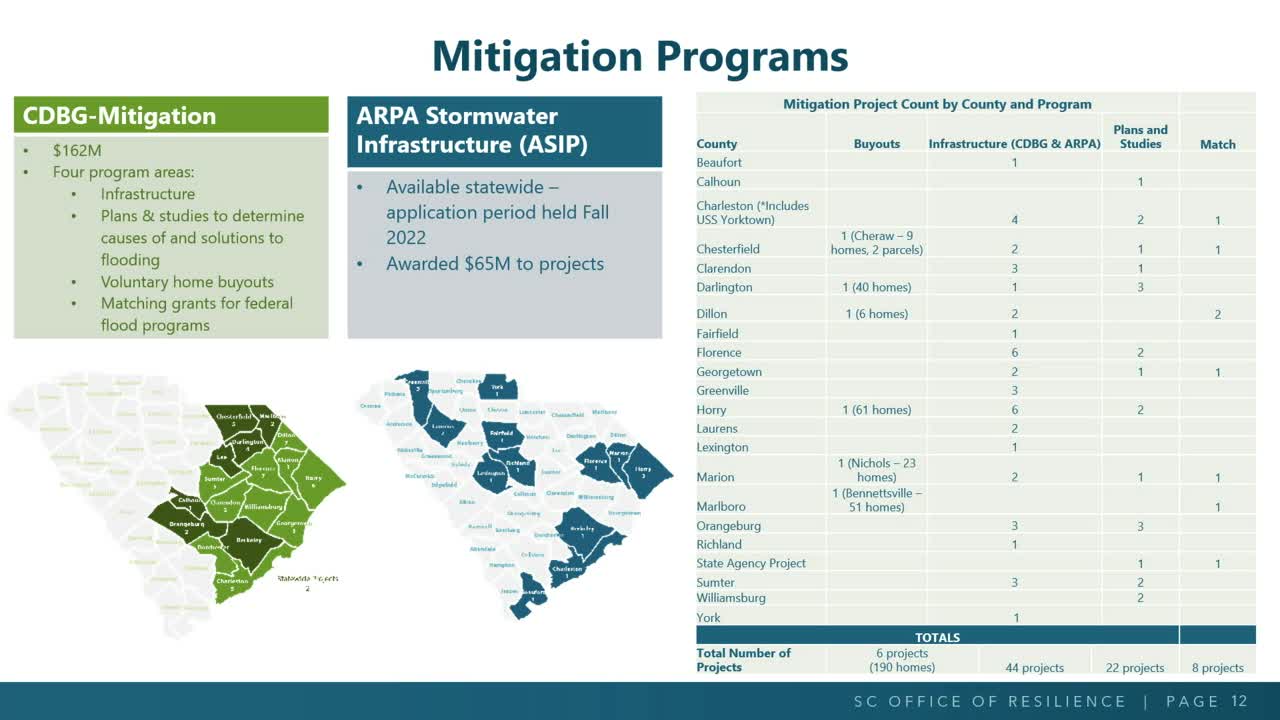
SCORE described its mitigation portfolio to the committee, including a $162 million HUD CDBG‑MIT allocation, ARPA-funded stormwater projects and voluntary buyouts of repeatedly flooded homes such as the Rosewood neighborhood buyouts in Horry County.
Alex Butler and Rand Reinhardt briefed senators on SCORE’s mitigation work, funded through HUD CDBG‑MIT, state ARPA allocations and other grants. Reinhardt said HUD allocated $162,000,000 in CDBG‑MIT funds for mitigation projects in repeatedly impacted watersheds; the program is a multi-year grant scheduled to run 12 years from its start date and is focused on flood reduction activities.
Reinhardt explained CDBG‑MIT program areas: infrastructure projects to prevent flooding, plans and studies, voluntary buyouts of repeatedly flooded homes, and matching funds to help communities compete for federal flood-reduction grants. He said the program is targeted to 17 counties in the PED (Santee) and PD watersheds that were repeatedly hit in 2015–2018 and that HUD has identified a subset of "most impacted and distressed" counties for concentrated spending.
Reinhardt highlighted a handful of mitigation projects: the Earhart Tunnel in Charleston’s Medical District, designed to store and pump water (the shaft stores water and pumps will handle up to 360,000 gallons per minute), and the Mingo Pond project on Highway 17 in Georgetown County, which used SCORE mitigation dollars plus county funds to lower standing water on a primary evacuation route. He also described the voluntary buyout program in Horry County’s Rosewood neighborhood: SCORE funded roughly $3.8 million toward buyouts; Horry County applied to buy out 61 homes and SCORE had completed 58 buyouts and was finishing demolitions at the time of the presentation.
Senators asked whether buyouts and mitigation dollars must benefit low- to moderate-income (LMI) households. Reinhardt said CDBG‑MIT requires at least 50% of funds be used to benefit LMI populations; he said SCORE expects to use "close to 60%" toward LMI beneficiaries once projects are complete. He also noted individual buyout caps (he cited a top cap around $350,000 per house) and said SCORE uses appraisals based on pre-disaster value to determine buyout offers.
Butler added that SCORE is executing an ARPA stormwater infrastructure program funded with $65,000,000 of the legislature’s $100,000,000 ARPA appropriation to the office; SCORE currently has 17 ARPA stormwater projects and a total of 44 mitigation projects in various stages across the state. Reinhardt and Butler said infrastructure projects can take longer to complete and that the CDBG‑MIT program has significant time to finish projects (grant end date described in the presentation).