Get Full Government Meeting Transcripts, Videos, & Alerts Forever!
Get email alerts on the Disaster Recovery topic
No spam. Unsubscribe anytime.
SCORE details disaster-recovery record, HUD and FEMA allocations and Helene timeline
Summary
SCORE told lawmakers it has used HUD CDBG-DR and FEMA disaster case management funding to repair or replace roughly 3,459 homes after 2015–2018 disasters, described current allocations for Hurricane Helene and outlined a HUD action-plan timeline tied to a $150 million CDBG-DR federal allocation.
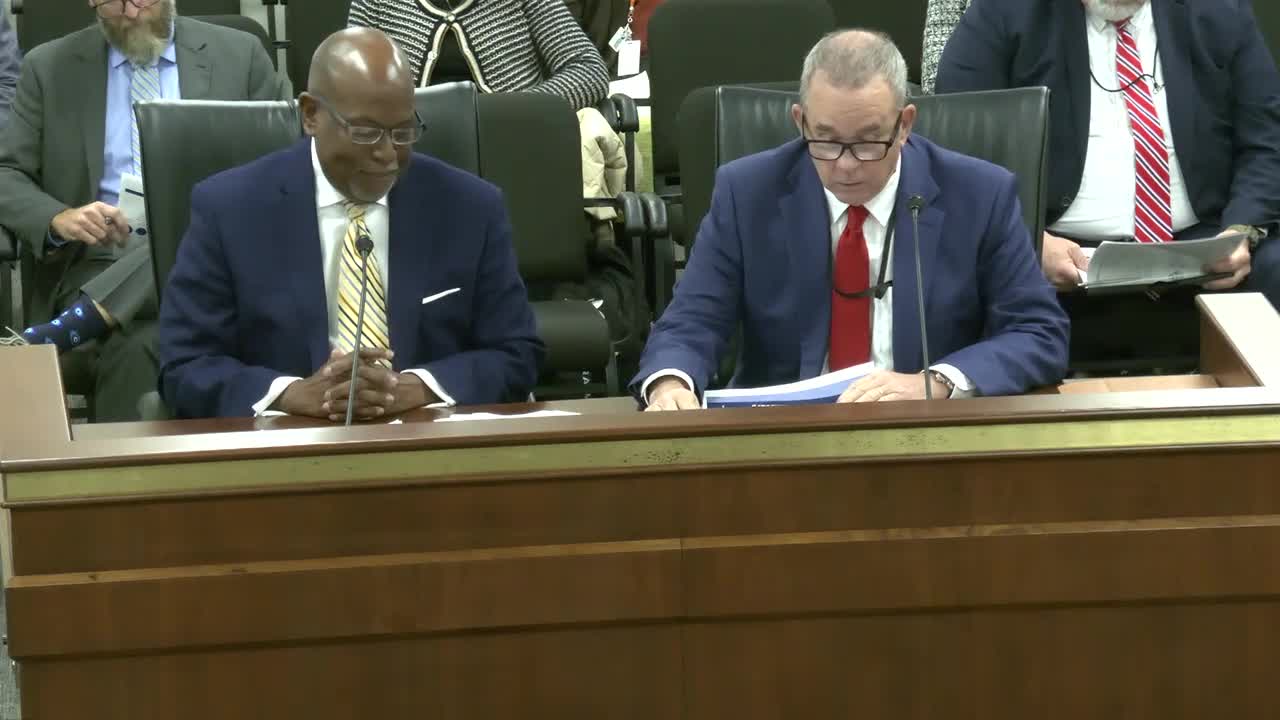
Rand Reinhardt, operations director at the South Carolina Office of Resilience (SCORE), briefed the Legislative Oversight Committee on SCORE’s disaster-recovery operations and federal funding history. Reinhardt said SCORE has used HUD Community Development Block Grant — Disaster Recovery (CDBG-DR) funding and FEMA disaster case management (DCMP) grants to repair, replace or rebuild nearly 3,459 homes across three major disasters since 2015.
Reinhardt gave a year-by-year breakdown: $126,000,000 drawn down for the 2015 flooding (Hurricane Joaquin), $95,000,000 for Hurricane Matthew in 2016, and about $72,000,000 for Hurricane Florence in 2018. He said the agency also drew down roughly $8,300,000 in FEMA disaster case management funding for earlier grants and recently received a $22,000,000 FEMA DCMP award for Hurricane Helene.
On the Helene response, Reinhardt said HUD published a federal register notice on Jan. 16 allocating $150,000,000 in CDBG-DR to South Carolina. SCORE is preparing an unmet-needs assessment and must complete an action plan and public comment process under HUD’s timeline. Reinhardt summarized the HUD schedule as: 60 days to complete an action plan and begin public outreach, a 30-day public comment period, HUD review (up to 45 days), and then execution of a grant agreement, with federal-funded construction anticipated to start after that administrative period (agency estimate: July).
Reinhardt described SCORE’s disaster case management model as a core program that helps low- to moderate-income residents navigate the recovery process. "Our case managers are linking our citizens with the resources that are out there," Reinhardt said, and he noted that case management lowers temporary housing costs by helping residents rapidly identify short-term housing options while repairs proceed.
To bridge the gap while federal funds are finalized, Reinhardt said SCORE will use state reserve funds to run a rapid rebuild program that targets destroyed homes and will enlist volunteer agencies such as Habitat for Humanity and the Red Cross for damaged-home repairs. He said SCORE expects a six-year federal spending window for the Helene CDBG-DR allocation beginning on Jan. 21, 2025.
Committee members asked about program completion for earlier grants; Reinhardt said most earlier grants are closed out and that roughly 55 homes remained under warranty from the 2018 program, with the one-year warranty period ending in November 2025.
Reinhardt also noted that HUD and FEMA grant rules require that a minimum percentage of CDBG-DR funds be used for low- to moderate-income residents and that a portion of funds must be dedicated to mitigation.