Get Full Government Meeting Transcripts, Videos, & Alerts Forever!
Get email alerts on the Earned Income Tax Credit topic
No spam. Unsubscribe anytime.
Lawmakers, advocates press to expand Oregon earned income tax credit; bills differ on size, advance payments
Summary
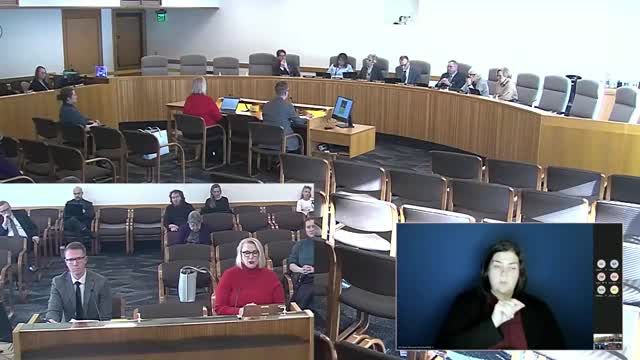
Salem — Lawmakers and policy experts told the House Committee on Revenue on Feb. 25 that Oregon’s earned income tax credit (EITC) helps low‑income working families but that the program needs higher state matches and better delivery.
Salem — Lawmakers and policy experts told the House Committee on Revenue on Feb. 25 that Oregon’s earned income tax credit (EITC) helps low‑income working families but that the program needs higher state matches and better delivery. The committee heard an informational briefing from the Legislative Revenue Office and the Department of Human Services and public testimony on three bills that would extend and expand the state credit.
The proposals differ in scale and mechanics. House Bill 3120 would extend the credit’s sunset by six years and raise Oregon’s standard EITC from 9% of the federal credit to 12%, increase the rate to 18% for taxpayers with a child under 3 and to 15% for those with a child ages 3–6. House Bill 2958 would raise the standard match to 20% and the under‑3 match to 25%, broaden eligibility for childless workers to age 18 and include a framework for quarterly (advance) EITC payments. House Bill 2091 would simply renew the current program for six years.
The committee’s informational presentation framed the policy tradeoffs. Kyle Easton of the Legislative Revenue Office summarized program mechanics and fiscal scale, saying Oregon’s credit “is a percentage of the federal credit” and that the state’s law sets the standard at 9% and 12% for taxpayers with a dependent under age 3. Easton told the committee a one‑percentage‑point increase in Oregon’s match is roughly $5 million per year.
Meg Reinholt, a program analyst at the Department of Human Services who manages Oregon’s tax infrastructure grant program, described the state’s outreach work through grants that fund Volunteer Income Tax Assistance (VITA) and culturally specific providers. Reinholt said the IRS reported about 5,000 more EITC claims in tax year 2023 than 2022, representing roughly $44 million in additional federal refunds to Oregon families; she said the tax infrastructure grantees likely contributed to some of that increase.
Advocates and local agencies strongly urged expansion. State Representative Lucetta Elmer, sponsor of HB 3120, said the bill “will provide needed financial relief to Oregon’s workers and their families” and argued higher credits help address affordability and declining birth and migration rates. Testimony from AARP Oregon, Oregon Food Bank, the Children’s Institute, Metropolitan Family Service, the Oregon Center for Public Policy and other organizations emphasized the credit’s anti‑poverty effects and called for larger state matches and, in some cases, advance payments.
Supporters said advance or quarterly payments could help families meet recurring expenses rather than waiting for an annual refund. Metropolitan Family Service’s Jeffrey Lauck said quarterly payments and higher credits could increase filing and participation and that experiments with advance federal child tax credits during the pandemic produced broad public engagement.
State officials and analysts cautioned about administrative and federal‑program interactions. LRO and Department of Revenue staff noted two constraints: Oregon’s credit is administratively inexpensive because eligibility is claimed on tax returns, but the IRS and the Census Bureau estimate substantial improper payments nationwide; the IRS taxpayer advocate reports improper EITC payments (overclaims plus underpayments) near 25% in some analyses. Department of Revenue senior staff said the department could implement most statutory changes but warned that the more complex provisions — in particular quarterly payments — would raise the state’s administrative costs.
The committee also heard that quarterly EITC payments raise federal‑program compatibility problems. LRO staff reminded members that Oregon’s earlier attempt to provide quarterly child‑tax credits ran into a federal rule: advance state payments can be treated as income for benefit programs such as SNAP. Oregon sought a federal waiver for the child tax credit quarterly payments that was denied; LRO and Department of Revenue witnesses said HB 2958’s quarterly‑payment language is written so payments would not take effect unless the federal rules changed or a federal waiver were granted.
Several witnesses described participation and targeting challenges. Easton said Oregon’s average state credit was about $210 in tax year 2022 and that the state’s total EITC cost was roughly $43 million in 2022 but is expected to rise toward $50–52 million in 2023 if current trends hold. LRO presented IRS‑Census utilization estimates showing Oregon’s participation rate below many states (generally in the high‑60s to mid‑70s percentile range in those federal estimates), and researchers told the committee that modest outreach such as IRS letters or employer notices yield only small increases in filing; targeted, personalized outreach produces stronger — but still limited — gains.
Several testifiers argued the public‑health and economic benefits justify the cost. Dana Hepper of the Children’s Institute urged larger credits for families with children under 3, citing research on early childhood development. AARP Oregon urged eliminating the program’s upper age cap to cover older workers who continue working past age 65. Testimony from DHS and free tax preparation providers stressed that the tax infrastructure grants fund culturally specific VITA sites and helped reach rural and coast communities with limited free tax help.
Fiscal and drafting concerns surfaced in the hearing record. LRO staff warned that increasing the statutory percentage raises state costs materially; Jody Weiser, testifying for Tax Fairness Oregon, urged lawmakers to include a statutory backstop so that a hypothetical federal repeal of the federal EITC would not automatically collapse the state program. Representative Ricky Ruiz and others said they supported HB 2958’s broader eligibility but asked sponsors to fix drafting issues in the bill’s references; proponents said they planned a technical amendment.
The committee took testimony on all three bills and closed the hearings without a vote. Department of Revenue staff said they would continue to consult with proponents on implementation issues; sponsors and advocates signaled plans to work with the department on technical fixes and on outreach to boost participation. The committee adjourned with further work on the bills expected in subsequent Revenue Committee hearings.
What happened: the committee received an informational briefing on the EITC and heard public testimony on HB 3120, HB 2958 and HB 2091. No final votes were taken on Feb. 25.
Key figures and estimates presented to the committee: - Oregon statutory match today: 9% of the federal EITC; 12% for taxpayers with a dependent under age 3 (LRO) - Oregon average state credit in 2022: about $210 (LRO) - Oregon cost of the state EITC: approximately $43 million in 2022; preliminary estimates for 2023 closer to $50–52 million (LRO) - Approximate fiscal rule of thumb presented: a one‑percentage‑point increase in Oregon’s EITC match ≈ $5 million per year (LRO) - IRS data cited by DHS: about 5,000 more federal EITC claims in 2023 vs. 2022 → roughly $44 million additional federal refunds to Oregon households; outreach grantees likely contributed to some of that increase (Department of Human Services)
Next steps: proponents said they will submit technical amendments; the Department of Revenue will continue implementation analysis; the House Revenue Committee will consider the bills in follow‑up hearings.