Get Full Government Meeting Transcripts, Videos, & Alerts Forever!
Get email alerts on the Natural Resources topic
No spam. Unsubscribe anytime.
Lawmakers Hear OWEB Budget Briefing; Agency Seeks Staffing Continuity, Systems Upgrades
Summary
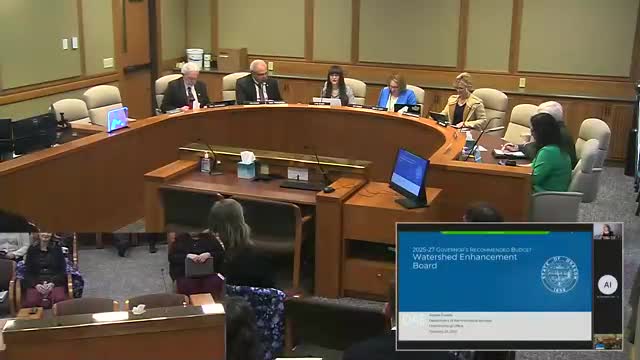
Lawmakers heard an informational briefing Feb. 25 on House Bill 5039 and House Bill 5040, the governor's recommended budget measures that fund the Oregon Watershed Enhancement Board (OWEB).
Lawmakers heard an informational briefing Feb. 25 on House Bill 5039 and House Bill 5040, the governor's recommended budget measures that fund the Oregon Watershed Enhancement Board (OWEB). Agency and Department of Administrative Services staff told the Natural Resources subcommittee the package would provide continuity for programs and staff who manage grants statewide, while committee members pressed on invasive weeds, juniper removal and reimbursement timing.
OWEB Executive Director Sarah O'Brien and DAS budget analyst Angela Perrotta framed the bills as companion measures: HB 5039 covers the agency's appropriation and operations while HB 5040 addresses constitutionally dedicated lottery funds for local grants, including a six-year limitation on certain lottery transfers. "The board is charged with helping to protect and restore healthy watershed and natural habitats, supporting thriving communities and strong economies," Angela Perrotta said as she opened the agency budget overview.
Why it matters: OWEB is a grant-making agency that distributes state lottery dollars and other funds to support watershed restoration and related projects across Oregon. The agency manages hundreds of grants per biennium and has increased its portfolio of programs in recent years; lawmakers and agency leaders said the recommended budget aims to convert some limited-duration positions to longer-term funding and to fund improvements to grant systems so staff can sustain customer service while handling diverse funding streams.
Key budget and program details
- Total budget and funding mix: Perrotta said the budget documents show a total budget on the order of $234,000,000 across general fund, lottery fund, federal funds and other funds for the 2025-27 biennium. Lottery funds administered through the Parks and Natural Resources Fund remain the principal revenue source for OWEB; those lottery receipts are split so that 70% supports grants and 30% supports operations shared among several agencies.
- Companion bills: Committee staff opened an informational meeting on "House Bill 5039, the appropriation bill, and House Bill 5040 on local grants," and invited OWEB staff to present. The agency described HB 5040 as addressing constitutionally dedicated lottery funds and a six-year limitation on local grant components, while HB 5039 covers the remainder of the agency budget and uses a two-year limitation.
Staffing and delivery challenges
- Limited-duration staffing: OWEB leaders told the committee that rapid program growth over recent biennia had relied heavily on limited-duration positions. "The repeated funding of programs originally slated to be 1 time has leveraged unsustainably limited duration staff, compromising the ability to provide stability," Perrotta said. O'Brien added that the governor's budget "allows us to make some big steps forward in this direction, stabilizing our staffing, taking time to modernize our grant making systems and procedures."
- Scale and workload: Stephanie Page, OWEB deputy director, said the agency manages roughly 1,200 open grants with about 48 staff. The agency also reported processing more than 900 grant applications this biennium and administering roughly $200 million or more in grants per biennium.
- Reimbursements and cash flow: Page said OWEB aims to process reimbursement requests quickly: "we're pretty reliably landing it within 2 to 3 weeks right now." Committee members pressed whether two- to three-week reimbursements could be a barrier for small nonprofits; Page said OWEB can issue advances on a case-by-case basis with documentation requirements.
Program examples, outcomes and metrics
- Program outcomes presented: Stephanie Page highlighted project examples including stream-channel restoration near Sisters, sage-grouse habitat work in northeast Oregon, an agricultural land protection project on the south coast funded by Oregon Agricultural Heritage Program dollars, and post-wildfire restoration in the Mackenzie watershed.
- Performance measures and customer surveys: Page said OWEB's timeliness measure for fully executed grant agreements within 30 days has improved from 0% in 2022 to the highest level recorded since that period, though targets are not yet met. The agency continues to exceed targets on timeliness of payments when paperwork is complete and scores highly on staff helpfulness in customer surveys.
Policy context and funding trends
- Diversified funding: OWEB staff described a steady diversification of funds since 2021, including general fund allocations for programs such as the Oregon Agricultural Heritage Program and the Natural and Working Lands Fund, federal funds such as the Pacific Coast Salmon Recovery Fund, salmon license plate revenues and other deposits into treasury accounts.
- Constitutional lottery split: OWEB staff explained that Measure 76 (2010) and earlier Measure 66 (1998) set the lottery-based funding structure; staff noted a shift to a 70/30 split between grant funds and operations once lottery revenue reached a specified threshold, and said that transition created timing issues for operations funding while revenues catch up.
Questions from lawmakers
Committee members asked for more detail on juniper removal, invasive weed control, and aquatic invasive species. Page said the agency allocates $3,250,000 in its spending plan to the Oregon Department of Agriculture for noxious weed grants; in 2024 OWEB funded 77 projects that included a weed-control component, totaling about $14,000,000. On juniper impacts, legislators described concerns about water uptake and habitat change; OWEB staff said they would provide additional project details and noted that corresponding projects exist across Central and Eastern Oregon.
Formal actions and next steps
The session was an informational hearing; no committee vote was recorded on the bills during the meeting. OWEB staff announced a public hearing for lawmakers to take public testimony on the bills scheduled for the following day. The agency requested staffing continuity and the operational authority reflected in the governor's recommended budget to reduce turnover and improve long-term program delivery.
Ending: The subcommittee closed the informational hearing after questions and OWEB said it would follow up on requests for more detail on invasive species projects and juniper removal.